

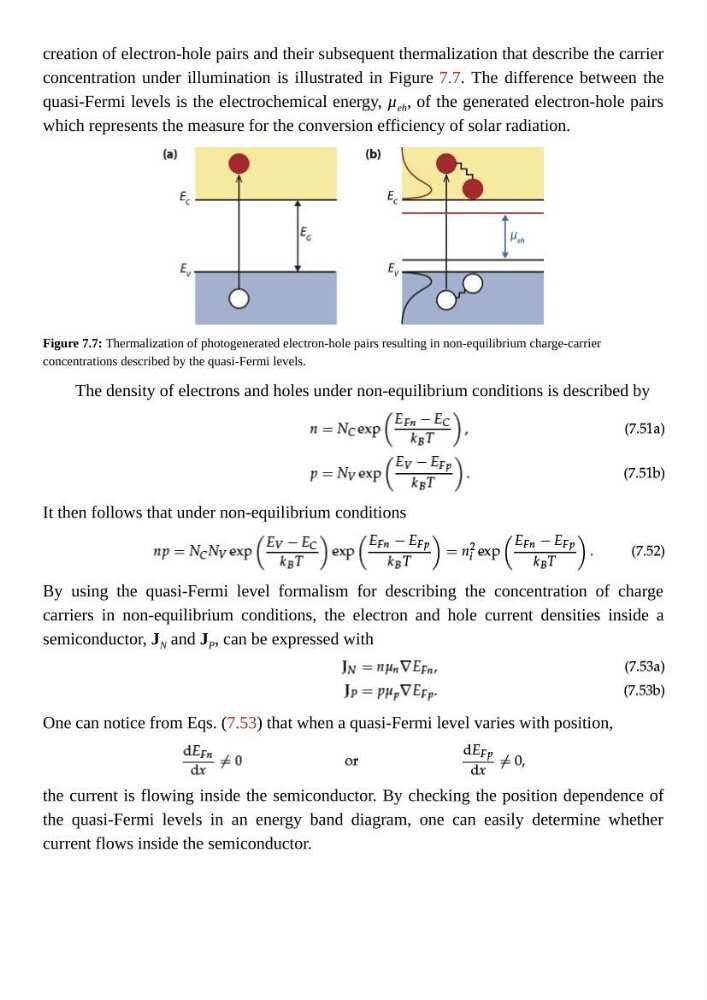
creation of electron-hole pairs and their subsequent thermalization that describe the carrier
concentration under illumination is illustrated in Figure 7.7. The difference between the
quasi-Fermi levels is the electrochemical energy, µ eh , of the generated electron-hole pairs
which represents the measure for the conversion efficiency of solar radiation.
Figure 7.7: Thermalization of photogenerated electron-hole pairs resulting in non-equilibrium charge-carrier
concentrations described by the quasi-Fermi levels.
The density of electrons and holes under non-equilibrium conditions is described by
It then follows that under non-equilibrium conditions
By using the quasi-Fermi level formalism for describing the concentration of charge
carriers in non-equilibrium conditions, the electron and hole current densities inside a
semiconductor, J N and J P , can be expressed with
One can notice from Eqs. (7.53) that when a quasi-Fermi level varies with position,
the current is flowing inside the semiconductor. By checking the position dependence of
the quasi-Fermi levels in an energy band diagram, one can easily determine whether
current flows inside the semiconductor.
concentration under illumination is illustrated in Figure 7.7. The difference between the
quasi-Fermi levels is the electrochemical energy, µ eh , of the generated electron-hole pairs
which represents the measure for the conversion efficiency of solar radiation.
Figure 7.7: Thermalization of photogenerated electron-hole pairs resulting in non-equilibrium charge-carrier
concentrations described by the quasi-Fermi levels.
The density of electrons and holes under non-equilibrium conditions is described by
It then follows that under non-equilibrium conditions
By using the quasi-Fermi level formalism for describing the concentration of charge
carriers in non-equilibrium conditions, the electron and hole current densities inside a
semiconductor, J N and J P , can be expressed with
One can notice from Eqs. (7.53) that when a quasi-Fermi level varies with position,
the current is flowing inside the semiconductor. By checking the position dependence of
the quasi-Fermi levels in an energy band diagram, one can easily determine whether
current flows inside the semiconductor.