

69
Contemporary Machining Processes
a better surface finish and depends on the diameter of the focusing nozzle.
The rate of abrasive mass flow is usually expressed as kg/min.
• Standoff distance, i.e., the distance between a target material and the nozzle, is usually maintained by an optimal level in mm.
• Jet impingement angle is associated with tilting of the cutting head and
is defined as the angle between the initial AWJ flowing direction and the
target material surface. Two different types of jet impingement angles used
in the machining process are distinguished, namely forward and backward.
Any change in the jet impingement angle eventually changes the jet attack
angle on the target material with an effect on the mode of erosion. Use of a
changeover jet impingement angle has a great impact on AWJ cutting performance without any additional costs.
• Work material in the AWJ machining process can have any size and shape.
The major phenomena found in the work material after the machining process are abrasive contamination and striation formation. The former for
soft materials is higher than for hard materials, while the latter is significantly present in a hard material cut surface rather than in soft materials.
This happens due to an increased abrasive attack angle at a larger cutting
depth.
The striations are curved opposite to the cutting direction and their curvature
depends on workpiece material type and thickness, AWJ intensity, and cutting velocity (Orbanic and Junkar, 2008). While the top part of the surface is quite smooth,
the bottom part is rough and wavy. A striated surface is characterized by different
parameters, typically lag of stria, curvatures of stria, and changing surface roughness or waviness related to the above parameters.
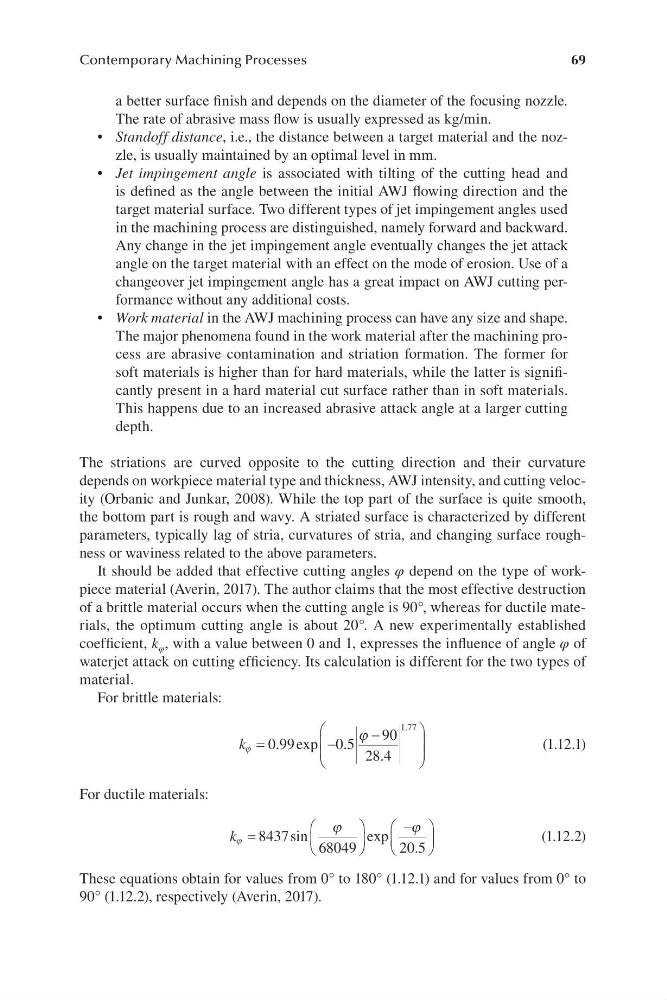
It should be added that effective cutting angles φ depend on the type of workpiece material (Averin, 2017). The author claims that the most effective destruction
of a brittle material occurs when the cutting angle is 90°, whereas for ductile materials, the optimum cutting angle is about 20°. A new experimentally established
coefficient, k φ , with a value between 0 and 1, expresses the influence of angle φ of
waterjet attack on cutting efficiency. Its calculation is different for the two types of
material.
For brittle materials:
k j
j
=
-
-
æ
è
ç
ç
ö
ø
÷
÷
0 99
05
90
28 4
1 77
. exp
.
.
.
(1.12.1)
For ductile materials:
k j
j
j
=
æ
è
ç
ö
ø
÷
-
æ
è
ç
ö
ø
÷
8437
68049
20 5
sin
e xp
.
(1.12.2)
These equations obtain for values from 0° to 180° (1.12.1) and for values from 0° to
90° (1.12.2), respectively (Averin, 2017).
Contemporary Machining Processes
a better surface finish and depends on the diameter of the focusing nozzle.
The rate of abrasive mass flow is usually expressed as kg/min.
• Standoff distance, i.e., the distance between a target material and the nozzle, is usually maintained by an optimal level in mm.
• Jet impingement angle is associated with tilting of the cutting head and
is defined as the angle between the initial AWJ flowing direction and the
target material surface. Two different types of jet impingement angles used
in the machining process are distinguished, namely forward and backward.
Any change in the jet impingement angle eventually changes the jet attack
angle on the target material with an effect on the mode of erosion. Use of a
changeover jet impingement angle has a great impact on AWJ cutting performance without any additional costs.
• Work material in the AWJ machining process can have any size and shape.
The major phenomena found in the work material after the machining process are abrasive contamination and striation formation. The former for
soft materials is higher than for hard materials, while the latter is significantly present in a hard material cut surface rather than in soft materials.
This happens due to an increased abrasive attack angle at a larger cutting
depth.
The striations are curved opposite to the cutting direction and their curvature
depends on workpiece material type and thickness, AWJ intensity, and cutting velocity (Orbanic and Junkar, 2008). While the top part of the surface is quite smooth,
the bottom part is rough and wavy. A striated surface is characterized by different
parameters, typically lag of stria, curvatures of stria, and changing surface roughness or waviness related to the above parameters.
It should be added that effective cutting angles φ depend on the type of workpiece material (Averin, 2017). The author claims that the most effective destruction
of a brittle material occurs when the cutting angle is 90°, whereas for ductile materials, the optimum cutting angle is about 20°. A new experimentally established
coefficient, k φ , with a value between 0 and 1, expresses the influence of angle φ of
waterjet attack on cutting efficiency. Its calculation is different for the two types of
material.
For brittle materials:
k j
j
=
-
-
æ
è
ç
ç
ö
ø
÷
÷
0 99
05
90
28 4
1 77
. exp
.
.
.
(1.12.1)
For ductile materials:
k j
j
j
=
æ
è
ç
ö
ø
÷
-
æ
è
ç
ö
ø
÷
8437
68049
20 5
sin
e xp
.
(1.12.2)
These equations obtain for values from 0° to 180° (1.12.1) and for values from 0° to
90° (1.12.2), respectively (Averin, 2017).