

67
Contemporary Machining Processes
that both techniques still find their applications in the cutting of different materials.
Namely, PWJ is commonly employed for machining weak materials such as foams
and polymers or when foreign material contamination has to be avoided, but for
cutting high-strength materials such as metal alloys or ceramics, the use of AWJ is
necessary (Bergs et al., 2020).
Abrasives are categorized as natural, zirconia alumina, glass, steel, and copper,
with different characteristics such as level of hardness and grit shape. For example,
those widely applied in AWJ glass beads have mineral hardness MOHS 5-6, in garnet
and ceramic beads, MOHS 7-8, black corundum, black and green silicon carbides, as
well as white and brown fused alumina MOHS 9, while steel grit and shot, stainless
steel cut wire, and copper slag exhibit hardness of 40–60 HRC (Llanto et al., 2021).
Natarajan et al. (2020) claimed that more than 80% of industries consume abrasives
of the garnet type only.
A harder abrasive demonstrates a greater MRR and depth of cut, providing higher
machining efficiency but potentially cutting the lifespan of focusing tubes. On the
other hand, a harder workpiece requires a harder abrasive particle. Thus, selection of
an appropriate abrasive size and type depends on the hardness of a workpiece. The
range of abrasive sizes is universally indicated by mesh size (#), as follows:
• mesh #40–60 of sizes 250–400 μm
• mesh #80–100 of sizes 180–210 μm
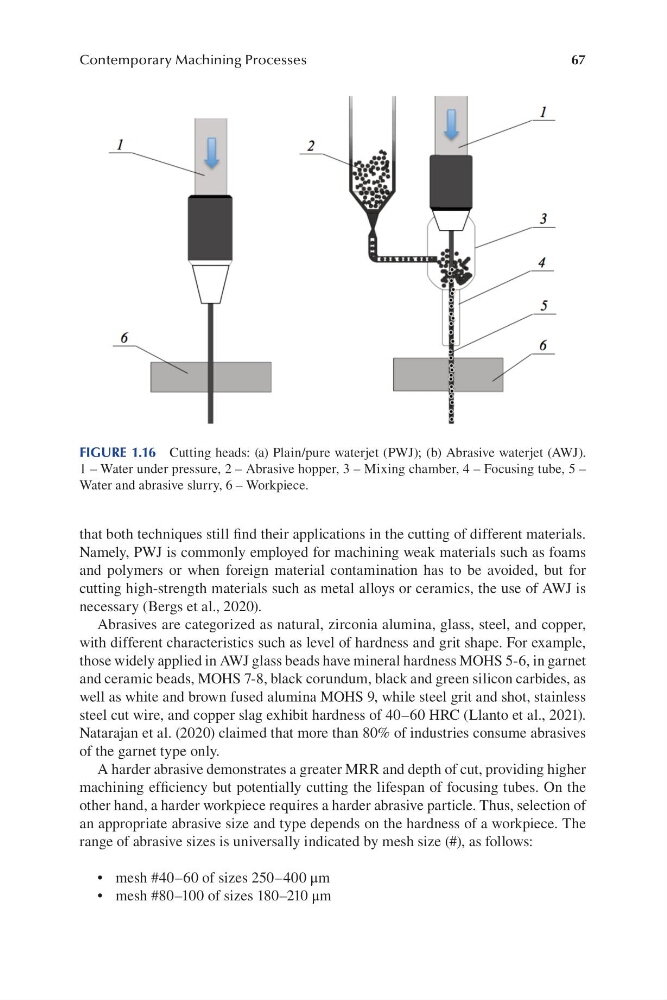
FIGURE 1.16 Cutting heads: (a) Plain/pure waterjet (PWJ); (b) Abrasive waterjet (AWJ).
1 – Water under pressure, 2 – Abrasive hopper, 3 – Mixing chamber, 4 – Focusing tube, 5 –
Water and abrasive slurry, 6 – Workpiece.
Contemporary Machining Processes
that both techniques still find their applications in the cutting of different materials.
Namely, PWJ is commonly employed for machining weak materials such as foams
and polymers or when foreign material contamination has to be avoided, but for
cutting high-strength materials such as metal alloys or ceramics, the use of AWJ is
necessary (Bergs et al., 2020).
Abrasives are categorized as natural, zirconia alumina, glass, steel, and copper,
with different characteristics such as level of hardness and grit shape. For example,
those widely applied in AWJ glass beads have mineral hardness MOHS 5-6, in garnet
and ceramic beads, MOHS 7-8, black corundum, black and green silicon carbides, as
well as white and brown fused alumina MOHS 9, while steel grit and shot, stainless
steel cut wire, and copper slag exhibit hardness of 40–60 HRC (Llanto et al., 2021).
Natarajan et al. (2020) claimed that more than 80% of industries consume abrasives
of the garnet type only.
A harder abrasive demonstrates a greater MRR and depth of cut, providing higher
machining efficiency but potentially cutting the lifespan of focusing tubes. On the
other hand, a harder workpiece requires a harder abrasive particle. Thus, selection of
an appropriate abrasive size and type depends on the hardness of a workpiece. The
range of abrasive sizes is universally indicated by mesh size (#), as follows:
• mesh #40–60 of sizes 250–400 μm
• mesh #80–100 of sizes 180–210 μm
FIGURE 1.16 Cutting heads: (a) Plain/pure waterjet (PWJ); (b) Abrasive waterjet (AWJ).
1 – Water under pressure, 2 – Abrasive hopper, 3 – Mixing chamber, 4 – Focusing tube, 5 –
Water and abrasive slurry, 6 – Workpiece.