

50
Remanufacturing and Advanced Machining
a sort of cutting process with laser to cut a contour out of the plate. Thus, holes of
any size and shape, both circular and noncircular, can be produced at a constant laser
intensity and with an improved quality. In helical trepanning, a focused laser beam
is rotated around the perimeter lowering its focal position with each rotation and thus
gradually deepening the hole (Nath, 2014).
The obtainable peak power density is dependent on the pulse durations. Thus, for
millisecond laser drilling, it is reported to range 106–109 W/cm 2 , for nanosecond
laser drilling in the range of 1–10 GW/cm 2 , and for ultrafast picosecond lasers used
for drilling holes, in the range of 10–1000 GW/cm 2 , decreasing thermal effect on
the zone drilled to very small values close to zero (Xia et al. 2021). Accordingly,
the quality and accuracy of holes are improved as the duration of the laser pulse
becomes shorter (Nath, 2014).
Further improvement of laser drilling efficiency and quality can be obtained by
means of magnetic field-assisted technique with or without assist-gas (Wang, Xu
et al., 2019), water assistance (Ren et al., 2020), ultrasonic assistance (Xia et al.,
2021), electrochemical corrosion assistance (Duan et al., 2020), etc. For example, in
the case of femtosecond laser drilling in alumina ceramics, the effect was considerably increased by water assistance, with the taper angle diminishing by 64.19% to
4.20° and the hole cross-section area increasing by 46% (Ren et al., 2020).
Laser cutting is a well-established technology that is nevertheless rapidly developing due to its excellent performance in terms of cutting speed, good yield and
width of a cut during machining of difficult-to-cut materials, especially metals and
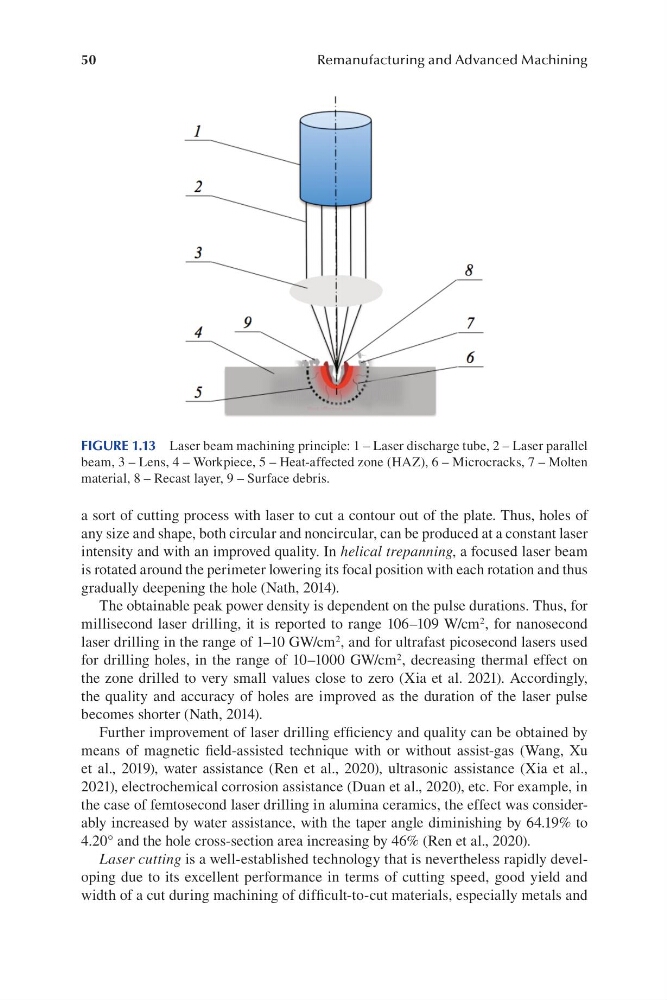
FIGURE 1.13 Laser beam machining principle: 1 – Laser discharge tube, 2 – Laser parallel
beam, 3 – Lens, 4 – Workpiece, 5 – Heat-affected zone (HAZ), 6 – Microcracks, 7 – Molten
material, 8 – Recast layer, 9 – Surface debris.
Remanufacturing and Advanced Machining
a sort of cutting process with laser to cut a contour out of the plate. Thus, holes of
any size and shape, both circular and noncircular, can be produced at a constant laser
intensity and with an improved quality. In helical trepanning, a focused laser beam
is rotated around the perimeter lowering its focal position with each rotation and thus
gradually deepening the hole (Nath, 2014).
The obtainable peak power density is dependent on the pulse durations. Thus, for
millisecond laser drilling, it is reported to range 106–109 W/cm 2 , for nanosecond
laser drilling in the range of 1–10 GW/cm 2 , and for ultrafast picosecond lasers used
for drilling holes, in the range of 10–1000 GW/cm 2 , decreasing thermal effect on
the zone drilled to very small values close to zero (Xia et al. 2021). Accordingly,
the quality and accuracy of holes are improved as the duration of the laser pulse
becomes shorter (Nath, 2014).
Further improvement of laser drilling efficiency and quality can be obtained by
means of magnetic field-assisted technique with or without assist-gas (Wang, Xu
et al., 2019), water assistance (Ren et al., 2020), ultrasonic assistance (Xia et al.,
2021), electrochemical corrosion assistance (Duan et al., 2020), etc. For example, in
the case of femtosecond laser drilling in alumina ceramics, the effect was considerably increased by water assistance, with the taper angle diminishing by 64.19% to
4.20° and the hole cross-section area increasing by 46% (Ren et al., 2020).
Laser cutting is a well-established technology that is nevertheless rapidly developing due to its excellent performance in terms of cutting speed, good yield and
width of a cut during machining of difficult-to-cut materials, especially metals and
FIGURE 1.13 Laser beam machining principle: 1 – Laser discharge tube, 2 – Laser parallel
beam, 3 – Lens, 4 – Workpiece, 5 – Heat-affected zone (HAZ), 6 – Microcracks, 7 – Molten
material, 8 – Recast layer, 9 – Surface debris.