

45
Contemporary Machining Processes
where the active species itself is a dopant ion with discrete energy levels. They add
that diode pumping has become more common and is expected to completely replace
lamp pumping (Yan and Takayama, 2020).
There are many types of optically active dopants, including transition metal ions,
rare-earth ions, and color centers. Fundamental properties of a particular laser are
determined by a combination of specific optically active point defects and specific
host materials. As a result, the operation can be performed by three-level, four-level,
and vibronic lasers spanning the near-ultraviolet, visible, and near-infrared spectral
regions. The solid-state lasers can be pulsed or continuous wave (CW), discrete line
or tunable, mode-locked or operating in Q-switched modes (Powell, 2003).
The best-known solid-state lasers are listed as follows (Abramczyk, 2005):
1. Ruby laser of 694.3 nm, visible region
2. Nd:YAG laser with neodymium-doped yttrium–aluminum garnet matrix
(1064 nm)
3. Titanium–sapphire laser (670–1,070 nm) and other solid-state tunable
vibronic lasers
4. Rare-earth elements other than neodymium, i.e., holmium, erbium, thulium
lasers, such as Ho:YAG, Er:glass, Er:YAG, Tm:YAG, emitting at about 2 μm
depending on the matrix and doped material used
Semiconductor laser diodes provide coherent sources of light to an ever-increasing
market with applications ranging from the defense industry and medical field to
entertainment and fiber-optic communications (Sobiesierski and Smowton, 2016). In
2015–2018, diode lasers accounted for approximately 40% of the world laser market
by value (Gefvert et al., 2019).
The fundamental advantage of semiconductor lasers, as compared to most other
laser types, consists in operation using direct current injection to provide population
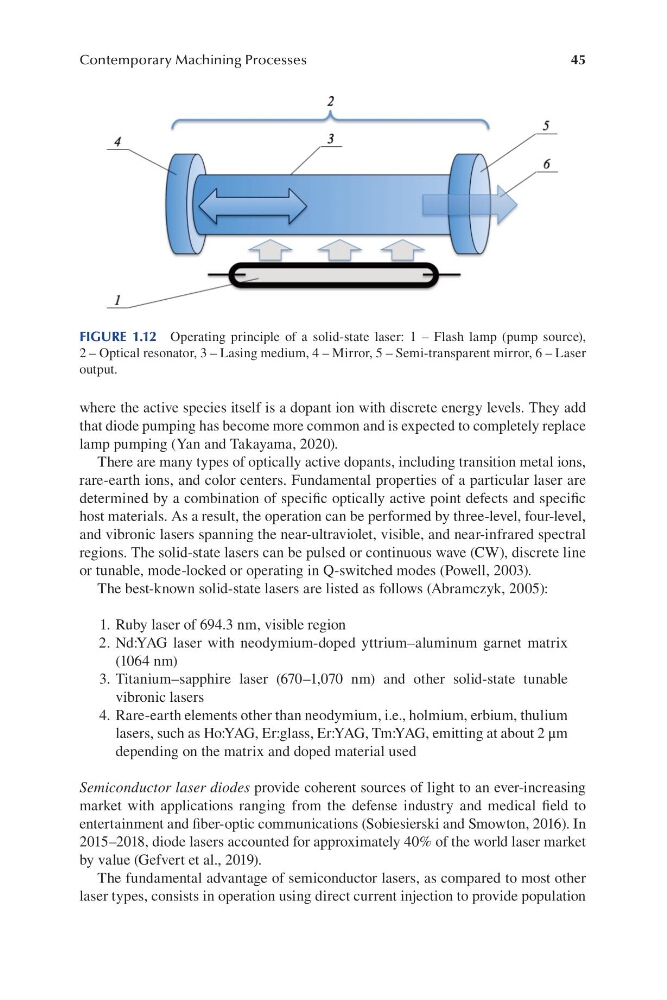
FIGURE 1.12 Operating principle of a solid-state laser: 1 – Flash lamp (pump source),
2 – Optical resonator, 3 – Lasing medium, 4 – Mirror, 5 – Semi-transparent mirror, 6 – Laser
output.
Contemporary Machining Processes
where the active species itself is a dopant ion with discrete energy levels. They add
that diode pumping has become more common and is expected to completely replace
lamp pumping (Yan and Takayama, 2020).
There are many types of optically active dopants, including transition metal ions,
rare-earth ions, and color centers. Fundamental properties of a particular laser are
determined by a combination of specific optically active point defects and specific
host materials. As a result, the operation can be performed by three-level, four-level,
and vibronic lasers spanning the near-ultraviolet, visible, and near-infrared spectral
regions. The solid-state lasers can be pulsed or continuous wave (CW), discrete line
or tunable, mode-locked or operating in Q-switched modes (Powell, 2003).
The best-known solid-state lasers are listed as follows (Abramczyk, 2005):
1. Ruby laser of 694.3 nm, visible region
2. Nd:YAG laser with neodymium-doped yttrium–aluminum garnet matrix
(1064 nm)
3. Titanium–sapphire laser (670–1,070 nm) and other solid-state tunable
vibronic lasers
4. Rare-earth elements other than neodymium, i.e., holmium, erbium, thulium
lasers, such as Ho:YAG, Er:glass, Er:YAG, Tm:YAG, emitting at about 2 μm
depending on the matrix and doped material used
Semiconductor laser diodes provide coherent sources of light to an ever-increasing
market with applications ranging from the defense industry and medical field to
entertainment and fiber-optic communications (Sobiesierski and Smowton, 2016). In
2015–2018, diode lasers accounted for approximately 40% of the world laser market
by value (Gefvert et al., 2019).
The fundamental advantage of semiconductor lasers, as compared to most other
laser types, consists in operation using direct current injection to provide population
FIGURE 1.12 Operating principle of a solid-state laser: 1 – Flash lamp (pump source),
2 – Optical resonator, 3 – Lasing medium, 4 – Mirror, 5 – Semi-transparent mirror, 6 – Laser
output.