

40
Remanufacturing and Advanced Machining
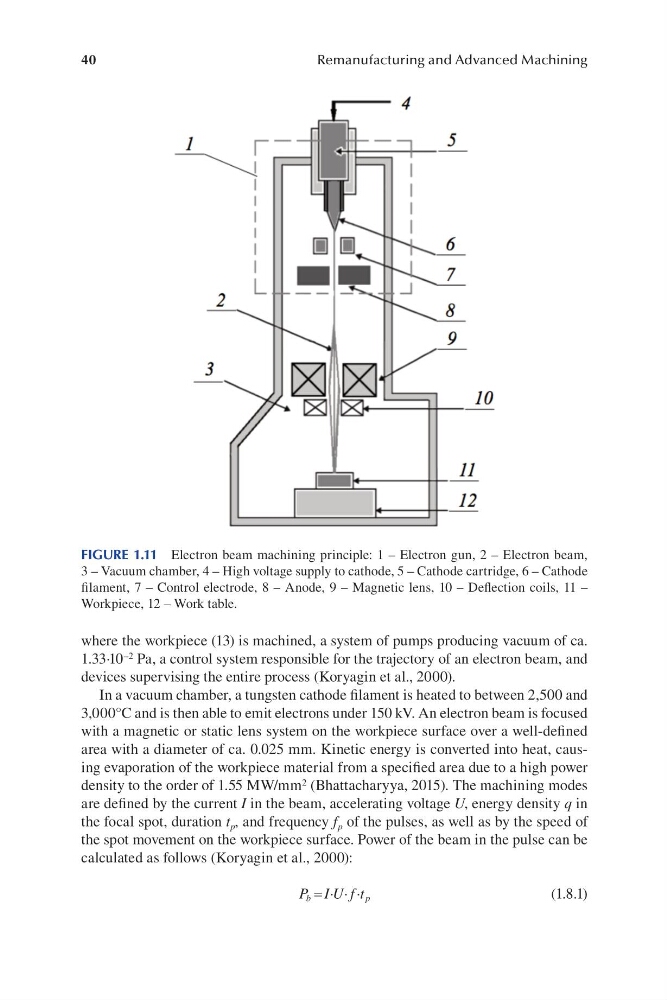
where the workpiece (13) is machined, a system of pumps producing vacuum of ca.
1.33·10 –2 Pa, a control system responsible for the trajectory of an electron beam, and
devices supervising the entire process (Koryagin et al., 2000).
In a vacuum chamber, a tungsten cathode filament is heated to between 2,500 and
3,000°C and is then able to emit electrons under 150 kV. An electron beam is focused
with a magnetic or static lens system on the workpiece surface over a well-defined
area with a diameter of ca. 0.025 mm. Kinetic energy is converted into heat, causing evaporation of the workpiece material from a specified area due to a high power
density to the order of 1.55 MW/mm 2 (Bhattacharyya, 2015). The machining modes
are defined by the current I in the beam, accelerating voltage U, energy density q in
the focal spot, duration t p , and frequency f p of the pulses, as well as by the speed of
the spot movement on the workpiece surface. Power of the beam in the pulse can be
calculated as follows (Koryagin et al., 2000):
P I U f t
b
p
· · ·
=
(1.8.1)
FIGURE 1.11 Electron beam machining principle: 1 – Electron gun, 2 – Electron beam,
3 – Vacuum chamber, 4 – High voltage supply to cathode, 5 – Cathode cartridge, 6 – Cathode
filament, 7 – Control electrode, 8 – Anode, 9 – Magnetic lens, 10 – Deflection coils, 11 –
Workpiece, 12 – Work table.
Remanufacturing and Advanced Machining
where the workpiece (13) is machined, a system of pumps producing vacuum of ca.
1.33·10 –2 Pa, a control system responsible for the trajectory of an electron beam, and
devices supervising the entire process (Koryagin et al., 2000).
In a vacuum chamber, a tungsten cathode filament is heated to between 2,500 and
3,000°C and is then able to emit electrons under 150 kV. An electron beam is focused
with a magnetic or static lens system on the workpiece surface over a well-defined
area with a diameter of ca. 0.025 mm. Kinetic energy is converted into heat, causing evaporation of the workpiece material from a specified area due to a high power
density to the order of 1.55 MW/mm 2 (Bhattacharyya, 2015). The machining modes
are defined by the current I in the beam, accelerating voltage U, energy density q in
the focal spot, duration t p , and frequency f p of the pulses, as well as by the speed of
the spot movement on the workpiece surface. Power of the beam in the pulse can be
calculated as follows (Koryagin et al., 2000):
P I U f t
b
p
· · ·
=
(1.8.1)
FIGURE 1.11 Electron beam machining principle: 1 – Electron gun, 2 – Electron beam,
3 – Vacuum chamber, 4 – High voltage supply to cathode, 5 – Cathode cartridge, 6 – Cathode
filament, 7 – Control electrode, 8 – Anode, 9 – Magnetic lens, 10 – Deflection coils, 11 –
Workpiece, 12 – Work table.