

28
Remanufacturing and Advanced Machining
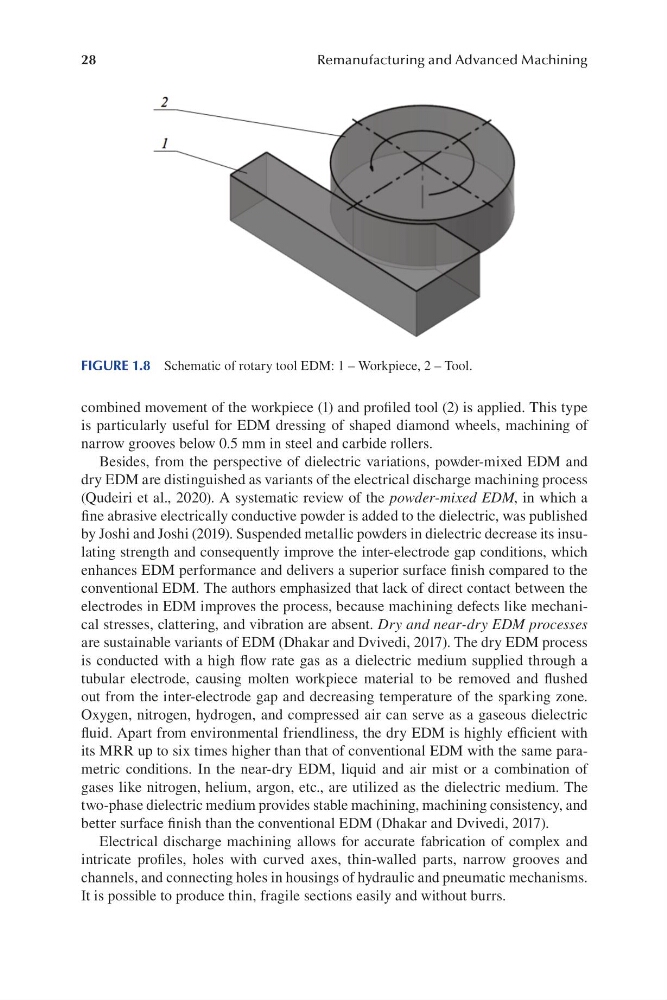
combined movement of the workpiece (1) and profiled tool (2) is applied. This type
is particularly useful for EDM dressing of shaped diamond wheels, machining of
narrow grooves below 0.5 mm in steel and carbide rollers.
Besides, from the perspective of dielectric variations, powder-mixed EDM and
dry EDM are distinguished as variants of the electrical discharge machining process
(Qudeiri et al., 2020). A systematic review of the powder-mixed EDM, in which a
fine abrasive electrically conductive powder is added to the dielectric, was published
by Joshi and Joshi (2019). Suspended metallic powders in dielectric decrease its insulating strength and consequently improve the inter-electrode gap conditions, which
enhances EDM performance and delivers a superior surface finish compared to the
conventional EDM. The authors emphasized that lack of direct contact between the
electrodes in EDM improves the process, because machining defects like mechanical stresses, clattering, and vibration are absent. Dry and near-dry EDM processes
are sustainable variants of EDM (Dhakar and Dvivedi, 2017). The dry EDM process
is conducted with a high flow rate gas as a dielectric medium supplied through a
tubular electrode, causing molten workpiece material to be removed and flushed
out from the inter-electrode gap and decreasing temperature of the sparking zone.
Oxygen, nitrogen, hydrogen, and compressed air can serve as a gaseous dielectric
fluid. Apart from environmental friendliness, the dry EDM is highly efficient with
its MRR up to six times higher than that of conventional EDM with the same parametric conditions. In the near-dry EDM, liquid and air mist or a combination of
gases like nitrogen, helium, argon, etc., are utilized as the dielectric medium. The
two-phase dielectric medium provides stable machining, machining consistency, and
better surface finish than the conventional EDM (Dhakar and Dvivedi, 2017).
Electrical discharge machining allows for accurate fabrication of complex and
intricate profiles, holes with curved axes, thin-walled parts, narrow grooves and
channels, and connecting holes in housings of hydraulic and pneumatic mechanisms.
It is possible to produce thin, fragile sections easily and without burrs.
FIGURE 1.8 Schematic of rotary tool EDM: 1 – Workpiece, 2 – Tool.
Remanufacturing and Advanced Machining
combined movement of the workpiece (1) and profiled tool (2) is applied. This type
is particularly useful for EDM dressing of shaped diamond wheels, machining of
narrow grooves below 0.5 mm in steel and carbide rollers.
Besides, from the perspective of dielectric variations, powder-mixed EDM and
dry EDM are distinguished as variants of the electrical discharge machining process
(Qudeiri et al., 2020). A systematic review of the powder-mixed EDM, in which a
fine abrasive electrically conductive powder is added to the dielectric, was published
by Joshi and Joshi (2019). Suspended metallic powders in dielectric decrease its insulating strength and consequently improve the inter-electrode gap conditions, which
enhances EDM performance and delivers a superior surface finish compared to the
conventional EDM. The authors emphasized that lack of direct contact between the
electrodes in EDM improves the process, because machining defects like mechanical stresses, clattering, and vibration are absent. Dry and near-dry EDM processes
are sustainable variants of EDM (Dhakar and Dvivedi, 2017). The dry EDM process
is conducted with a high flow rate gas as a dielectric medium supplied through a
tubular electrode, causing molten workpiece material to be removed and flushed
out from the inter-electrode gap and decreasing temperature of the sparking zone.
Oxygen, nitrogen, hydrogen, and compressed air can serve as a gaseous dielectric
fluid. Apart from environmental friendliness, the dry EDM is highly efficient with
its MRR up to six times higher than that of conventional EDM with the same parametric conditions. In the near-dry EDM, liquid and air mist or a combination of
gases like nitrogen, helium, argon, etc., are utilized as the dielectric medium. The
two-phase dielectric medium provides stable machining, machining consistency, and
better surface finish than the conventional EDM (Dhakar and Dvivedi, 2017).
Electrical discharge machining allows for accurate fabrication of complex and
intricate profiles, holes with curved axes, thin-walled parts, narrow grooves and
channels, and connecting holes in housings of hydraulic and pneumatic mechanisms.
It is possible to produce thin, fragile sections easily and without burrs.
FIGURE 1.8 Schematic of rotary tool EDM: 1 – Workpiece, 2 – Tool.