

149
Smart Machining Processes
which leads to finer and more uniformly distributed grains and may generate secondphase particles during the FSP process (Harwani et al., 2021). The authors also point
out that the tool configuration has a profound influence on heat generation, material
flow, and temperature distribution during FSP, which is precisely reflected in the
material grain structure.
The thermomechanical nature of FSP involves a combination of high temperature
and strain, which modifies the initial microstructure in several ways. There are three
distinct microstructural zones (Bauri and Yadav, 2018), namely:
1. Stir zone (SZ), the region which experiences maximum temperature, strain,
and maximum grain refinement. SZ is also called a nugget zone or a dynamically recrystallized zone and is characterized by equiaxed fine grains. The
SZ’s volume depends on the tool dimensions. Due to nonuniform deformation during processing, the advancing side of SZ has a relatively sharper
interface between the SZ and an adjacent thermomechanically affected
zone (TMAZ) than the retreating side. The grain sizes exhibit variations
from top to bottom and also across the zone from advancing to the retreating side.
2. Thermomechanically affected zone (TMAZ) appears around the volume
of the SZ and experiences lower temperature compared to SZ. The strain
rate in TMAZ is too low to cause dynamic recrystallization. It contains
deformed and elongated grains with high dislocation density inside. The
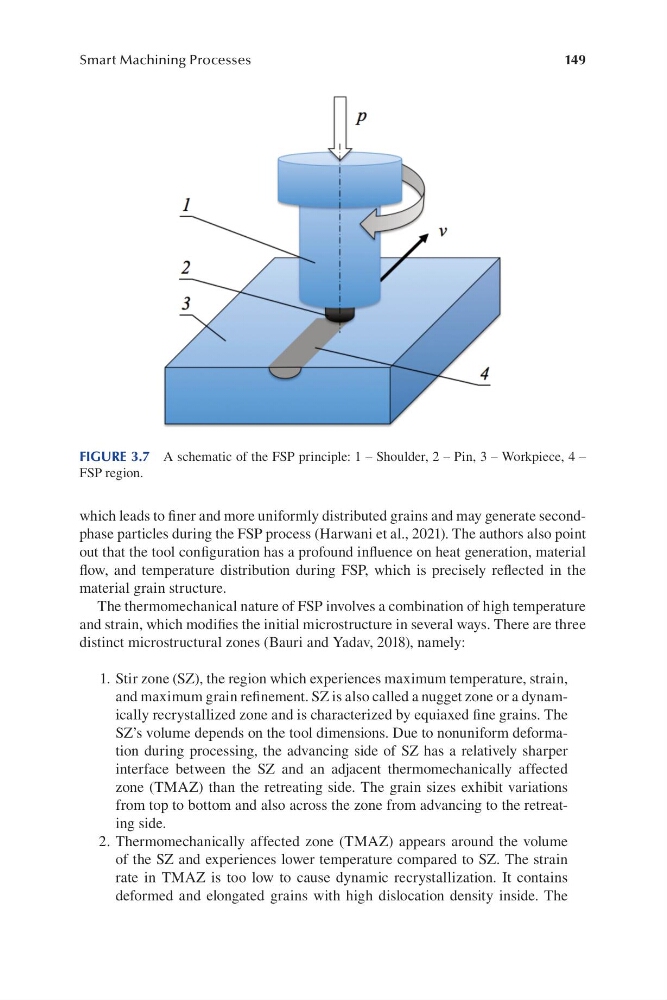
FIGURE 3.7 A schematic of the FSP principle: 1 – Shoulder, 2 – Pin, 3 – Workpiece, 4 –
FSP region.
Smart Machining Processes
which leads to finer and more uniformly distributed grains and may generate secondphase particles during the FSP process (Harwani et al., 2021). The authors also point
out that the tool configuration has a profound influence on heat generation, material
flow, and temperature distribution during FSP, which is precisely reflected in the
material grain structure.
The thermomechanical nature of FSP involves a combination of high temperature
and strain, which modifies the initial microstructure in several ways. There are three
distinct microstructural zones (Bauri and Yadav, 2018), namely:
1. Stir zone (SZ), the region which experiences maximum temperature, strain,
and maximum grain refinement. SZ is also called a nugget zone or a dynamically recrystallized zone and is characterized by equiaxed fine grains. The
SZ’s volume depends on the tool dimensions. Due to nonuniform deformation during processing, the advancing side of SZ has a relatively sharper
interface between the SZ and an adjacent thermomechanically affected
zone (TMAZ) than the retreating side. The grain sizes exhibit variations
from top to bottom and also across the zone from advancing to the retreating side.
2. Thermomechanically affected zone (TMAZ) appears around the volume
of the SZ and experiences lower temperature compared to SZ. The strain
rate in TMAZ is too low to cause dynamic recrystallization. It contains
deformed and elongated grains with high dislocation density inside. The
FIGURE 3.7 A schematic of the FSP principle: 1 – Shoulder, 2 – Pin, 3 – Workpiece, 4 –
FSP region.