

143
Smart Machining Processes
• When exceptional accuracy with minimum waste is required, e.g., due to
the high price of a starting material
• When forging large components that require increased power in the normal
forging process, or components of elevated quality and safety requirements
Superplasticity forming is now a widely accepted method for producing vanes of
gas turbine engines out of nickel-based superalloys and for forming airframes for
military applications (Dudina et al., 2016). There is widespread interest worldwide
in applying SPF to forming automotive parts, but since a much-desired factor in
the heavily competitive sector of automobile production is the reduction of forming
time, intense research is aimed at refining grain size that leads to faster forming
rates. Perhaps SPF is most used for sheet materials (Pupan and Kononenko, 2008).
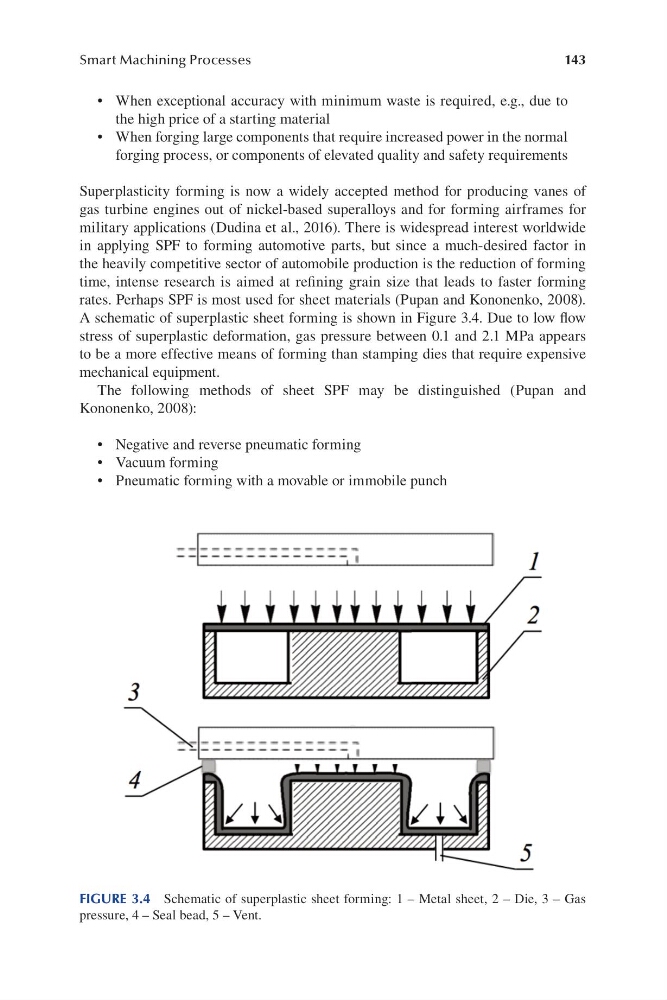
A schematic of superplastic sheet forming is shown in Figure 3.4. Due to low flow
stress of superplastic deformation, gas pressure between 0.1 and 2.1 MPa appears
to be a more effective means of forming than stamping dies that require expensive
mechanical equipment.
The following methods of sheet SPF may be distinguished (Pupan and
Kononenko, 2008):
• Negative and reverse pneumatic forming
• Vacuum forming
• Pneumatic forming with a movable or immobile punch
FIGURE 3.4 Schematic of superplastic sheet forming: 1 – Metal sheet, 2 – Die, 3 – Gas
pressure, 4 – Seal bead, 5 – Vent.
Smart Machining Processes
• When exceptional accuracy with minimum waste is required, e.g., due to
the high price of a starting material
• When forging large components that require increased power in the normal
forging process, or components of elevated quality and safety requirements
Superplasticity forming is now a widely accepted method for producing vanes of
gas turbine engines out of nickel-based superalloys and for forming airframes for
military applications (Dudina et al., 2016). There is widespread interest worldwide
in applying SPF to forming automotive parts, but since a much-desired factor in
the heavily competitive sector of automobile production is the reduction of forming
time, intense research is aimed at refining grain size that leads to faster forming
rates. Perhaps SPF is most used for sheet materials (Pupan and Kononenko, 2008).
A schematic of superplastic sheet forming is shown in Figure 3.4. Due to low flow
stress of superplastic deformation, gas pressure between 0.1 and 2.1 MPa appears
to be a more effective means of forming than stamping dies that require expensive
mechanical equipment.
The following methods of sheet SPF may be distinguished (Pupan and
Kononenko, 2008):
• Negative and reverse pneumatic forming
• Vacuum forming
• Pneumatic forming with a movable or immobile punch
FIGURE 3.4 Schematic of superplastic sheet forming: 1 – Metal sheet, 2 – Die, 3 – Gas
pressure, 4 – Seal bead, 5 – Vent.