

141
Smart Machining Processes
In fact, there are three main requirements for manifestation of superplasticity in
microcrystalline materials, namely (Dudina et al., 2016):
1. Fine and equiaxed grains whose size is reasonably stable during deformation
2. Temperature that is more than about half the melting point of the matrix in
absolute degrees
3. A strain rate that is not too high or too low, i.e., between 10 –2 and 10 –6 s –1
Moreover, Dudina et al. (2016) point out that with the refinement of grain size to
nanoscale, superplasticity can be extended to lower temperatures and significantly
higher strain rates.
Zhang (2010) states the existence of second phases is the best way to stabilize the
grain size, because a small amount of second phase particles in alloys can inhibit
the grain growth by pinning grain boundaries. However, the second phase particles
are unable to hinder the grain growth completely. Thus, the optimum microstructure
for superplasticity appears to be a “microduplex” structure, where ultrafine grains
of two or more phases are arranged alternately. Eutectic and eutectoid alloys often
have this microduplex characteristic, hence their microstructure is very stable during
deformation (Zhang, 2010).
Superplasticity can be classified as follows (Harwani et al., 2021):
1. Internal stress superplasticity (ISS) that involves developing internal
stresses in a material by thermal cycling, which later helps achieve large
strains during deformation
2. Fine structural superplasticity (FSS), also known as micro-grain superplasticity, which relies on the fine grain microstructure that remains thermally
stable during large tensile deformations
Ren et al. (2019) underline that the mechanisms responsible for superplastic deformation have long remained a controversial subject. The proposed theories include grain
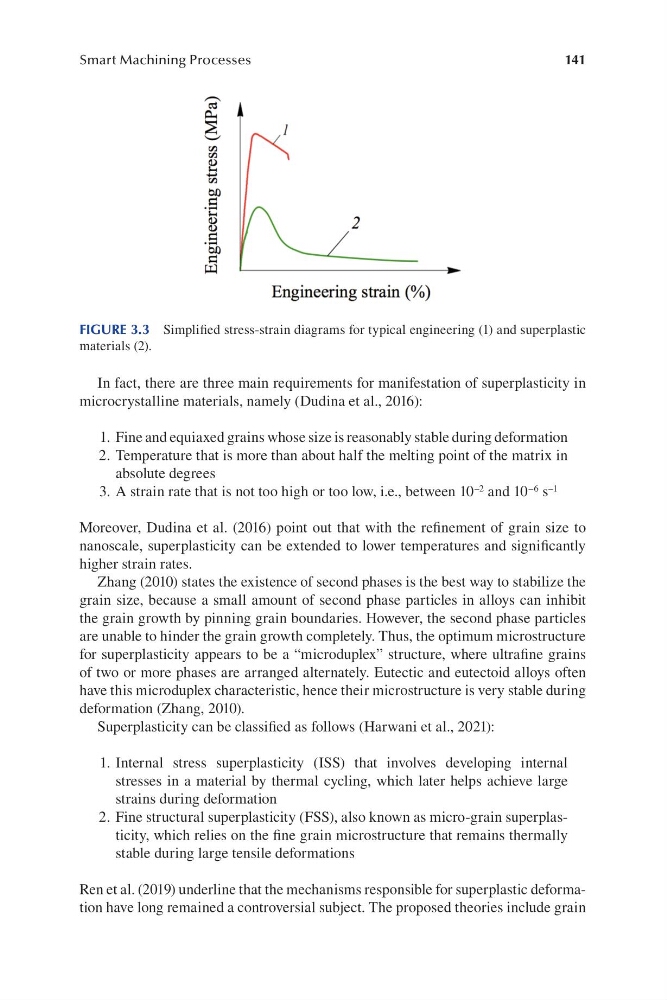
FIGURE 3.3 Simplified stress-strain diagrams for typical engineering (1) and superplastic
materials (2).
Smart Machining Processes
In fact, there are three main requirements for manifestation of superplasticity in
microcrystalline materials, namely (Dudina et al., 2016):
1. Fine and equiaxed grains whose size is reasonably stable during deformation
2. Temperature that is more than about half the melting point of the matrix in
absolute degrees
3. A strain rate that is not too high or too low, i.e., between 10 –2 and 10 –6 s –1
Moreover, Dudina et al. (2016) point out that with the refinement of grain size to
nanoscale, superplasticity can be extended to lower temperatures and significantly
higher strain rates.
Zhang (2010) states the existence of second phases is the best way to stabilize the
grain size, because a small amount of second phase particles in alloys can inhibit
the grain growth by pinning grain boundaries. However, the second phase particles
are unable to hinder the grain growth completely. Thus, the optimum microstructure
for superplasticity appears to be a “microduplex” structure, where ultrafine grains
of two or more phases are arranged alternately. Eutectic and eutectoid alloys often
have this microduplex characteristic, hence their microstructure is very stable during
deformation (Zhang, 2010).
Superplasticity can be classified as follows (Harwani et al., 2021):
1. Internal stress superplasticity (ISS) that involves developing internal
stresses in a material by thermal cycling, which later helps achieve large
strains during deformation
2. Fine structural superplasticity (FSS), also known as micro-grain superplasticity, which relies on the fine grain microstructure that remains thermally
stable during large tensile deformations
Ren et al. (2019) underline that the mechanisms responsible for superplastic deformation have long remained a controversial subject. The proposed theories include grain
FIGURE 3.3 Simplified stress-strain diagrams for typical engineering (1) and superplastic
materials (2).