

85
Protection and Restoration
• Extended maintenance intervals
• Enhanced recyclability of materials
• Reduced environmental impact
From the perspective of product lifecycle prolongation and restoration of its functionality, we will address the following issues in this chapter:
• Additive manufacturing and hybrid additive-subtractive methods
• Protective and technological coatings and their properties
• Modern coating methods, such as thermal and vacuum spraying and beam
coating methods
• Hard alloys and titanium nitride coatings
2.1 APPLICATION OF ADDITIVE MANUFACTURING
METHODS ALONG THE PRODUCT LIFE CYCLE
A process of joining materials to make objects from 3D model data, known as additive manufacturing (AM), 3D printing (3DP), rapid prototyping (RP), and solid-freeform (SFF), is an exponentially evolving manufacturing technology (Zhang et al.,
2020). Additive manufacturing (AM) with its manufacturing capabilities is becoming a key industrial process that could play a relevant role in the transition from a
linear to circular economy (Sanchez et al., 2020).
2.1.1 shorT review of am and hyBrid meThods
The widely known Additive Manufacturing is a unique manufacturing category described in the ASTM F2792 – 10: Standard Terminology for Additive
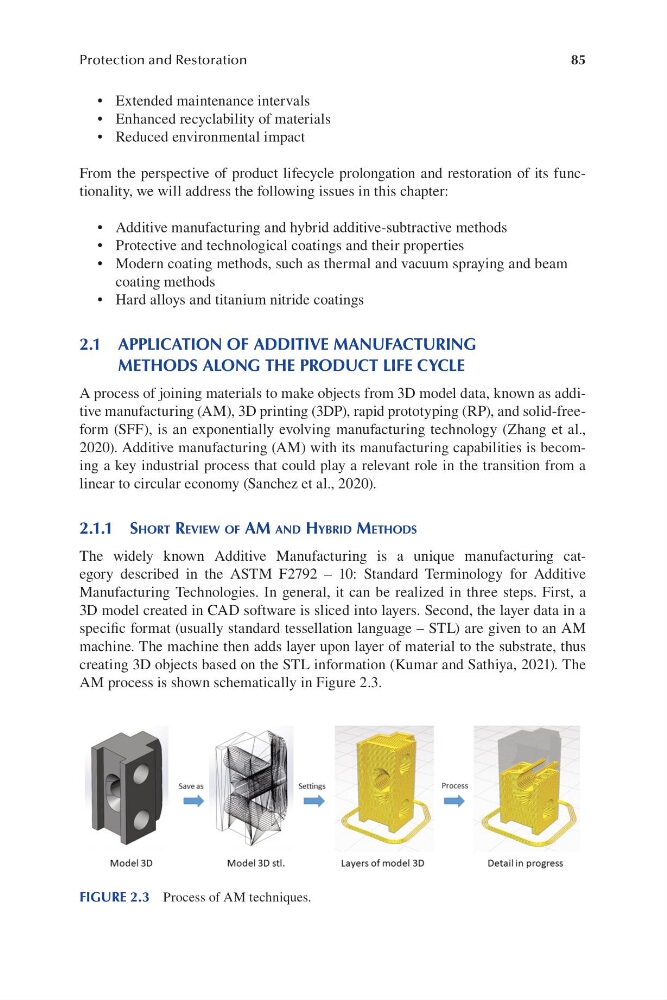
Manufacturing Technologies. In general, it can be realized in three steps. First, a
3D model created in CAD software is sliced into layers. Second, the layer data in a
specific format (usually standard tessellation language – STL) are given to an AM
machine. The machine then adds layer upon layer of material to the substrate, thus
creating 3D objects based on the STL information (Kumar and Sathiya, 2021). The
AM process is shown schematically in Figure 2.3.
FIGURE 2.3 Process of AM techniques.
Protection and Restoration
• Extended maintenance intervals
• Enhanced recyclability of materials
• Reduced environmental impact
From the perspective of product lifecycle prolongation and restoration of its functionality, we will address the following issues in this chapter:
• Additive manufacturing and hybrid additive-subtractive methods
• Protective and technological coatings and their properties
• Modern coating methods, such as thermal and vacuum spraying and beam
coating methods
• Hard alloys and titanium nitride coatings
2.1 APPLICATION OF ADDITIVE MANUFACTURING
METHODS ALONG THE PRODUCT LIFE CYCLE
A process of joining materials to make objects from 3D model data, known as additive manufacturing (AM), 3D printing (3DP), rapid prototyping (RP), and solid-freeform (SFF), is an exponentially evolving manufacturing technology (Zhang et al.,
2020). Additive manufacturing (AM) with its manufacturing capabilities is becoming a key industrial process that could play a relevant role in the transition from a
linear to circular economy (Sanchez et al., 2020).
2.1.1 shorT review of am and hyBrid meThods
The widely known Additive Manufacturing is a unique manufacturing category described in the ASTM F2792 – 10: Standard Terminology for Additive
Manufacturing Technologies. In general, it can be realized in three steps. First, a
3D model created in CAD software is sliced into layers. Second, the layer data in a
specific format (usually standard tessellation language – STL) are given to an AM
machine. The machine then adds layer upon layer of material to the substrate, thus
creating 3D objects based on the STL information (Kumar and Sathiya, 2021). The
AM process is shown schematically in Figure 2.3.
FIGURE 2.3 Process of AM techniques.