

65
17,000-fold was obtained in the tetrabutylammonium bromide:ethylene glycol
(TBAB:EG) solvent compared with water.
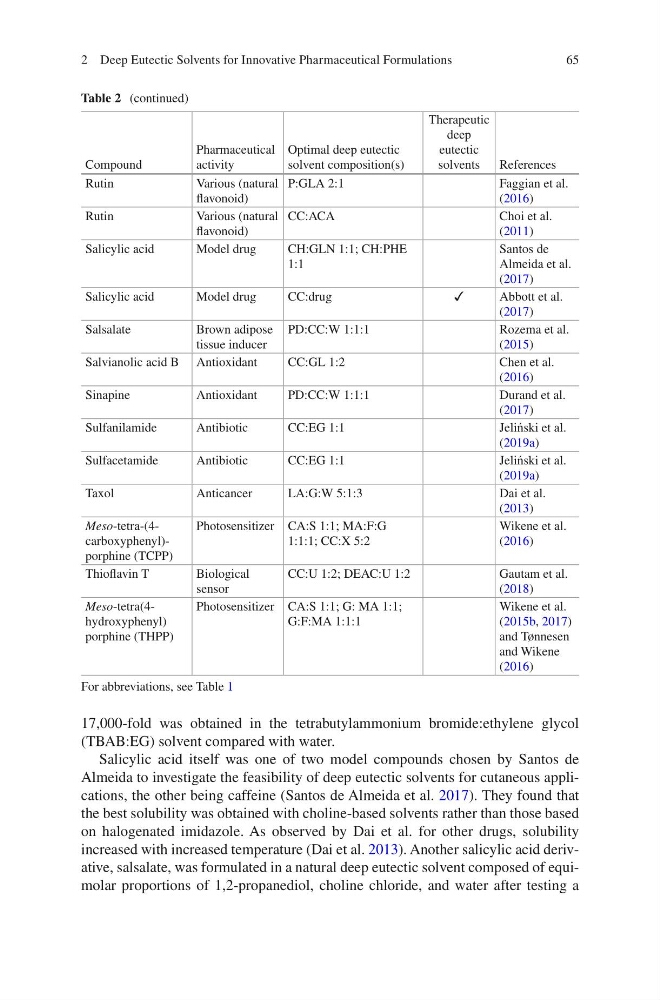
Salicylic acid itself was one of two model compounds chosen by Santos de
Almeida to investigate the feasibility of deep eutectic solvents for cutaneous applications, the other being caffeine (Santos de Almeida et al. 2017). They found that
the best solubility was obtained with choline-based solvents rather than those based
on halogenated imidazole. As observed by Dai et al. for other drugs, solubility
increased with increased temperature (Dai et al. 2013). Another salicylic acid derivative, salsalate, was formulated in a natural deep eutectic solvent composed of equimolar proportions of 1,2-propanediol, choline chloride, and water after testing a
Table 2 (continued)
Compound
Pharmaceutical
activity
Optimal deep eutectic
solvent composition(s)
Therapeutic
deep
eutectic
solvents
References
Rutin
Various (natural
flavonoid)
P:GLA 2:1
Faggian et al.
(2016)
Rutin
Various (natural
flavonoid)
CC:ACA
Choi et al.
(2011)
Salicylic acid
Model drug
CH:GLN 1:1; CH:PHE
1:1
Santos de
Almeida et al.
(2017)
Salicylic acid
Model drug
CC:drug
✓
Abbott et al.
(2017)
Salsalate
Brown adipose
tissue inducer
PD:CC:W 1:1:1
Rozema et al.
(2015)
Salvianolic acid B Antioxidant
CC:GL 1:2
Chen et al.
(2016)
Sinapine
Antioxidant
PD:CC:W 1:1:1
Durand et al.
(2017)
Sulfanilamide
Antibiotic
CC:EG 1:1
Jeliński et al.
(2019a)
Sulfacetamide
Antibiotic
CC:EG 1:1
Jeliński et al.
(2019a)
Taxol
Anticancer
LA:G:W 5:1:3
Dai et al.
(2013)
carboxyphenyl)porphine (TCPP)
Photosensitizer CA:S 1:1; MA:F:G
1:1:1; CC:X 5:2
Wikene et al.
(2016)
Thioflavin T
Biological
sensor
CC:U 1:2; DEAC:U 1:2
Gautam et al.
(2018)
Meso-tetra(4hydroxyphenyl)
porphine (THPP)
Photosensitizer CA:S 1:1; G: MA 1:1;
G:F:MA 1:1:1
Wikene et al.
(2015b, 2017)
and Tønnesen
and Wikene
(2016)
For abbreviations, see Table 1
2 Deep Eutectic Solvents for Innovative Pharmaceutical Formulations
17,000-fold was obtained in the tetrabutylammonium bromide:ethylene glycol
(TBAB:EG) solvent compared with water.
Salicylic acid itself was one of two model compounds chosen by Santos de
Almeida to investigate the feasibility of deep eutectic solvents for cutaneous applications, the other being caffeine (Santos de Almeida et al. 2017). They found that
the best solubility was obtained with choline-based solvents rather than those based
on halogenated imidazole. As observed by Dai et al. for other drugs, solubility
increased with increased temperature (Dai et al. 2013). Another salicylic acid derivative, salsalate, was formulated in a natural deep eutectic solvent composed of equimolar proportions of 1,2-propanediol, choline chloride, and water after testing a
Table 2 (continued)
Compound
Pharmaceutical
activity
Optimal deep eutectic
solvent composition(s)
Therapeutic
deep
eutectic
solvents
References
Rutin
Various (natural
flavonoid)
P:GLA 2:1
Faggian et al.
(2016)
Rutin
Various (natural
flavonoid)
CC:ACA
Choi et al.
(2011)
Salicylic acid
Model drug
CH:GLN 1:1; CH:PHE
1:1
Santos de
Almeida et al.
(2017)
Salicylic acid
Model drug
CC:drug
✓
Abbott et al.
(2017)
Salsalate
Brown adipose
tissue inducer
PD:CC:W 1:1:1
Rozema et al.
(2015)
Salvianolic acid B Antioxidant
CC:GL 1:2
Chen et al.
(2016)
Sinapine
Antioxidant
PD:CC:W 1:1:1
Durand et al.
(2017)
Sulfanilamide
Antibiotic
CC:EG 1:1
Jeliński et al.
(2019a)
Sulfacetamide
Antibiotic
CC:EG 1:1
Jeliński et al.
(2019a)
Taxol
Anticancer
LA:G:W 5:1:3
Dai et al.
(2013)
carboxyphenyl)porphine (TCPP)
Photosensitizer CA:S 1:1; MA:F:G
1:1:1; CC:X 5:2
Wikene et al.
(2016)
Thioflavin T
Biological
sensor
CC:U 1:2; DEAC:U 1:2
Gautam et al.
(2018)
Meso-tetra(4hydroxyphenyl)
porphine (THPP)
Photosensitizer CA:S 1:1; G: MA 1:1;
G:F:MA 1:1:1
Wikene et al.
(2015b, 2017)
and Tønnesen
and Wikene
(2016)
For abbreviations, see Table 1
2 Deep Eutectic Solvents for Innovative Pharmaceutical Formulations