

283
The selection of the technology has a major impact on the extraction rates
observed (Table 7.3). Maceration is one of the methods commonly used in extraction. It is generally a method compatible with the majority of solvents. The maceration is also often named in publications as “heating”, “heating reflux”, or even
“stirring heating”. This traditional method is still widely employed in many publications with deep eutectic solvents. This is not for reasons of performance but more
likely to study the potential benefit of deep eutectic solvent on the extraction compared to traditional organic solvents (Duan et al. 2016; Cvjetko Bubalo et al. 2016;
Jancheva et al. 2017; Cui et al. 2018; Chanioti and Tzia 2018; Cunha and Fernandes
2018). In other words, maceration technique can be regarded as a basic reference
technology. Thus, Cui and coworkers have carried out a detailed study comparing
both the influence of deep eutectic solvents and the technologies used (Cui et al.
2015). Maceration was used as a reference technology to highlight the effect of
microwaves and ultrasound activations on extraction rates. The study involved 11
different deep eutectic solvents, but mainly based on choline chloride (9 over 11).
According to single factor experiments and a Box-Behnken design test, the extraction parameters have been optimized. Optimal performance was obtained with a
temperature of 80 °C, an extraction time of 11 min, using 1,6-hexanediol/ChCl
solvent with a ratio of 7:1 with a water content of 30%, and a solvent-to-solid ratio
of 14 mL/g. The highest extraction yields of genistin, genistein, and apigenin were
obtained under microwave irradiation (0.4688, 0.6410, and 0.2664 mg/g, respectively), while the extraction yields from maceration were a little bit lower (0.4085,
0.5531, and 0.2442 mg/g, respectively) (Cui et al. 2015).
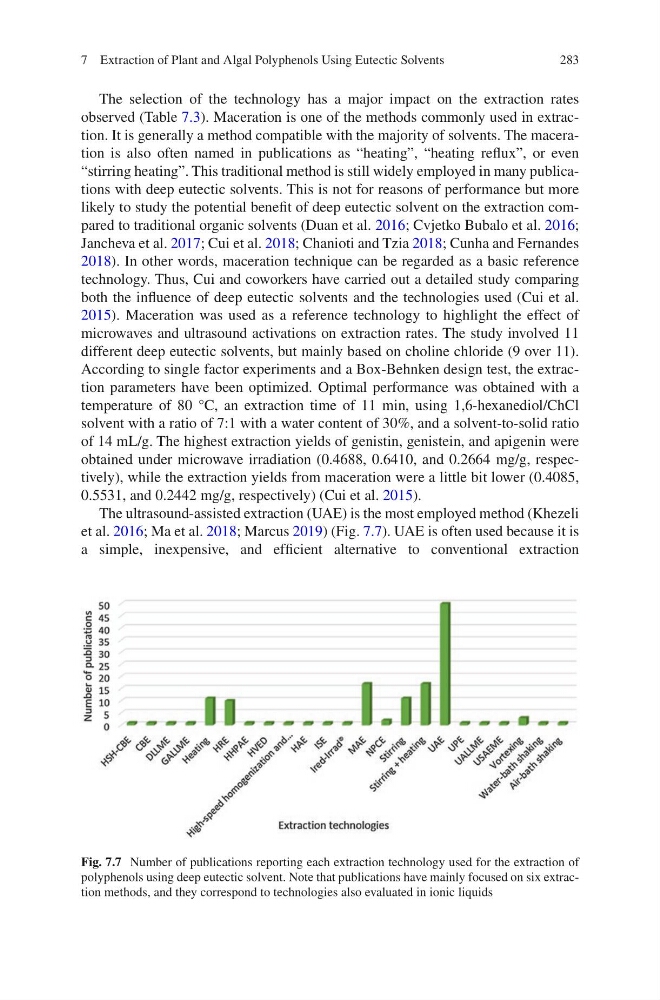
The ultrasound-assisted extraction (UAE) is the most employed method (Khezeli
et al. 2016; Ma et al. 2018; Marcus 2019) (Fig. 7.7). UAE is often used because it is
a simple, inexpensive, and efficient alternative to conventional extraction
Fig. 7.7 Number of publications reporting each extraction technology used for the extraction of
polyphenols using deep eutectic solvent. Note that publications have mainly focused on six extraction methods, and they correspond to technologies also evaluated in ionic liquids
7 Extraction of Plant and Algal Polyphenols Using Eutectic Solvents
The selection of the technology has a major impact on the extraction rates
observed (Table 7.3). Maceration is one of the methods commonly used in extraction. It is generally a method compatible with the majority of solvents. The maceration is also often named in publications as “heating”, “heating reflux”, or even
“stirring heating”. This traditional method is still widely employed in many publications with deep eutectic solvents. This is not for reasons of performance but more
likely to study the potential benefit of deep eutectic solvent on the extraction compared to traditional organic solvents (Duan et al. 2016; Cvjetko Bubalo et al. 2016;
Jancheva et al. 2017; Cui et al. 2018; Chanioti and Tzia 2018; Cunha and Fernandes
2018). In other words, maceration technique can be regarded as a basic reference
technology. Thus, Cui and coworkers have carried out a detailed study comparing
both the influence of deep eutectic solvents and the technologies used (Cui et al.
2015). Maceration was used as a reference technology to highlight the effect of
microwaves and ultrasound activations on extraction rates. The study involved 11
different deep eutectic solvents, but mainly based on choline chloride (9 over 11).
According to single factor experiments and a Box-Behnken design test, the extraction parameters have been optimized. Optimal performance was obtained with a
temperature of 80 °C, an extraction time of 11 min, using 1,6-hexanediol/ChCl
solvent with a ratio of 7:1 with a water content of 30%, and a solvent-to-solid ratio
of 14 mL/g. The highest extraction yields of genistin, genistein, and apigenin were
obtained under microwave irradiation (0.4688, 0.6410, and 0.2664 mg/g, respectively), while the extraction yields from maceration were a little bit lower (0.4085,
0.5531, and 0.2442 mg/g, respectively) (Cui et al. 2015).
The ultrasound-assisted extraction (UAE) is the most employed method (Khezeli
et al. 2016; Ma et al. 2018; Marcus 2019) (Fig. 7.7). UAE is often used because it is
a simple, inexpensive, and efficient alternative to conventional extraction
Fig. 7.7 Number of publications reporting each extraction technology used for the extraction of
polyphenols using deep eutectic solvent. Note that publications have mainly focused on six extraction methods, and they correspond to technologies also evaluated in ionic liquids
7 Extraction of Plant and Algal Polyphenols Using Eutectic Solvents