

252
The formation of a deep eutectic solvent requires strong and multiple interactions between its components. Deep eutectic solvents generally contain an organic
salt Cat
+
X
−
, where Cat
+
is an organic bulky cation (ammonium, sulfonium, phosphonium) and X
−
is a Lewis base, in most cases a halide anion. This organic salt is
combined with a Lewis or an organic hydrogen bond donor Y, which interacts with
the anionic species X
−
through electrostatic interactions or hydrogen bonds, respectively. The role of the bulky (and generally of low symmetry) Cat
+
is to lower the
lattice energy of the salt Cat
+
X
−
and to reduce the freezing temperature of the mixture. The first successful achievement of a room temperature deep eutectic solvent
was observed in a mixture of choline chloride as the Cat
+
X
−
salt and urea as the
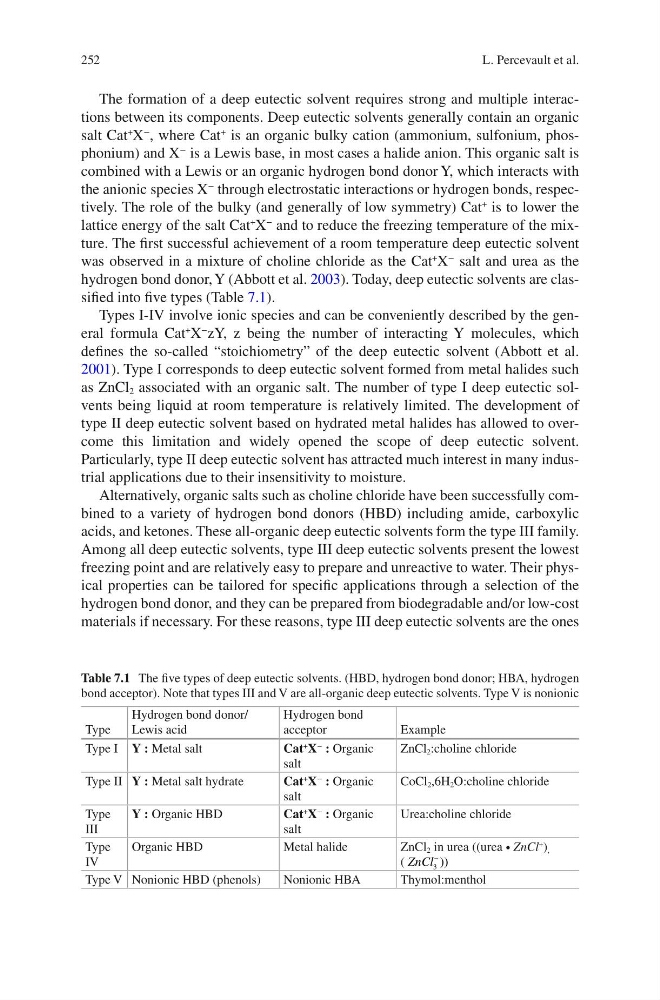
hydrogen bond donor, Y (Abbott et al. 2003). Today, deep eutectic solvents are classified into five types (Table 7.1).
Types I-IV involve ionic species and can be conveniently described by the general formula Cat
+
X
−
zY, z being the number of interacting Y molecules, which
defines the so-called “stoichiometry” of the deep eutectic solvent (Abbott et al.
2001). Type I corresponds to deep eutectic solvent formed from metal halides such
as ZnCl 2 associated with an organic salt. The number of type I deep eutectic solvents being liquid at room temperature is relatively limited. The development of
type II deep eutectic solvent based on hydrated metal halides has allowed to overcome this limitation and widely opened the scope of deep eutectic solvent.
Particularly, type II deep eutectic solvent has attracted much interest in many industrial applications due to their insensitivity to moisture.
Alternatively, organic salts such as choline chloride have been successfully combined to a variety of hydrogen bond donors (HBD) including amide, carboxylic
acids, and ketones. These all-organic deep eutectic solvents form the type III family.
Among all deep eutectic solvents, type III deep eutectic solvents present the lowest
freezing point and are relatively easy to prepare and unreactive to water. Their physical properties can be tailored for specific applications through a selection of the
hydrogen bond donor, and they can be prepared from biodegradable and/or low-cost
materials if necessary. For these reasons, type III deep eutectic solvents are the ones
Table 7.1 The five types of deep eutectic solvents. (HBD, hydrogen bond donor; HBA, hydrogen
bond acceptor). Note that types III and V are all-organic deep eutectic solvents. Type V is nonionic
Type
Hydrogen bond donor/
Lewis acid
Hydrogen bond
acceptor
Example
Type I Y : Metal salt
Cat
+
X
−
: Organic
salt
ZnCl 2 :choline chloride
Type II Y : Metal salt hydrate
Cat
+
X
−
: Organic
salt
CoCl 2 ,6H 2 O:choline chloride
Type
III
Y : Organic HBD
Cat
+
X
−
: Organic
salt
Urea:choline chloride
Type
IV
Organic HBD
Metal halide
ZnCl 2 in urea ((urea ∙ ZnCl
+
) ,
( ZnCl 3
− ))
Type V Nonionic HBD (phenols)
Nonionic HBA
Thymol:menthol
L. Percevault et al.
The formation of a deep eutectic solvent requires strong and multiple interactions between its components. Deep eutectic solvents generally contain an organic
salt Cat
+
X
−
, where Cat
+
is an organic bulky cation (ammonium, sulfonium, phosphonium) and X
−
is a Lewis base, in most cases a halide anion. This organic salt is
combined with a Lewis or an organic hydrogen bond donor Y, which interacts with
the anionic species X
−
through electrostatic interactions or hydrogen bonds, respectively. The role of the bulky (and generally of low symmetry) Cat
+
is to lower the
lattice energy of the salt Cat
+
X
−
and to reduce the freezing temperature of the mixture. The first successful achievement of a room temperature deep eutectic solvent
was observed in a mixture of choline chloride as the Cat
+
X
−
salt and urea as the
hydrogen bond donor, Y (Abbott et al. 2003). Today, deep eutectic solvents are classified into five types (Table 7.1).
Types I-IV involve ionic species and can be conveniently described by the general formula Cat
+
X
−
zY, z being the number of interacting Y molecules, which
defines the so-called “stoichiometry” of the deep eutectic solvent (Abbott et al.
2001). Type I corresponds to deep eutectic solvent formed from metal halides such
as ZnCl 2 associated with an organic salt. The number of type I deep eutectic solvents being liquid at room temperature is relatively limited. The development of
type II deep eutectic solvent based on hydrated metal halides has allowed to overcome this limitation and widely opened the scope of deep eutectic solvent.
Particularly, type II deep eutectic solvent has attracted much interest in many industrial applications due to their insensitivity to moisture.
Alternatively, organic salts such as choline chloride have been successfully combined to a variety of hydrogen bond donors (HBD) including amide, carboxylic
acids, and ketones. These all-organic deep eutectic solvents form the type III family.
Among all deep eutectic solvents, type III deep eutectic solvents present the lowest
freezing point and are relatively easy to prepare and unreactive to water. Their physical properties can be tailored for specific applications through a selection of the
hydrogen bond donor, and they can be prepared from biodegradable and/or low-cost
materials if necessary. For these reasons, type III deep eutectic solvents are the ones
Table 7.1 The five types of deep eutectic solvents. (HBD, hydrogen bond donor; HBA, hydrogen
bond acceptor). Note that types III and V are all-organic deep eutectic solvents. Type V is nonionic
Type
Hydrogen bond donor/
Lewis acid
Hydrogen bond
acceptor
Example
Type I Y : Metal salt
Cat
+
X
−
: Organic
salt
ZnCl 2 :choline chloride
Type II Y : Metal salt hydrate
Cat
+
X
−
: Organic
salt
CoCl 2 ,6H 2 O:choline chloride
Type
III
Y : Organic HBD
Cat
+
X
−
: Organic
salt
Urea:choline chloride
Type
IV
Organic HBD
Metal halide
ZnCl 2 in urea ((urea ∙ ZnCl
+
) ,
( ZnCl 3
− ))
Type V Nonionic HBD (phenols)
Nonionic HBA
Thymol:menthol
L. Percevault et al.