

144
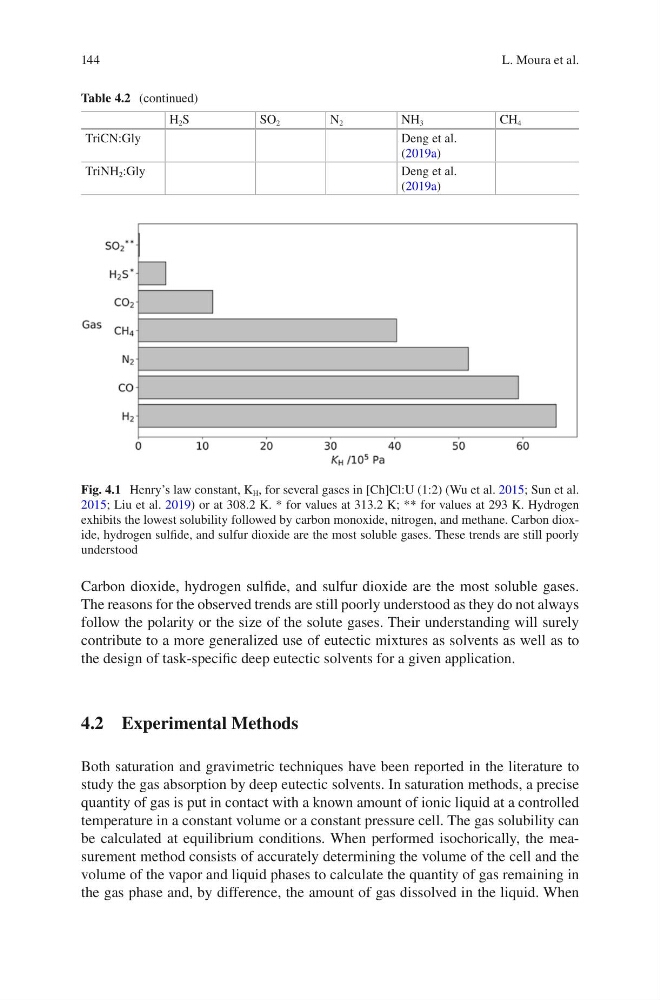
Carbon dioxide, hydrogen sulfide, and sulfur dioxide are the most soluble gases.
The reasons for the observed trends are still poorly understood as they do not always
follow the polarity or the size of the solute gases. Their understanding will surely
contribute to a more generalized use of eutectic mixtures as solvents as well as to
the design of task-specific deep eutectic solvents for a given application.
4.2 Experimental Methods
Both saturation and gravimetric techniques have been reported in the literature to
study the gas absorption by deep eutectic solvents. In saturation methods, a precise
quantity of gas is put in contact with a known amount of ionic liquid at a controlled
temperature in a constant volume or a constant pressure cell. The gas solubility can
be calculated at equilibrium conditions. When performed isochorically, the measurement method consists of accurately determining the volume of the cell and the
volume of the vapor and liquid phases to calculate the quantity of gas remaining in
the gas phase and, by difference, the amount of gas dissolved in the liquid. When
Table 4.2 (continued)
H 2 S
SO 2
N 2
NH 3
CH 4
TriCN:Gly
Deng et al.
(2019a)
TriNH 2 :Gly
Deng et al.
(2019a)
Fig. 4.1 Henry’s law constant, K H , for several gases in [Ch]Cl:U (1:2) (Wu et al. 2015; Sun et al.
2015; Liu et al. 2019) or at 308.2 K. * for values at 313.2 K; ** for values at 293 K. Hydrogen
exhibits the lowest solubility followed by carbon monoxide, nitrogen, and methane. Carbon dioxide, hydrogen sulfide, and sulfur dioxide are the most soluble gases. These trends are still poorly
understood
L. Moura et al.
Carbon dioxide, hydrogen sulfide, and sulfur dioxide are the most soluble gases.
The reasons for the observed trends are still poorly understood as they do not always
follow the polarity or the size of the solute gases. Their understanding will surely
contribute to a more generalized use of eutectic mixtures as solvents as well as to
the design of task-specific deep eutectic solvents for a given application.
4.2 Experimental Methods
Both saturation and gravimetric techniques have been reported in the literature to
study the gas absorption by deep eutectic solvents. In saturation methods, a precise
quantity of gas is put in contact with a known amount of ionic liquid at a controlled
temperature in a constant volume or a constant pressure cell. The gas solubility can
be calculated at equilibrium conditions. When performed isochorically, the measurement method consists of accurately determining the volume of the cell and the
volume of the vapor and liquid phases to calculate the quantity of gas remaining in
the gas phase and, by difference, the amount of gas dissolved in the liquid. When
Table 4.2 (continued)
H 2 S
SO 2
N 2
NH 3
CH 4
TriCN:Gly
Deng et al.
(2019a)
TriNH 2 :Gly
Deng et al.
(2019a)
Fig. 4.1 Henry’s law constant, K H , for several gases in [Ch]Cl:U (1:2) (Wu et al. 2015; Sun et al.
2015; Liu et al. 2019) or at 308.2 K. * for values at 313.2 K; ** for values at 293 K. Hydrogen
exhibits the lowest solubility followed by carbon monoxide, nitrogen, and methane. Carbon dioxide, hydrogen sulfide, and sulfur dioxide are the most soluble gases. These trends are still poorly
understood
L. Moura et al.