

140
[P 4444 ]Cl:Me 2 U (1:1) (Sun et al. 2017b) and [N 4444 ]Br:EG (1:50) (Dou et al. 2019),
and CO 2 through carbamate formation (Ali et al. 2014; Adeyemi et al. 2017a, b) or
calcium carbonate production (Karimi et al. 2018)). Some of the studies concerning
SO 2 were carried out in simulated flue gas mixtures where the presence of N 2 is not
explicitly taken into account as it is just considered as a filler gas (Deng et al. 2019a).
Although in the cases where the gas reacts with the liquid absorber a value for
Henry’s law constant cannot be calculated, we have included in this report the values of K H even for reactive gases when published as such by the different authors.
In Fig. 4.1, Henry’s law constants, K H , of different gases in [Ch]Cl:U (1:2) are
presented. Hydrogen exhibits the lowest solubility (represented by the largest
Henry’s law constant) followed by carbon monoxide, nitrogen, and methane.
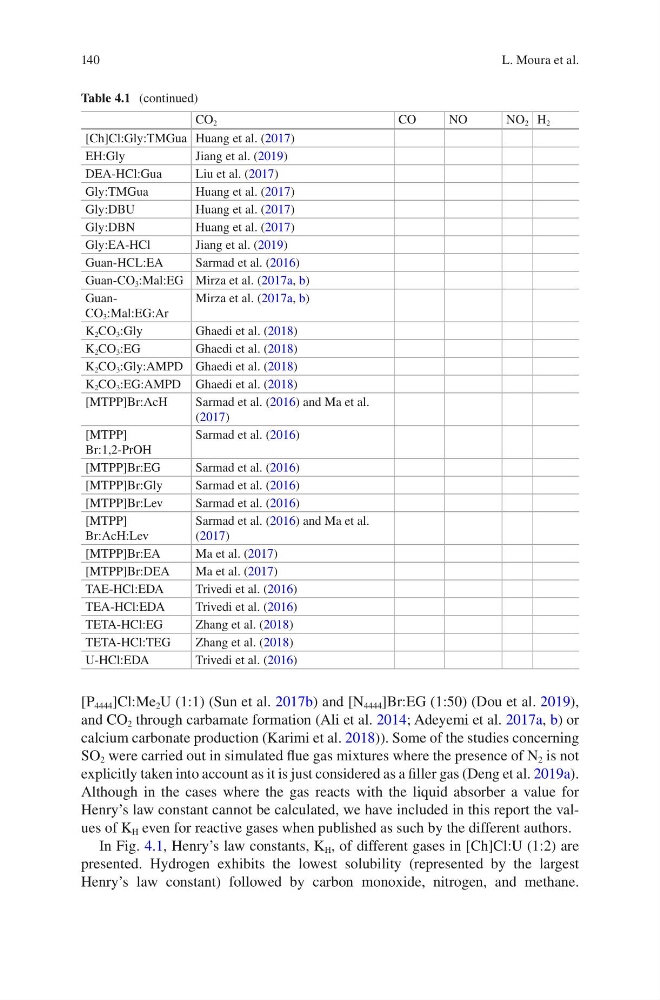
Table 4.1 (continued)
CO 2
CO
NO
NO 2 H 2
[Ch]Cl:Gly:TMGua Huang et al. (2017)
EH:Gly
Jiang et al. (2019)
DEA-HCl:Gua
Liu et al. (2017)
Gly:TMGua
Huang et al. (2017)
Gly:DBU
Huang et al. (2017)
Gly:DBN
Huang et al. (2017)
Gly:EA-HCl
Jiang et al. (2019)
Guan-HCL:EA
Sarmad et al. (2016)
Guan-CO 3 :Mal:EG Mirza et al. (2017a, b)
GuanCO 3 :Mal:EG:Ar
Mirza et al. (2017a, b)
K 2 CO 3 :Gly
Ghaedi et al. (2018)
K 2 CO 3 :EG
Ghaedi et al. (2018)
K 2 CO 3 :Gly:AMPD Ghaedi et al. (2018)
K 2 CO 3 :EG:AMPD Ghaedi et al. (2018)
[MTPP]Br:AcH
Sarmad et al. (2016) and Ma et al.
(2017)
[MTPP]
Br:1,2-PrOH
Sarmad et al. (2016)
[MTPP]Br:EG
Sarmad et al. (2016)
[MTPP]Br:Gly
Sarmad et al. (2016)
[MTPP]Br:Lev
Sarmad et al. (2016)
[MTPP]
Br:AcH:Lev
Sarmad et al. (2016) and Ma et al.
(2017)
[MTPP]Br:EA
Ma et al. (2017)
[MTPP]Br:DEA
Ma et al. (2017)
TAE-HCl:EDA
Trivedi et al. (2016)
TEA-HCl:EDA
Trivedi et al. (2016)
TETA-HCl:EG
Zhang et al. (2018)
TETA-HCl:TEG
Zhang et al. (2018)
U-HCl:EDA
Trivedi et al. (2016)
L. Moura et al.
[P 4444 ]Cl:Me 2 U (1:1) (Sun et al. 2017b) and [N 4444 ]Br:EG (1:50) (Dou et al. 2019),
and CO 2 through carbamate formation (Ali et al. 2014; Adeyemi et al. 2017a, b) or
calcium carbonate production (Karimi et al. 2018)). Some of the studies concerning
SO 2 were carried out in simulated flue gas mixtures where the presence of N 2 is not
explicitly taken into account as it is just considered as a filler gas (Deng et al. 2019a).
Although in the cases where the gas reacts with the liquid absorber a value for
Henry’s law constant cannot be calculated, we have included in this report the values of K H even for reactive gases when published as such by the different authors.
In Fig. 4.1, Henry’s law constants, K H , of different gases in [Ch]Cl:U (1:2) are
presented. Hydrogen exhibits the lowest solubility (represented by the largest
Henry’s law constant) followed by carbon monoxide, nitrogen, and methane.
Table 4.1 (continued)
CO 2
CO
NO
NO 2 H 2
[Ch]Cl:Gly:TMGua Huang et al. (2017)
EH:Gly
Jiang et al. (2019)
DEA-HCl:Gua
Liu et al. (2017)
Gly:TMGua
Huang et al. (2017)
Gly:DBU
Huang et al. (2017)
Gly:DBN
Huang et al. (2017)
Gly:EA-HCl
Jiang et al. (2019)
Guan-HCL:EA
Sarmad et al. (2016)
Guan-CO 3 :Mal:EG Mirza et al. (2017a, b)
GuanCO 3 :Mal:EG:Ar
Mirza et al. (2017a, b)
K 2 CO 3 :Gly
Ghaedi et al. (2018)
K 2 CO 3 :EG
Ghaedi et al. (2018)
K 2 CO 3 :Gly:AMPD Ghaedi et al. (2018)
K 2 CO 3 :EG:AMPD Ghaedi et al. (2018)
[MTPP]Br:AcH
Sarmad et al. (2016) and Ma et al.
(2017)
[MTPP]
Br:1,2-PrOH
Sarmad et al. (2016)
[MTPP]Br:EG
Sarmad et al. (2016)
[MTPP]Br:Gly
Sarmad et al. (2016)
[MTPP]Br:Lev
Sarmad et al. (2016)
[MTPP]
Br:AcH:Lev
Sarmad et al. (2016) and Ma et al.
(2017)
[MTPP]Br:EA
Ma et al. (2017)
[MTPP]Br:DEA
Ma et al. (2017)
TAE-HCl:EDA
Trivedi et al. (2016)
TEA-HCl:EDA
Trivedi et al. (2016)
TETA-HCl:EG
Zhang et al. (2018)
TETA-HCl:TEG
Zhang et al. (2018)
U-HCl:EDA
Trivedi et al. (2016)
L. Moura et al.