

134
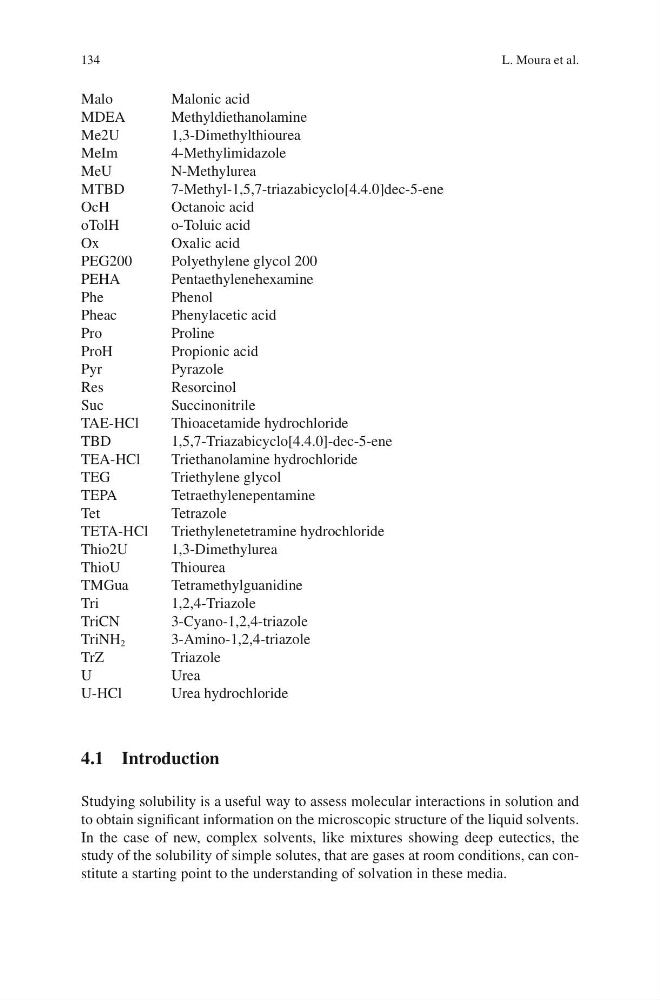
Malo
Malonic acid
MDEA
Methyldiethanolamine
Me2U
1,3-Dimethylthiourea
MeIm
4-Methylimidazole
MeU
N-Methylurea
MTBD
7-Methyl-1,5,7-triazabicyclo[4.4.0]dec-5-ene
OcH
Octanoic acid
oTolH
o-Toluic acid
Ox
Oxalic acid
PEG200
Polyethylene glycol 200
PEHA
Pentaethylenehexamine
Phe
Phenol
Pheac
Phenylacetic acid
Pro
Proline
ProH
Propionic acid
Pyr
Pyrazole
Res
Resorcinol
Suc
Succinonitrile
TAE-HCl
Thioacetamide hydrochloride
TBD
1,5,7-Triazabicyclo[4.4.0]-dec-5-ene
TEA-HCl
Triethanolamine hydrochloride
TEG
Triethylene glycol
TEPA
Tetraethylenepentamine
Tet
Tetrazole
TETA-HCl
Triethylenetetramine hydrochloride
Thio2U
1,3-Dimethylurea
ThioU
Thiourea
TMGua
Tetramethylguanidine
Tri
1,2,4-Triazole
TriCN
3-Cyano-1,2,4-triazole
TriNH 2
3-Amino-1,2,4-triazole
TrZ
Triazole
U
Urea
U-HCl
Urea hydrochloride
4.1 Introduction
Studying solubility is a useful way to assess molecular interactions in solution and
to obtain significant information on the microscopic structure of the liquid solvents.
In the case of new, complex solvents, like mixtures showing deep eutectics, the
study of the solubility of simple solutes, that are gases at room conditions, can constitute a starting point to the understanding of solvation in these media.
L. Moura et al.
Malo
Malonic acid
MDEA
Methyldiethanolamine
Me2U
1,3-Dimethylthiourea
MeIm
4-Methylimidazole
MeU
N-Methylurea
MTBD
7-Methyl-1,5,7-triazabicyclo[4.4.0]dec-5-ene
OcH
Octanoic acid
oTolH
o-Toluic acid
Ox
Oxalic acid
PEG200
Polyethylene glycol 200
PEHA
Pentaethylenehexamine
Phe
Phenol
Pheac
Phenylacetic acid
Pro
Proline
ProH
Propionic acid
Pyr
Pyrazole
Res
Resorcinol
Suc
Succinonitrile
TAE-HCl
Thioacetamide hydrochloride
TBD
1,5,7-Triazabicyclo[4.4.0]-dec-5-ene
TEA-HCl
Triethanolamine hydrochloride
TEG
Triethylene glycol
TEPA
Tetraethylenepentamine
Tet
Tetrazole
TETA-HCl
Triethylenetetramine hydrochloride
Thio2U
1,3-Dimethylurea
ThioU
Thiourea
TMGua
Tetramethylguanidine
Tri
1,2,4-Triazole
TriCN
3-Cyano-1,2,4-triazole
TriNH 2
3-Amino-1,2,4-triazole
TrZ
Triazole
U
Urea
U-HCl
Urea hydrochloride
4.1 Introduction
Studying solubility is a useful way to assess molecular interactions in solution and
to obtain significant information on the microscopic structure of the liquid solvents.
In the case of new, complex solvents, like mixtures showing deep eutectics, the
study of the solubility of simple solutes, that are gases at room conditions, can constitute a starting point to the understanding of solvation in these media.
L. Moura et al.