

111
change the properties of the drugs. The polymorphism is a problem of crystalline
APIs and is defined as the ability of a substance to exist in two or more crystalline
forms with different arrangements and/or conformations of the molecules in the
crystalline matrix. Several classes of drugs exhibit polymorphism, and the API
could crystallize as a solvate that can be stoichiometric or nonstoichiometric. The
presence of polymorphs or solvates can affect the mechanism of action of an API;
subsequently, the solid-state structure determines its properties as dissolution rate,
solubility, permeability, bioavailability, and others. In the production processes,
polymorphism could also occur and lead to formulations with an API with ineffective doses (Domingos et al. 2015; Hough and Rogers 2007; Zainal-Abidin et al.
2019). Frequently, polymorphism is a solid-state phenomenon and is more prominent in compounds that contain more than one functional group promoting the interactions and form multiple supramolecular synthons (Domingos et al. 2015). One
example of polymorphism that occurs in drugs was reported with risperidone, an
antipsychotic drug commonly used in schizophrenia. This drug presented three
forms, and just one of them could be used safely in therapeutics as it does not suffer
polymorphic transformation during the manufacturing or storage process (Domingos
et al. 2015).
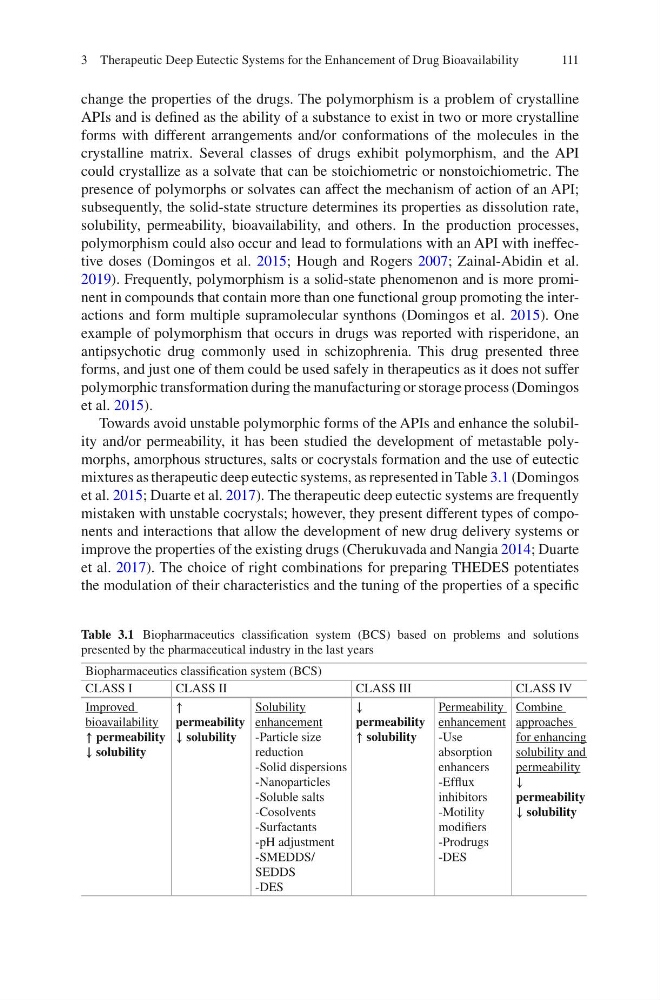
Towards avoid unstable polymorphic forms of the APIs and enhance the solubility and/or permeability, it has been studied the development of metastable polymorphs, amorphous structures, salts or cocrystals formation and the use of eutectic
mixtures as therapeutic deep eutectic systems, as represented in Table 3.1 (Domingos
et al. 2015; Duarte et al. 2017). The therapeutic deep eutectic systems are frequently
mistaken with unstable cocrystals; however, they present different types of components and interactions that allow the development of new drug delivery systems or
improve the properties of the existing drugs (Cherukuvada and Nangia 2014; Duarte
et al. 2017). The choice of right combinations for preparing THEDES potentiates
the modulation of their characteristics and the tuning of the properties of a specific
Table 3.1 Biopharmaceutics classification system (BCS) based on problems and solutions
presented by the pharmaceutical industry in the last years
Biopharmaceutics classification system (BCS)
CLASS I
CLASS II
CLASS III
CLASS IV
Improved
bioavailability
↑ permeability
↓ solubility
↑
permeability
↓ solubility
Solubility
enhancement
-Particle size
reduction
-Solid dispersions
-Nanoparticles
-Soluble salts
-Cosolvents
-Surfactants
-pH adjustment
-SMEDDS/
SEDDS
-DES
↓
permeability
↑ solubility
Permeability
enhancement
-Use
absorption
enhancers
-Efflux
inhibitors
-Motility
modifiers
-Prodrugs
-DES
Combine
approaches
for enhancing
solubility and
permeability
↓
permeability
↓ solubility
3 Therapeutic Deep Eutectic Systems for the Enhancement of Drug Bioavailability
change the properties of the drugs. The polymorphism is a problem of crystalline
APIs and is defined as the ability of a substance to exist in two or more crystalline
forms with different arrangements and/or conformations of the molecules in the
crystalline matrix. Several classes of drugs exhibit polymorphism, and the API
could crystallize as a solvate that can be stoichiometric or nonstoichiometric. The
presence of polymorphs or solvates can affect the mechanism of action of an API;
subsequently, the solid-state structure determines its properties as dissolution rate,
solubility, permeability, bioavailability, and others. In the production processes,
polymorphism could also occur and lead to formulations with an API with ineffective doses (Domingos et al. 2015; Hough and Rogers 2007; Zainal-Abidin et al.
2019). Frequently, polymorphism is a solid-state phenomenon and is more prominent in compounds that contain more than one functional group promoting the interactions and form multiple supramolecular synthons (Domingos et al. 2015). One
example of polymorphism that occurs in drugs was reported with risperidone, an
antipsychotic drug commonly used in schizophrenia. This drug presented three
forms, and just one of them could be used safely in therapeutics as it does not suffer
polymorphic transformation during the manufacturing or storage process (Domingos
et al. 2015).
Towards avoid unstable polymorphic forms of the APIs and enhance the solubility and/or permeability, it has been studied the development of metastable polymorphs, amorphous structures, salts or cocrystals formation and the use of eutectic
mixtures as therapeutic deep eutectic systems, as represented in Table 3.1 (Domingos
et al. 2015; Duarte et al. 2017). The therapeutic deep eutectic systems are frequently
mistaken with unstable cocrystals; however, they present different types of components and interactions that allow the development of new drug delivery systems or
improve the properties of the existing drugs (Cherukuvada and Nangia 2014; Duarte
et al. 2017). The choice of right combinations for preparing THEDES potentiates
the modulation of their characteristics and the tuning of the properties of a specific
Table 3.1 Biopharmaceutics classification system (BCS) based on problems and solutions
presented by the pharmaceutical industry in the last years
Biopharmaceutics classification system (BCS)
CLASS I
CLASS II
CLASS III
CLASS IV
Improved
bioavailability
↑ permeability
↓ solubility
↑
permeability
↓ solubility
Solubility
enhancement
-Particle size
reduction
-Solid dispersions
-Nanoparticles
-Soluble salts
-Cosolvents
-Surfactants
-pH adjustment
-SMEDDS/
SEDDS
-DES
↓
permeability
↑ solubility
Permeability
enhancement
-Use
absorption
enhancers
-Efflux
inhibitors
-Motility
modifiers
-Prodrugs
-DES
Combine
approaches
for enhancing
solubility and
permeability
↓
permeability
↓ solubility
3 Therapeutic Deep Eutectic Systems for the Enhancement of Drug Bioavailability