

52
A. V. Glushkov et al.
and spectroscopy, laser physics and quantum electronics and many others (e.g., [1–
93]). By the way, it is known that a number of astrophysical processes in interstellar
gas that interacts with fragments of supernova explosions, collisions of interstellar
clouds, and supersonic gas flows in the formation of stars, lead to the formation of
the Rydberg atoms with very large n (~1000).
The reasons for the significant interest in study of the Rydberg atoms RA are
well known and related, first, to their extraordinary properties, namely, sufficiently
long life (τ ~ n
3 for l ~ 1, τ ~ n
5 for n ~ l; l is the orbital quantum number) and
geometric sizes (the typical Rydberg orbit size, n
2 a 0 /Z, a 0 = è
2 /me
2 ), significant
polarizabilities (~n
2 ), dipole moments of radiation transitions, high sensitivity to
external electromagnetic fields (Stark shift ~ ~n
7 l
5 , Zeeman effect ~n
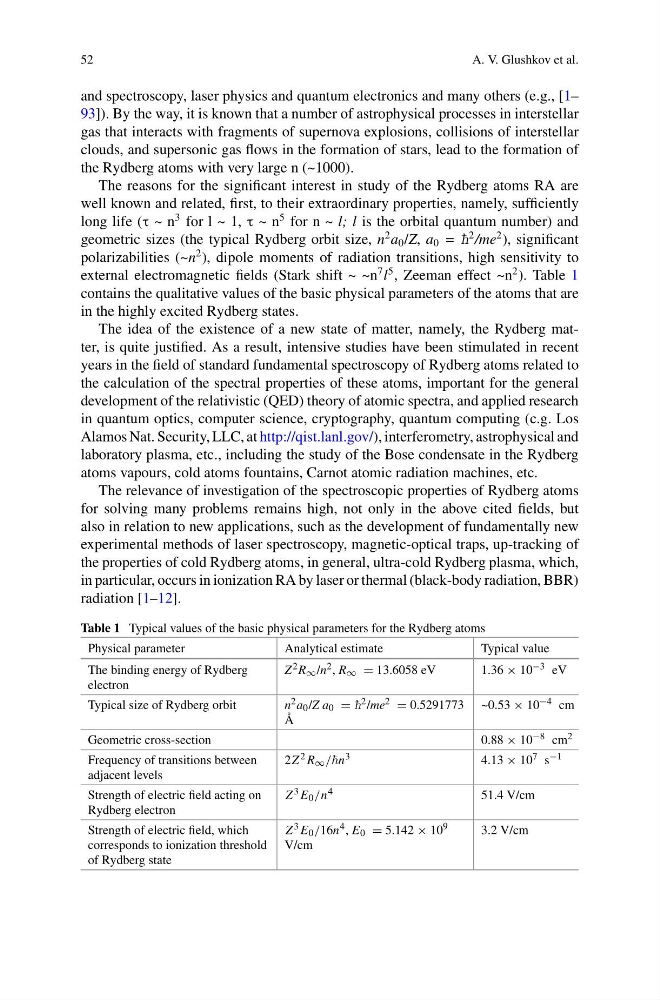
2 ). Table 1
contains the qualitative values of the basic physical parameters of the atoms that are
in the highly excited Rydberg states.
The idea of the existence of a new state of matter, namely, the Rydberg matter, is quite justified. As a result, intensive studies have been stimulated in recent
years in the field of standard fundamental spectroscopy of Rydberg atoms related to
the calculation of the spectral properties of these atoms, important for the general
development of the relativistic (QED) theory of atomic spectra, and applied research
in quantum optics, computer science, cryptography, quantum computing (c.g. Los
Alamos Nat. Security, LLC, at http://qist.lanl.gov/), interferometry, astrophysical and
laboratory plasma, etc., including the study of the Bose condensate in the Rydberg
atoms vapours, cold atoms fountains, Carnot atomic radiation machines, etc.
The relevance of investigation of the spectroscopic properties of Rydberg atoms
for solving many problems remains high, not only in the above cited fields, but
also in relation to new applications, such as the development of fundamentally new
experimental methods of laser spectroscopy, magnetic-optical traps, up-tracking of
the properties of cold Rydberg atoms, in general, ultra-cold Rydberg plasma, which,
in particular, occurs in ionization RA by laser or thermal (black-body radiation, BBR)
radiation [1–12].
Table 1 Typical values of the basic physical parameters for the Rydberg atoms
Physical parameter
Analytical estimate
Typical value
The binding energy of Rydberg
electron
Z 2 R ∞ /n 2 , R ∞ = 13.6058 eV
1.36 × 10 −3 eV
Typical size of Rydberg orbit
n 2 a 0 /Z a 0 = è 2 /me 2 = 0.5291773
Å
~0.53 × 10 −4 cm
Geometric cross-section
0.88 × 10 −8 cm 2
Frequency of transitions between
adjacent levels
2Z 2 R ∞ /n 3
4.13 × 10 7 s −1
Strength of electric field acting on
Rydberg electron
Z 3 E 0 /n 4
51.4 V/cm
Strength of electric field, which
corresponds to ionization threshold
of Rydberg state
Z 3 E 0 /16n 4 , E 0 = 5.142 × 10 9
V/cm
3.2 V/cm
A. V. Glushkov et al.
and spectroscopy, laser physics and quantum electronics and many others (e.g., [1–
93]). By the way, it is known that a number of astrophysical processes in interstellar
gas that interacts with fragments of supernova explosions, collisions of interstellar
clouds, and supersonic gas flows in the formation of stars, lead to the formation of
the Rydberg atoms with very large n (~1000).
The reasons for the significant interest in study of the Rydberg atoms RA are
well known and related, first, to their extraordinary properties, namely, sufficiently
long life (τ ~ n
3 for l ~ 1, τ ~ n
5 for n ~ l; l is the orbital quantum number) and
geometric sizes (the typical Rydberg orbit size, n
2 a 0 /Z, a 0 = è
2 /me
2 ), significant
polarizabilities (~n
2 ), dipole moments of radiation transitions, high sensitivity to
external electromagnetic fields (Stark shift ~ ~n
7 l
5 , Zeeman effect ~n
2 ). Table 1
contains the qualitative values of the basic physical parameters of the atoms that are
in the highly excited Rydberg states.
The idea of the existence of a new state of matter, namely, the Rydberg matter, is quite justified. As a result, intensive studies have been stimulated in recent
years in the field of standard fundamental spectroscopy of Rydberg atoms related to
the calculation of the spectral properties of these atoms, important for the general
development of the relativistic (QED) theory of atomic spectra, and applied research
in quantum optics, computer science, cryptography, quantum computing (c.g. Los
Alamos Nat. Security, LLC, at http://qist.lanl.gov/), interferometry, astrophysical and
laboratory plasma, etc., including the study of the Bose condensate in the Rydberg
atoms vapours, cold atoms fountains, Carnot atomic radiation machines, etc.
The relevance of investigation of the spectroscopic properties of Rydberg atoms
for solving many problems remains high, not only in the above cited fields, but
also in relation to new applications, such as the development of fundamentally new
experimental methods of laser spectroscopy, magnetic-optical traps, up-tracking of
the properties of cold Rydberg atoms, in general, ultra-cold Rydberg plasma, which,
in particular, occurs in ionization RA by laser or thermal (black-body radiation, BBR)
radiation [1–12].
Table 1 Typical values of the basic physical parameters for the Rydberg atoms
Physical parameter
Analytical estimate
Typical value
The binding energy of Rydberg
electron
Z 2 R ∞ /n 2 , R ∞ = 13.6058 eV
1.36 × 10 −3 eV
Typical size of Rydberg orbit
n 2 a 0 /Z a 0 = è 2 /me 2 = 0.5291773
Å
~0.53 × 10 −4 cm
Geometric cross-section
0.88 × 10 −8 cm 2
Frequency of transitions between
adjacent levels
2Z 2 R ∞ /n 3
4.13 × 10 7 s −1
Strength of electric field acting on
Rydberg electron
Z 3 E 0 /n 4
51.4 V/cm
Strength of electric field, which
corresponds to ionization threshold
of Rydberg state
Z 3 E 0 /16n 4 , E 0 = 5.142 × 10 9
V/cm
3.2 V/cm