

450
J. Maruani
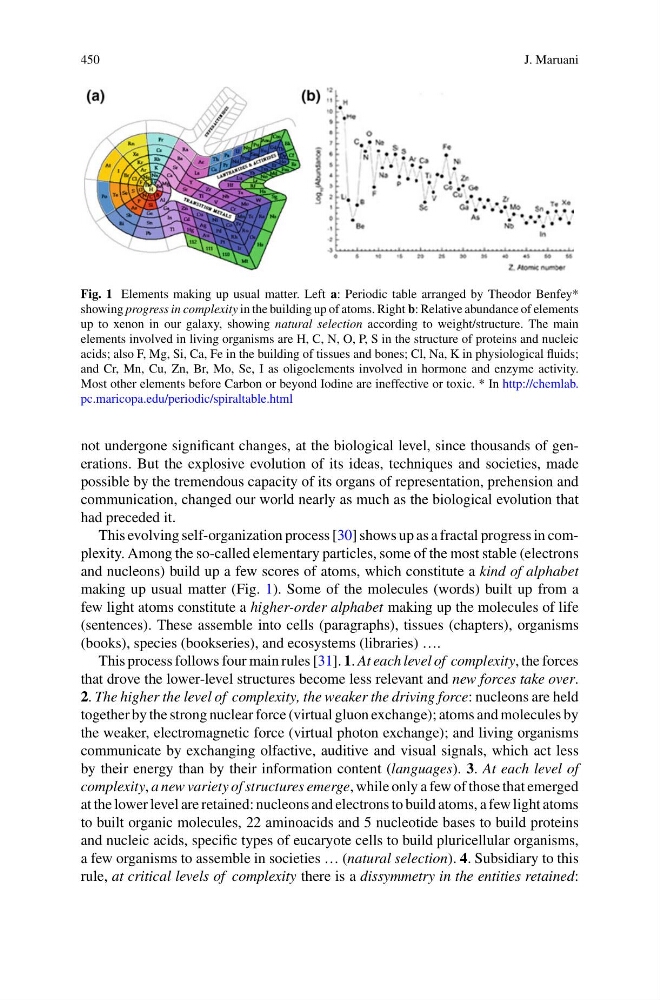
Fig. 1 Elements making up usual matter. Left a: Periodic table arranged by Theodor Benfey*
showing progress in complexity in the building up of atoms. Right b: Relative abundance of elements
up to xenon in our galaxy, showing natural selection according to weight/structure. The main
elements involved in living organisms are H, C, N, O, P, S in the structure of proteins and nucleic
acids; also F, Mg, Si, Ca, Fe in the building of tissues and bones; Cl, Na, K in physiological fluids;
and Cr, Mn, Cu, Zn, Br, Mo, Se, I as oligoelements involved in hormone and enzyme activity.
Most other elements before Carbon or beyond Iodine are ineffective or toxic. * In http://chemlab.
pc.maricopa.edu/periodic/spiraltable.html
not undergone significant changes, at the biological level, since thousands of generations. But the explosive evolution of its ideas, techniques and societies, made
possible by the tremendous capacity of its organs of representation, prehension and
communication, changed our world nearly as much as the biological evolution that
had preceded it.
This evolving self-organization process [30] shows up as a fractal progress in complexity. Among the so-called elementary particles, some of the most stable (electrons
and nucleons) build up a few scores of atoms, which constitute a kind of alphabet
making up usual matter (Fig. 1). Some of the molecules (words) built up from a
few light atoms constitute a higher-order alphabet making up the molecules of life
(sentences). These assemble into cells (paragraphs), tissues (chapters), organisms
(books), species (bookseries), and ecosystems (libraries) ….
This process follows four main rules [31]. 1. At each level of complexity, the forces
that drove the lower-level structures become less relevant and new forces take over.
2. The higher the level of complexity, the weaker the driving force: nucleons are held
together by the strong nuclear force (virtual gluon exchange); atoms and molecules by
the weaker, electromagnetic force (virtual photon exchange); and living organisms
communicate by exchanging olfactive, auditive and visual signals, which act less
by their energy than by their information content (languages). 3. At each level of
complexity, a new variety of structures emerge, while only a few of those that emerged
at the lower level are retained: nucleons and electrons to build atoms, a few light atoms
to built organic molecules, 22 aminoacids and 5 nucleotide bases to build proteins
and nucleic acids, specific types of eucaryote cells to build pluricellular organisms,
a few organisms to assemble in societies … (natural selection). 4. Subsidiary to this
rule, at critical levels of complexity there is a dissymmetry in the entities retained:
J. Maruani
Fig. 1 Elements making up usual matter. Left a: Periodic table arranged by Theodor Benfey*
showing progress in complexity in the building up of atoms. Right b: Relative abundance of elements
up to xenon in our galaxy, showing natural selection according to weight/structure. The main
elements involved in living organisms are H, C, N, O, P, S in the structure of proteins and nucleic
acids; also F, Mg, Si, Ca, Fe in the building of tissues and bones; Cl, Na, K in physiological fluids;
and Cr, Mn, Cu, Zn, Br, Mo, Se, I as oligoelements involved in hormone and enzyme activity.
Most other elements before Carbon or beyond Iodine are ineffective or toxic. * In http://chemlab.
pc.maricopa.edu/periodic/spiraltable.html
not undergone significant changes, at the biological level, since thousands of generations. But the explosive evolution of its ideas, techniques and societies, made
possible by the tremendous capacity of its organs of representation, prehension and
communication, changed our world nearly as much as the biological evolution that
had preceded it.
This evolving self-organization process [30] shows up as a fractal progress in complexity. Among the so-called elementary particles, some of the most stable (electrons
and nucleons) build up a few scores of atoms, which constitute a kind of alphabet
making up usual matter (Fig. 1). Some of the molecules (words) built up from a
few light atoms constitute a higher-order alphabet making up the molecules of life
(sentences). These assemble into cells (paragraphs), tissues (chapters), organisms
(books), species (bookseries), and ecosystems (libraries) ….
This process follows four main rules [31]. 1. At each level of complexity, the forces
that drove the lower-level structures become less relevant and new forces take over.
2. The higher the level of complexity, the weaker the driving force: nucleons are held
together by the strong nuclear force (virtual gluon exchange); atoms and molecules by
the weaker, electromagnetic force (virtual photon exchange); and living organisms
communicate by exchanging olfactive, auditive and visual signals, which act less
by their energy than by their information content (languages). 3. At each level of
complexity, a new variety of structures emerge, while only a few of those that emerged
at the lower level are retained: nucleons and electrons to build atoms, a few light atoms
to built organic molecules, 22 aminoacids and 5 nucleotide bases to build proteins
and nucleic acids, specific types of eucaryote cells to build pluricellular organisms,
a few organisms to assemble in societies … (natural selection). 4. Subsidiary to this
rule, at critical levels of complexity there is a dissymmetry in the entities retained: