

446
J. Maruani
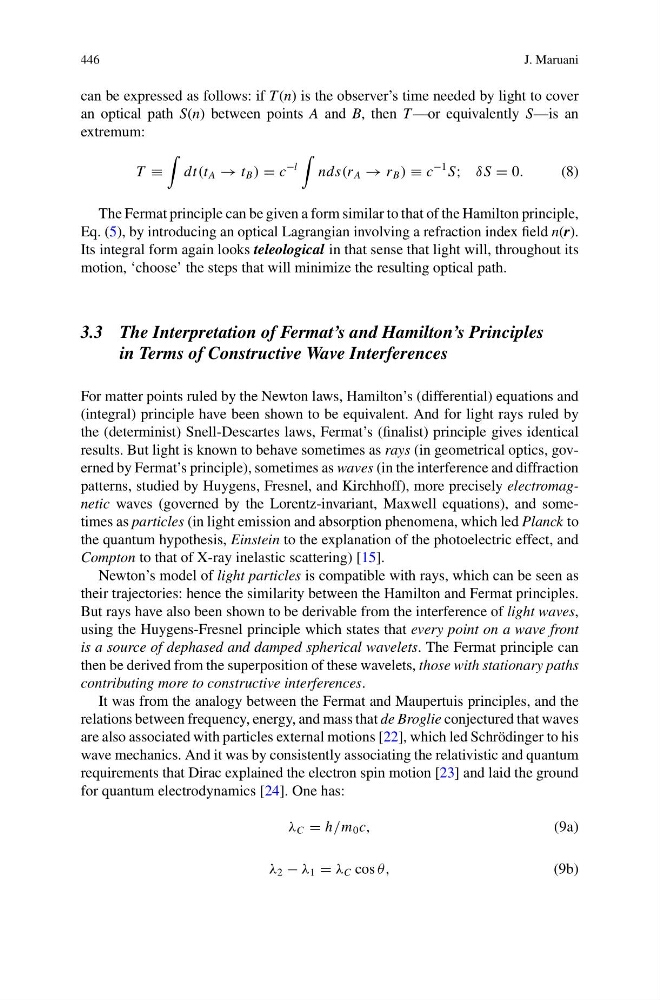
can be expressed as follows: if T (n) is the observer’s time needed by light to cover
an optical path S(n) between points A and B, then T —or equivalently S—is an
extremum:
T ≡
dt(t A → t B ) = c
−l
nds(r A → r B ) ≡ c
−1 S; δS = 0.
(8)
The Fermat principle can be given a form similar to that of the Hamilton principle,
Eq. (5), by introducing an optical Lagrangian involving a refraction index field n(r).
Its integral form again looks teleological in that sense that light will, throughout its
motion, ‘choose’ the steps that will minimize the resulting optical path.
3.3 The Interpretation of Fermat’s and Hamilton’s Principles
in Terms of Constructive Wave Interferences
For matter points ruled by the Newton laws, Hamilton’s (differential) equations and
(integral) principle have been shown to be equivalent. And for light rays ruled by
the (determinist) Snell-Descartes laws, Fermat’s (finalist) principle gives identical
results. But light is known to behave sometimes as rays (in geometrical optics, governed by Fermat’s principle), sometimes as waves (in the interference and diffraction
patterns, studied by Huygens, Fresnel, and Kirchhoff), more precisely electromagnetic waves (governed by the Lorentz-invariant, Maxwell equations), and sometimes as particles (in light emission and absorption phenomena, which led Planck to
the quantum hypothesis, Einstein to the explanation of the photoelectric effect, and
Compton to that of X-ray inelastic scattering) [15].
Newton’s model of light particles is compatible with rays, which can be seen as
their trajectories: hence the similarity between the Hamilton and Fermat principles.
But rays have also been shown to be derivable from the interference of light waves,
using the Huygens-Fresnel principle which states that every point on a wave front
is a source of dephased and damped spherical wavelets. The Fermat principle can
then be derived from the superposition of these wavelets, those with stationary paths
contributing more to constructive interferences.
It was from the analogy between the Fermat and Maupertuis principles, and the
relations between frequency, energy, and mass that de Broglie conjectured that waves
are also associated with particles external motions [22], which led Schrödinger to his
wave mechanics. And it was by consistently associating the relativistic and quantum
requirements that Dirac explained the electron spin motion [23] and laid the ground
for quantum electrodynamics [24]. One has:
λ C = h/m 0 c,
(9a)
λ 2 − λ 1 = λ C cos θ,
(9b)
J. Maruani
can be expressed as follows: if T (n) is the observer’s time needed by light to cover
an optical path S(n) between points A and B, then T —or equivalently S—is an
extremum:
T ≡
dt(t A → t B ) = c
−l
nds(r A → r B ) ≡ c
−1 S; δS = 0.
(8)
The Fermat principle can be given a form similar to that of the Hamilton principle,
Eq. (5), by introducing an optical Lagrangian involving a refraction index field n(r).
Its integral form again looks teleological in that sense that light will, throughout its
motion, ‘choose’ the steps that will minimize the resulting optical path.
3.3 The Interpretation of Fermat’s and Hamilton’s Principles
in Terms of Constructive Wave Interferences
For matter points ruled by the Newton laws, Hamilton’s (differential) equations and
(integral) principle have been shown to be equivalent. And for light rays ruled by
the (determinist) Snell-Descartes laws, Fermat’s (finalist) principle gives identical
results. But light is known to behave sometimes as rays (in geometrical optics, governed by Fermat’s principle), sometimes as waves (in the interference and diffraction
patterns, studied by Huygens, Fresnel, and Kirchhoff), more precisely electromagnetic waves (governed by the Lorentz-invariant, Maxwell equations), and sometimes as particles (in light emission and absorption phenomena, which led Planck to
the quantum hypothesis, Einstein to the explanation of the photoelectric effect, and
Compton to that of X-ray inelastic scattering) [15].
Newton’s model of light particles is compatible with rays, which can be seen as
their trajectories: hence the similarity between the Hamilton and Fermat principles.
But rays have also been shown to be derivable from the interference of light waves,
using the Huygens-Fresnel principle which states that every point on a wave front
is a source of dephased and damped spherical wavelets. The Fermat principle can
then be derived from the superposition of these wavelets, those with stationary paths
contributing more to constructive interferences.
It was from the analogy between the Fermat and Maupertuis principles, and the
relations between frequency, energy, and mass that de Broglie conjectured that waves
are also associated with particles external motions [22], which led Schrödinger to his
wave mechanics. And it was by consistently associating the relativistic and quantum
requirements that Dirac explained the electron spin motion [23] and laid the ground
for quantum electrodynamics [24]. One has:
λ C = h/m 0 c,
(9a)
λ 2 − λ 1 = λ C cos θ,
(9b)