

444
J. Maruani
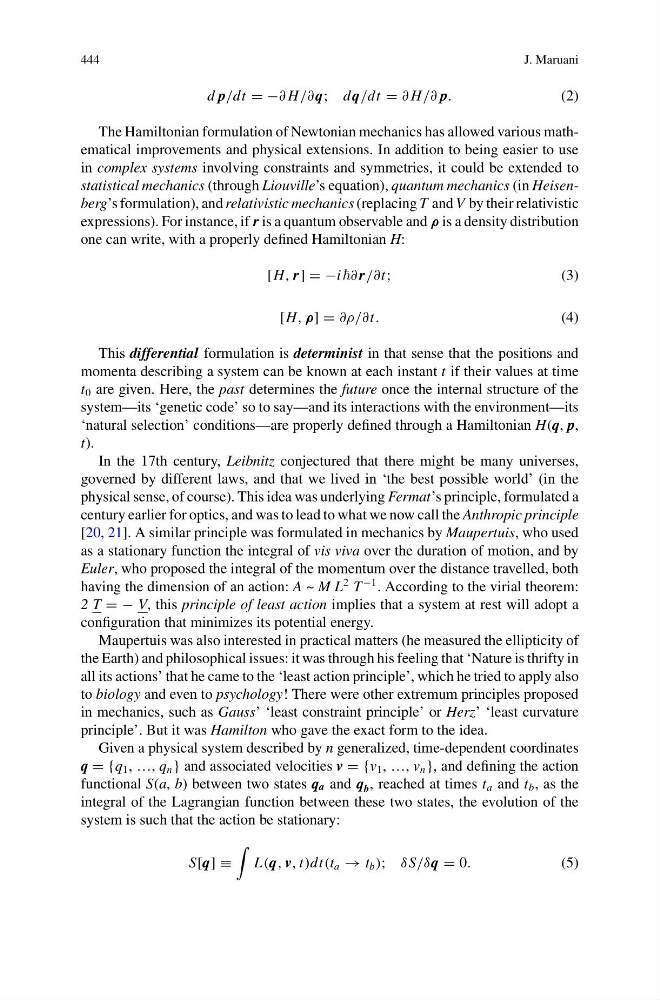
d p/dt = −∂ H/∂q; dq/dt = ∂ H/∂ p.
(2)
The Hamiltonian formulation of Newtonian mechanics has allowed various mathematical improvements and physical extensions. In addition to being easier to use
in complex systems involving constraints and symmetries, it could be extended to
statistical mechanics (through Liouville’s equation), quantum mechanics (in Heisenberg’s formulation), and relativistic mechanics (replacing T and V by their relativistic
expressions). For instance, if r is a quantum observable and ρ is a density distribution
one can write, with a properly defined Hamiltonian H:
[H, r] = −i∂ r/∂t;
(3)
[H, ρ] = ∂ρ/∂t.
(4)
This differential formulation is determinist in that sense that the positions and
momenta describing a system can be known at each instant t if their values at time
t 0 are given. Here, the past determines the future once the internal structure of the
system—its ‘genetic code’ so to say—and its interactions with the environment—its
‘natural selection’ conditions—are properly defined through a Hamiltonian H(q, p,
t).
In the 17th century, Leibnitz conjectured that there might be many universes,
governed by different laws, and that we lived in ‘the best possible world’ (in the
physical sense, of course). This idea was underlying Fermat’s principle, formulated a
century earlier for optics, and was to lead to what we now call the Anthropic principle
[20, 21]. A similar principle was formulated in mechanics by Maupertuis, who used
as a stationary function the integral of vis viva over the duration of motion, and by
Euler, who proposed the integral of the momentum over the distance travelled, both
having the dimension of an action: A ~ M L
2 T
−1 . According to the virial theorem:
2 T = − V, this principle of least action implies that a system at rest will adopt a
configuration that minimizes its potential energy.
Maupertuis was also interested in practical matters (he measured the ellipticity of
the Earth) and philosophical issues: it was through his feeling that ‘Nature is thrifty in
all its actions’ that he came to the ‘least action principle’, which he tried to apply also
to biology and even to psychology! There were other extremum principles proposed
in mechanics, such as Gauss’ ‘least constraint principle’ or Herz’ ‘least curvature
principle’. But it was Hamilton who gave the exact form to the idea.
Given a physical system described by n generalized, time-dependent coordinates
q = {q 1 , …, q n } and associated velocities v = {v 1 , …, v n }, and defining the action
functional S(a, b) between two states q a and q b , reached at times t a and t b , as the
integral of the Lagrangian function between these two states, the evolution of the
system is such that the action be stationary:
S[q] ≡
L(q, v, t)dt(t a → t b ); δS/δq = 0.
(5)
J. Maruani
d p/dt = −∂ H/∂q; dq/dt = ∂ H/∂ p.
(2)
The Hamiltonian formulation of Newtonian mechanics has allowed various mathematical improvements and physical extensions. In addition to being easier to use
in complex systems involving constraints and symmetries, it could be extended to
statistical mechanics (through Liouville’s equation), quantum mechanics (in Heisenberg’s formulation), and relativistic mechanics (replacing T and V by their relativistic
expressions). For instance, if r is a quantum observable and ρ is a density distribution
one can write, with a properly defined Hamiltonian H:
[H, r] = −i∂ r/∂t;
(3)
[H, ρ] = ∂ρ/∂t.
(4)
This differential formulation is determinist in that sense that the positions and
momenta describing a system can be known at each instant t if their values at time
t 0 are given. Here, the past determines the future once the internal structure of the
system—its ‘genetic code’ so to say—and its interactions with the environment—its
‘natural selection’ conditions—are properly defined through a Hamiltonian H(q, p,
t).
In the 17th century, Leibnitz conjectured that there might be many universes,
governed by different laws, and that we lived in ‘the best possible world’ (in the
physical sense, of course). This idea was underlying Fermat’s principle, formulated a
century earlier for optics, and was to lead to what we now call the Anthropic principle
[20, 21]. A similar principle was formulated in mechanics by Maupertuis, who used
as a stationary function the integral of vis viva over the duration of motion, and by
Euler, who proposed the integral of the momentum over the distance travelled, both
having the dimension of an action: A ~ M L
2 T
−1 . According to the virial theorem:
2 T = − V, this principle of least action implies that a system at rest will adopt a
configuration that minimizes its potential energy.
Maupertuis was also interested in practical matters (he measured the ellipticity of
the Earth) and philosophical issues: it was through his feeling that ‘Nature is thrifty in
all its actions’ that he came to the ‘least action principle’, which he tried to apply also
to biology and even to psychology! There were other extremum principles proposed
in mechanics, such as Gauss’ ‘least constraint principle’ or Herz’ ‘least curvature
principle’. But it was Hamilton who gave the exact form to the idea.
Given a physical system described by n generalized, time-dependent coordinates
q = {q 1 , …, q n } and associated velocities v = {v 1 , …, v n }, and defining the action
functional S(a, b) between two states q a and q b , reached at times t a and t b , as the
integral of the Lagrangian function between these two states, the evolution of the
system is such that the action be stationary:
S[q] ≡
L(q, v, t)dt(t a → t b ); δS/δq = 0.
(5)