

374
M. Svrˇ cek
Table 2 Microscopicmegascopic
mirrors
First quantum floor:
microscopic quantum physics
Second quantum floor:
megascopic quantum
chemistry
First complementarity
Second complementarity
Causality
Teleology
Projections
Injections
Born rule
Einselection rule
von Neumann–Wigner rule
Jung rule
‘putting-up’, first phase of the two-stage model, and Compton’s relationship between
free will and quantum indeterminism and the randomness on the first phase of the
two-stage model.
The second mirror is not apparent until we have introduced megascopic quantum
chemistry. For instance, Doyle’s concept of “adequate determinism” in his Cogito
model, attempting to explain free will only on the basis of quantum physics, cannot
be right. The physicist Compton and psychiatrist Flanagan were right in claiming that
quantum physics is insufficient for the justification of free will. Compton argued that
freedom involves an additional determining factor of choice, about which science tells
us nothing. Moreover Flanagan stated that free actions need to be caused by me, in
an undetermined and non-random manner. The combination of non-determinism and
non-randomness follows only from the megascopic einselection processes of quantum chemistry, and not from microscopic physical processes that are indeterministic
and random.
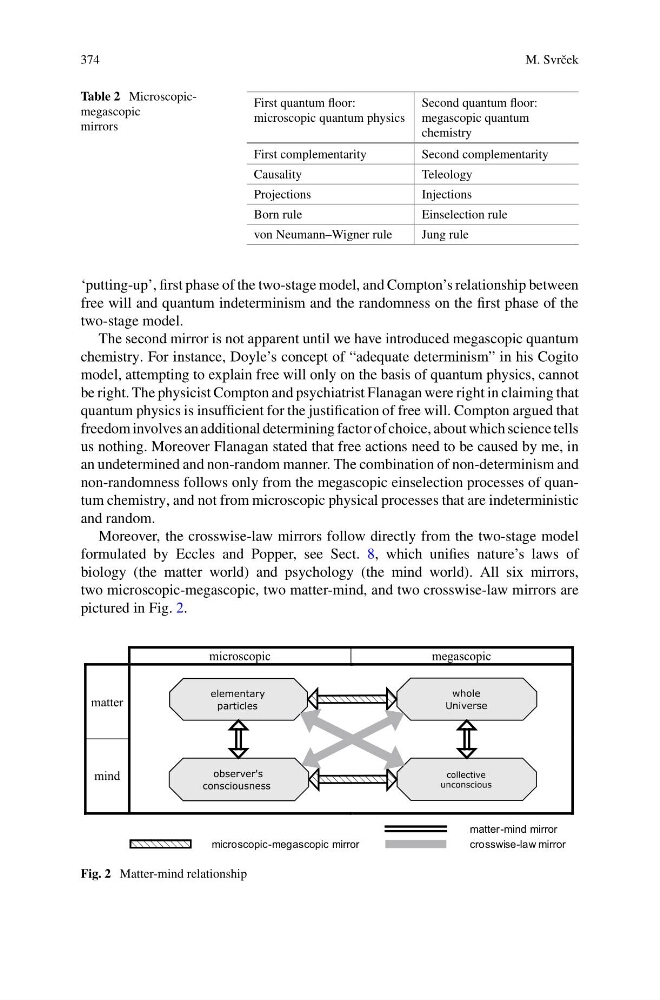
Moreover, the crosswise-law mirrors follow directly from the two-stage model
formulated by Eccles and Popper, see Sect. 8, which unifies nature’s laws of
biology (the matter world) and psychology (the mind world). All six mirrors,
two microscopic-megascopic, two matter-mind, and two crosswise-law mirrors are
pictured in Fig. 2.
microscopic
megascopic
matter
elementary
particles
whole
Universe
mind
observer’s
consciousness
collective
unconscious
elementary
particles
observer's
consciousness
whole
Universe
collective
unconscious
matter-mind mirror
microscopic-megascopic mirror
crosswise-law mirror
Fig. 2 Matter-mind relationship
M. Svrˇ cek
Table 2 Microscopicmegascopic
mirrors
First quantum floor:
microscopic quantum physics
Second quantum floor:
megascopic quantum
chemistry
First complementarity
Second complementarity
Causality
Teleology
Projections
Injections
Born rule
Einselection rule
von Neumann–Wigner rule
Jung rule
‘putting-up’, first phase of the two-stage model, and Compton’s relationship between
free will and quantum indeterminism and the randomness on the first phase of the
two-stage model.
The second mirror is not apparent until we have introduced megascopic quantum
chemistry. For instance, Doyle’s concept of “adequate determinism” in his Cogito
model, attempting to explain free will only on the basis of quantum physics, cannot
be right. The physicist Compton and psychiatrist Flanagan were right in claiming that
quantum physics is insufficient for the justification of free will. Compton argued that
freedom involves an additional determining factor of choice, about which science tells
us nothing. Moreover Flanagan stated that free actions need to be caused by me, in
an undetermined and non-random manner. The combination of non-determinism and
non-randomness follows only from the megascopic einselection processes of quantum chemistry, and not from microscopic physical processes that are indeterministic
and random.
Moreover, the crosswise-law mirrors follow directly from the two-stage model
formulated by Eccles and Popper, see Sect. 8, which unifies nature’s laws of
biology (the matter world) and psychology (the mind world). All six mirrors,
two microscopic-megascopic, two matter-mind, and two crosswise-law mirrors are
pictured in Fig. 2.
microscopic
megascopic
matter
elementary
particles
whole
Universe
mind
observer’s
consciousness
collective
unconscious
elementary
particles
observer's
consciousness
whole
Universe
collective
unconscious
matter-mind mirror
microscopic-megascopic mirror
crosswise-law mirror
Fig. 2 Matter-mind relationship