

Megascopic Quantum Phenomena
367
Table 1 Megascopic phenomena
Megascopic
phenomena
Equilibrium processes
Non-equilibrium
processes
Adiabatic systems
Non-adiabatic
systems
Microscopic level
Isomeric transitions
Jahn-Teller effect
Chemical reactions
Macroscopic level
Einstein-de Haas
effect
Superconductivity
and superfluidity
Brittle fracture
has no microscopic explanation, there are nevertheless two categories of cracks from
the microscopic perspective [152], (i) a crack that passes through the grains within
the material undergoing transgranular fracture, (ii) a crack that propagates along the
grain boundaries termed an intergranular fracture.
The most interesting fracture feature process is a ductile to brittle transition. At
low temperatures some materials that would be ductile at room temperature become
brittle. It means that at higher temperatures the fracture is of microscopic origin, but
under the critical temperature it is of megascopic origin. Compare for instance the
relation as microscopic normal conductivity under the critical temperature becomes
megascopic superconductivity. This similarity is certainly not accidental, since materials that usually fracture in a brittle manner are glasses, ceramics, and some polymers
and metals. This also explains why good superconductors are usually formed with
brittle ceramics on the verge of rupture.
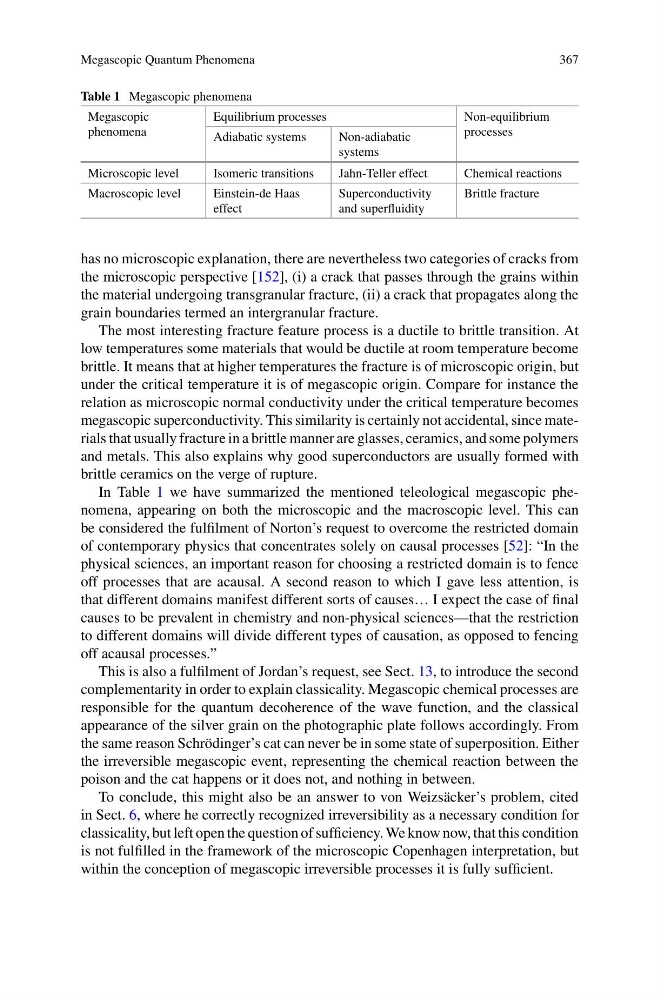
In Table 1 we have summarized the mentioned teleological megascopic phenomena, appearing on both the microscopic and the macroscopic level. This can
be considered the fulfilment of Norton’s request to overcome the restricted domain
of contemporary physics that concentrates solely on causal processes [52]: “In the
physical sciences, an important reason for choosing a restricted domain is to fence
off processes that are acausal. A second reason to which I gave less attention, is
that different domains manifest different sorts of causes… I expect the case of final
causes to be prevalent in chemistry and non-physical sciences—that the restriction
to different domains will divide different types of causation, as opposed to fencing
off acausal processes.”
This is also a fulfilment of Jordan’s request, see Sect. 13, to introduce the second
complementarity in order to explain classicality. Megascopic chemical processes are
responsible for the quantum decoherence of the wave function, and the classical
appearance of the silver grain on the photographic plate follows accordingly. From
the same reason Schrödinger’s cat can never be in some state of superposition. Either
the irreversible megascopic event, representing the chemical reaction between the
poison and the cat happens or it does not, and nothing in between.
To conclude, this might also be an answer to von Weizsäcker’s problem, cited
in Sect. 6, where he correctly recognized irreversibility as a necessary condition for
classicality, but left open the question of sufficiency. We know now, that this condition
is not fulfilled in the framework of the microscopic Copenhagen interpretation, but
within the conception of megascopic irreversible processes it is fully sufficient.
367
Table 1 Megascopic phenomena
Megascopic
phenomena
Equilibrium processes
Non-equilibrium
processes
Adiabatic systems
Non-adiabatic
systems
Microscopic level
Isomeric transitions
Jahn-Teller effect
Chemical reactions
Macroscopic level
Einstein-de Haas
effect
Superconductivity
and superfluidity
Brittle fracture
has no microscopic explanation, there are nevertheless two categories of cracks from
the microscopic perspective [152], (i) a crack that passes through the grains within
the material undergoing transgranular fracture, (ii) a crack that propagates along the
grain boundaries termed an intergranular fracture.
The most interesting fracture feature process is a ductile to brittle transition. At
low temperatures some materials that would be ductile at room temperature become
brittle. It means that at higher temperatures the fracture is of microscopic origin, but
under the critical temperature it is of megascopic origin. Compare for instance the
relation as microscopic normal conductivity under the critical temperature becomes
megascopic superconductivity. This similarity is certainly not accidental, since materials that usually fracture in a brittle manner are glasses, ceramics, and some polymers
and metals. This also explains why good superconductors are usually formed with
brittle ceramics on the verge of rupture.
In Table 1 we have summarized the mentioned teleological megascopic phenomena, appearing on both the microscopic and the macroscopic level. This can
be considered the fulfilment of Norton’s request to overcome the restricted domain
of contemporary physics that concentrates solely on causal processes [52]: “In the
physical sciences, an important reason for choosing a restricted domain is to fence
off processes that are acausal. A second reason to which I gave less attention, is
that different domains manifest different sorts of causes… I expect the case of final
causes to be prevalent in chemistry and non-physical sciences—that the restriction
to different domains will divide different types of causation, as opposed to fencing
off acausal processes.”
This is also a fulfilment of Jordan’s request, see Sect. 13, to introduce the second
complementarity in order to explain classicality. Megascopic chemical processes are
responsible for the quantum decoherence of the wave function, and the classical
appearance of the silver grain on the photographic plate follows accordingly. From
the same reason Schrödinger’s cat can never be in some state of superposition. Either
the irreversible megascopic event, representing the chemical reaction between the
poison and the cat happens or it does not, and nothing in between.
To conclude, this might also be an answer to von Weizsäcker’s problem, cited
in Sect. 6, where he correctly recognized irreversibility as a necessary condition for
classicality, but left open the question of sufficiency. We know now, that this condition
is not fulfilled in the framework of the microscopic Copenhagen interpretation, but
within the conception of megascopic irreversible processes it is fully sufficient.