

360
M. Svrˇ cek
have derived the J-T distorted ground state of superconductors, represented by
Eq. (11.52), and their excited states, Eqs. (11.54), (11.55). However, superconductivity itself, as caused by the transitions between distorted J-T states, has no microscopic
explanation. At this point microcosm does shake hands with megacosm.
Whereas Eqs. (11.52), (11.54), (11.55) are of the Bloch type, for dealing
with the transitions between the distorted J-T states, the Fourier mirror of the Bloch
functions—the Wannier functions—is more transparent. From the Bloch functions
ψ k (r) = exp(ikr)u k (r)
(14.7)
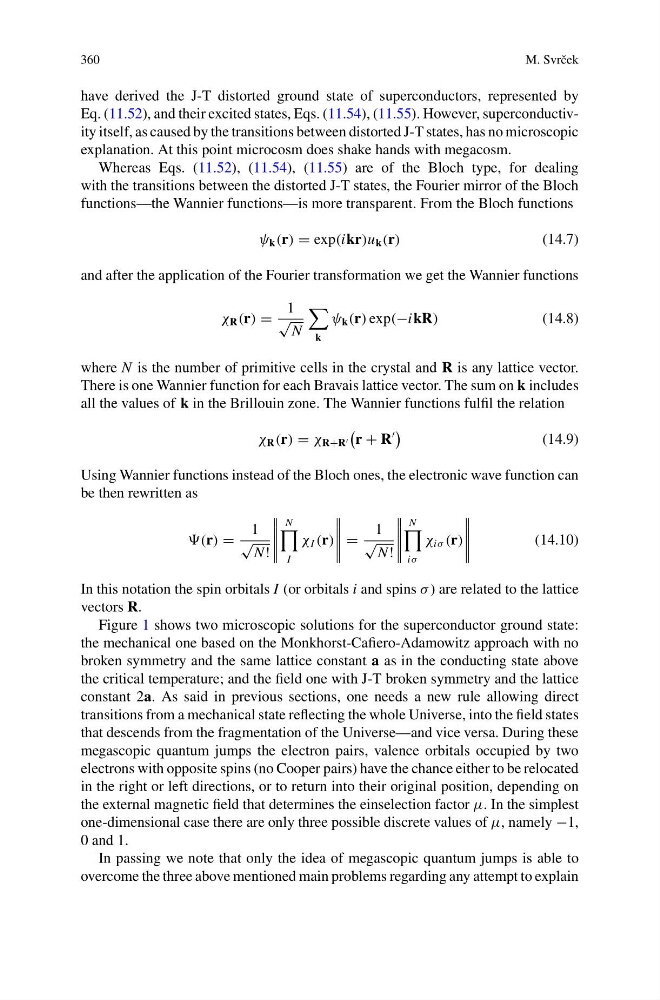
and after the application of the Fourier transformation we get the Wannier functions
χ R (r) =
1
√
N
k
ψ k (r) exp(−ikR)
(14.8)
where N is the number of primitive cells in the crystal and R is any lattice vector.
There is one Wannier function for each Bravais lattice vector. The sum on k includes
all the values of k in the Brillouin zone. The Wannier functions fulfil the relation
χ R (r) = χ R+R
r + R
(14.9)
Using Wannier functions instead of the Bloch ones, the electronic wave function can
be then rewritten as
(r) =
1
√
N !
N
I
χ I (r)
=
1
√
N !
N
iσ
χ iσ (r)
(14.10)
In this notation the spin orbitals I (or orbitals i and spins σ ) are related to the lattice
vectors R.
Figure 1 shows two microscopic solutions for the superconductor ground state:
the mechanical one based on the Monkhorst-Cafiero-Adamowitz approach with no
broken symmetry and the same lattice constant a as in the conducting state above
the critical temperature; and the field one with J-T broken symmetry and the lattice
constant 2a. As said in previous sections, one needs a new rule allowing direct
transitions from a mechanical state reflecting the whole Universe, into the field states
that descends from the fragmentation of the Universe—and vice versa. During these
megascopic quantum jumps the electron pairs, valence orbitals occupied by two
electrons with opposite spins (no Cooper pairs) have the chance either to be relocated
in the right or left directions, or to return into their original position, depending on
the external magnetic field that determines the einselection factor μ. In the simplest
one-dimensional case there are only three possible discrete values of μ, namely −1,
0 and 1.
In passing we note that only the idea of megascopic quantum jumps is able to
overcome the three above mentioned main problems regarding any attempt to explain
M. Svrˇ cek
have derived the J-T distorted ground state of superconductors, represented by
Eq. (11.52), and their excited states, Eqs. (11.54), (11.55). However, superconductivity itself, as caused by the transitions between distorted J-T states, has no microscopic
explanation. At this point microcosm does shake hands with megacosm.
Whereas Eqs. (11.52), (11.54), (11.55) are of the Bloch type, for dealing
with the transitions between the distorted J-T states, the Fourier mirror of the Bloch
functions—the Wannier functions—is more transparent. From the Bloch functions
ψ k (r) = exp(ikr)u k (r)
(14.7)
and after the application of the Fourier transformation we get the Wannier functions
χ R (r) =
1
√
N
k
ψ k (r) exp(−ikR)
(14.8)
where N is the number of primitive cells in the crystal and R is any lattice vector.
There is one Wannier function for each Bravais lattice vector. The sum on k includes
all the values of k in the Brillouin zone. The Wannier functions fulfil the relation
χ R (r) = χ R+R
r + R
(14.9)
Using Wannier functions instead of the Bloch ones, the electronic wave function can
be then rewritten as
(r) =
1
√
N !
N
I
χ I (r)
=
1
√
N !
N
iσ
χ iσ (r)
(14.10)
In this notation the spin orbitals I (or orbitals i and spins σ ) are related to the lattice
vectors R.
Figure 1 shows two microscopic solutions for the superconductor ground state:
the mechanical one based on the Monkhorst-Cafiero-Adamowitz approach with no
broken symmetry and the same lattice constant a as in the conducting state above
the critical temperature; and the field one with J-T broken symmetry and the lattice
constant 2a. As said in previous sections, one needs a new rule allowing direct
transitions from a mechanical state reflecting the whole Universe, into the field states
that descends from the fragmentation of the Universe—and vice versa. During these
megascopic quantum jumps the electron pairs, valence orbitals occupied by two
electrons with opposite spins (no Cooper pairs) have the chance either to be relocated
in the right or left directions, or to return into their original position, depending on
the external magnetic field that determines the einselection factor μ. In the simplest
one-dimensional case there are only three possible discrete values of μ, namely −1,
0 and 1.
In passing we note that only the idea of megascopic quantum jumps is able to
overcome the three above mentioned main problems regarding any attempt to explain