

330
M. Svrˇ cek
E 0(ad) =
AIrsiα
2
2M i
c
r
AI c
s
∗
AI β
r
∗
iα β
s
ia
(11.25)
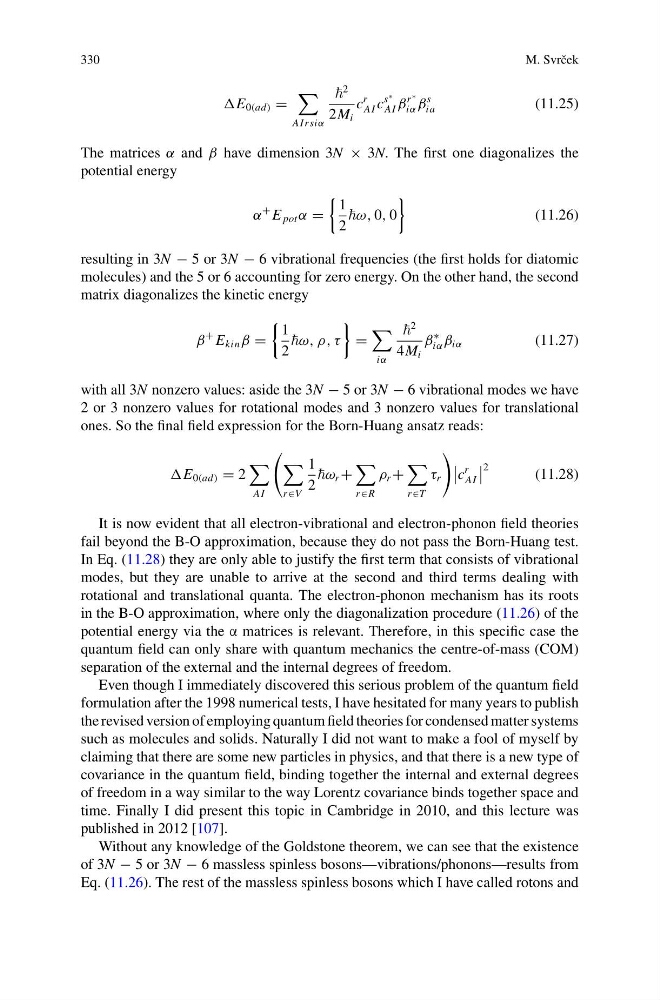
The matrices α and β have dimension 3N × 3N. The first one diagonalizes the
potential energy
α
+ E pot α =
1
2
ω, 0, 0
(11.26)
resulting in 3N − 5 or 3N − 6 vibrational frequencies (the first holds for diatomic
molecules) and the 5 or 6 accounting for zero energy. On the other hand, the second
matrix diagonalizes the kinetic energy
β
+ E kin β =
1
2
ω, ρ, τ
=
iα
2
4M i
β
∗
iα β iα
(11.27)
with all 3N nonzero values: aside the 3N − 5 or 3N − 6 vibrational modes we have
2 or 3 nonzero values for rotational modes and 3 nonzero values for translational
ones. So the final field expression for the Born-Huang ansatz reads:
E 0(ad) = 2
AI
r ∈V
1
2
ω r +
r ∈R
ρ r +
r ∈T
τ r
c
r
AI
2
(11.28)
It is now evident that all electron-vibrational and electron-phonon field theories
fail beyond the B-O approximation, because they do not pass the Born-Huang test.
In Eq. (11.28) they are only able to justify the first term that consists of vibrational
modes, but they are unable to arrive at the second and third terms dealing with
rotational and translational quanta. The electron-phonon mechanism has its roots
in the B-O approximation, where only the diagonalization procedure (11.26) of the
potential energy via the α matrices is relevant. Therefore, in this specific case the
quantum field can only share with quantum mechanics the centre-of-mass (COM)
separation of the external and the internal degrees of freedom.
Even though I immediately discovered this serious problem of the quantum field
formulation after the 1998 numerical tests, I have hesitated for many years to publish
the revised version of employing quantum field theories for condensed matter systems
such as molecules and solids. Naturally I did not want to make a fool of myself by
claiming that there are some new particles in physics, and that there is a new type of
covariance in the quantum field, binding together the internal and external degrees
of freedom in a way similar to the way Lorentz covariance binds together space and
time. Finally I did present this topic in Cambridge in 2010, and this lecture was
published in 2012 [107].
Without any knowledge of the Goldstone theorem, we can see that the existence
of 3N − 5 or 3N − 6 massless spinless bosons—vibrations/phonons—results from
Eq. (11.26). The rest of the massless spinless bosons which I have called rotons and
M. Svrˇ cek
E 0(ad) =
AIrsiα
2
2M i
c
r
AI c
s
∗
AI β
r
∗
iα β
s
ia
(11.25)
The matrices α and β have dimension 3N × 3N. The first one diagonalizes the
potential energy
α
+ E pot α =
1
2
ω, 0, 0
(11.26)
resulting in 3N − 5 or 3N − 6 vibrational frequencies (the first holds for diatomic
molecules) and the 5 or 6 accounting for zero energy. On the other hand, the second
matrix diagonalizes the kinetic energy
β
+ E kin β =
1
2
ω, ρ, τ
=
iα
2
4M i
β
∗
iα β iα
(11.27)
with all 3N nonzero values: aside the 3N − 5 or 3N − 6 vibrational modes we have
2 or 3 nonzero values for rotational modes and 3 nonzero values for translational
ones. So the final field expression for the Born-Huang ansatz reads:
E 0(ad) = 2
AI
r ∈V
1
2
ω r +
r ∈R
ρ r +
r ∈T
τ r
c
r
AI
2
(11.28)
It is now evident that all electron-vibrational and electron-phonon field theories
fail beyond the B-O approximation, because they do not pass the Born-Huang test.
In Eq. (11.28) they are only able to justify the first term that consists of vibrational
modes, but they are unable to arrive at the second and third terms dealing with
rotational and translational quanta. The electron-phonon mechanism has its roots
in the B-O approximation, where only the diagonalization procedure (11.26) of the
potential energy via the α matrices is relevant. Therefore, in this specific case the
quantum field can only share with quantum mechanics the centre-of-mass (COM)
separation of the external and the internal degrees of freedom.
Even though I immediately discovered this serious problem of the quantum field
formulation after the 1998 numerical tests, I have hesitated for many years to publish
the revised version of employing quantum field theories for condensed matter systems
such as molecules and solids. Naturally I did not want to make a fool of myself by
claiming that there are some new particles in physics, and that there is a new type of
covariance in the quantum field, binding together the internal and external degrees
of freedom in a way similar to the way Lorentz covariance binds together space and
time. Finally I did present this topic in Cambridge in 2010, and this lecture was
published in 2012 [107].
Without any knowledge of the Goldstone theorem, we can see that the existence
of 3N − 5 or 3N − 6 massless spinless bosons—vibrations/phonons—results from
Eq. (11.26). The rest of the massless spinless bosons which I have called rotons and