

310
M. Svrˇ cek
where e is the electron charge, n the density of superconducting carriers and v the
superfluid velocity, and further using Newton law for the carriers with mass m, they
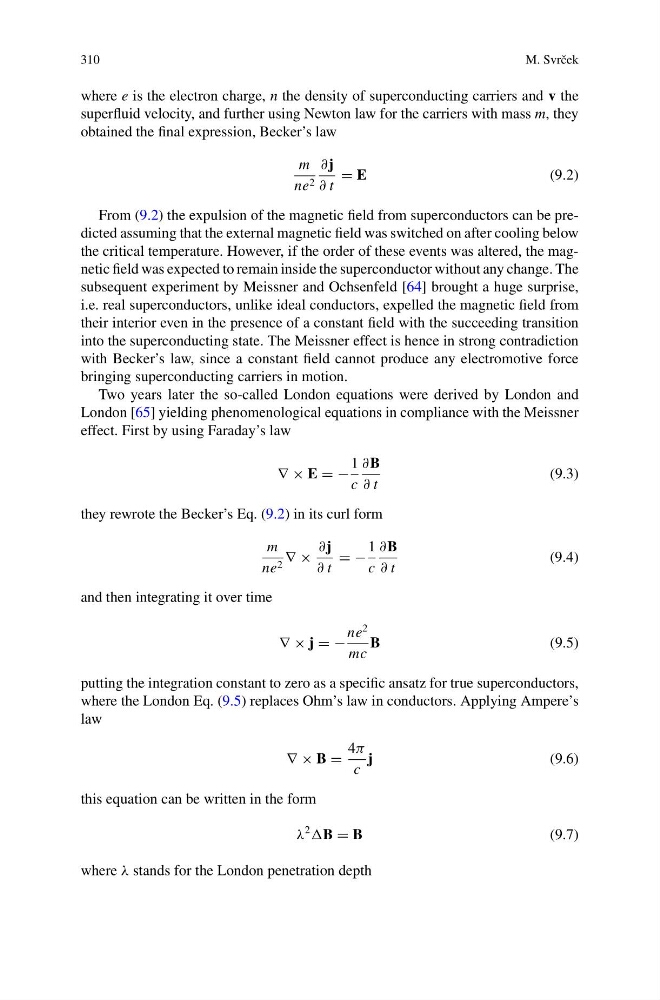
obtained the final expression, Becker’s law
m
ne 2
∂j
∂ t
= E
(9.2)
From (9.2) the expulsion of the magnetic field from superconductors can be predicted assuming that the external magnetic field was switched on after cooling below
the critical temperature. However, if the order of these events was altered, the magnetic field was expected to remain inside the superconductor without any change. The
subsequent experiment by Meissner and Ochsenfeld [64] brought a huge surprise,
i.e. real superconductors, unlike ideal conductors, expelled the magnetic field from
their interior even in the presence of a constant field with the succeeding transition
into the superconducting state. The Meissner effect is hence in strong contradiction
with Becker’s law, since a constant field cannot produce any electromotive force
bringing superconducting carriers in motion.
Two years later the so-called London equations were derived by London and
London [65] yielding phenomenological equations in compliance with the Meissner
effect. First by using Faraday’s law
∇ × E = −
1
c
∂B
∂ t
(9.3)
they rewrote the Becker’s Eq. (9.2) in its curl form
m
ne 2 ∇ ×
∂j
∂ t
= −
1
c
∂B
∂ t
(9.4)
and then integrating it over time
∇ × j = −
ne
2
mc
B
(9.5)
putting the integration constant to zero as a specific ansatz for true superconductors,
where the London Eq. (9.5) replaces Ohm’s law in conductors. Applying Ampere’s
law
∇ × B =
4π
c
j
(9.6)
this equation can be written in the form
λ
2
B = B
(9.7)
where λ stands for the London penetration depth
M. Svrˇ cek
where e is the electron charge, n the density of superconducting carriers and v the
superfluid velocity, and further using Newton law for the carriers with mass m, they
obtained the final expression, Becker’s law
m
ne 2
∂j
∂ t
= E
(9.2)
From (9.2) the expulsion of the magnetic field from superconductors can be predicted assuming that the external magnetic field was switched on after cooling below
the critical temperature. However, if the order of these events was altered, the magnetic field was expected to remain inside the superconductor without any change. The
subsequent experiment by Meissner and Ochsenfeld [64] brought a huge surprise,
i.e. real superconductors, unlike ideal conductors, expelled the magnetic field from
their interior even in the presence of a constant field with the succeeding transition
into the superconducting state. The Meissner effect is hence in strong contradiction
with Becker’s law, since a constant field cannot produce any electromotive force
bringing superconducting carriers in motion.
Two years later the so-called London equations were derived by London and
London [65] yielding phenomenological equations in compliance with the Meissner
effect. First by using Faraday’s law
∇ × E = −
1
c
∂B
∂ t
(9.3)
they rewrote the Becker’s Eq. (9.2) in its curl form
m
ne 2 ∇ ×
∂j
∂ t
= −
1
c
∂B
∂ t
(9.4)
and then integrating it over time
∇ × j = −
ne
2
mc
B
(9.5)
putting the integration constant to zero as a specific ansatz for true superconductors,
where the London Eq. (9.5) replaces Ohm’s law in conductors. Applying Ampere’s
law
∇ × B =
4π
c
j
(9.6)
this equation can be written in the form
λ
2
B = B
(9.7)
where λ stands for the London penetration depth