

Efficient “Middle” Thermostat Scheme …
267
ˆ
B
= lim
P→∞
P
j=1
dξ j dp j
exp
−β H eff
ξ 1 , . . . , ξ P ; p 1 , . . . , p P
˜
B(x 1 , . . . , x P )
P
j=1
dξ j dp j
exp
−β H eff
ξ 1 , . . . , ξ P ; p 1 , . . . , p P
.
(34)
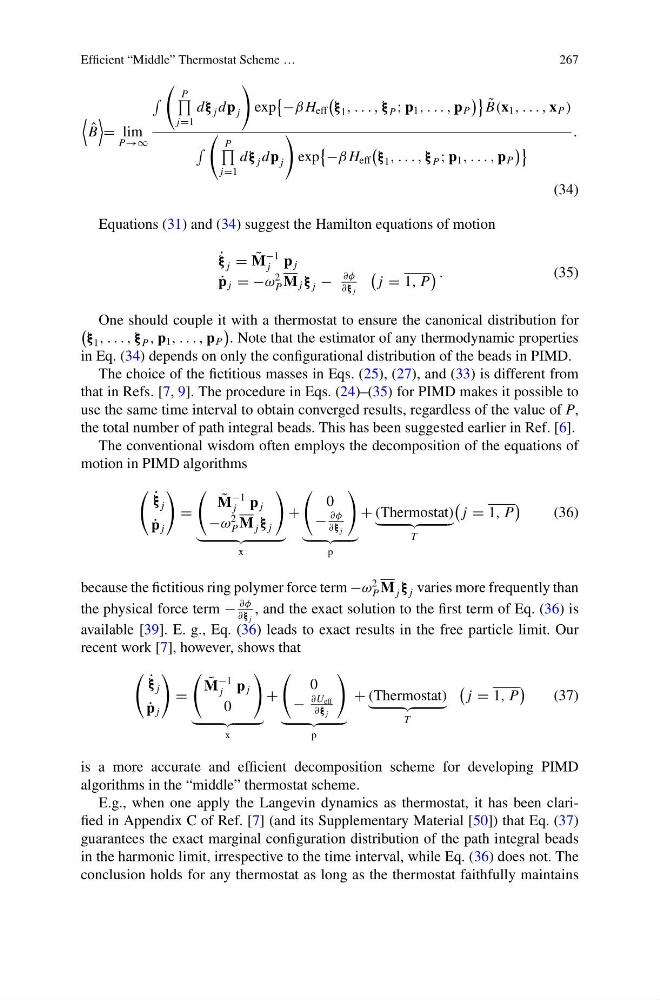
Equations (31) and (34) suggest the Hamilton equations of motion
˙
ξ j = ˜
M
−1
j p j
˙
p j = −ω
2
P M j ξ j −
∂φ
∂ξ j
j = 1, P
.
(35)
One should couple it with a thermostat to ensure the canonical distribution for
ξ 1 , . . . , ξ P , p 1 , . . . , p P
. Note that the estimator of any thermodynamic properties
in Eq. (34) depends on only the configurational distribution of the beads in PIMD.
The choice of the fictitious masses in Eqs. (25), (27), and (33) is different from
that in Refs. [7, 9]. The procedure in Eqs. (24)–(35) for PIMD makes it possible to
use the same time interval to obtain converged results, regardless of the value of P,
the total number of path integral beads. This has been suggested earlier in Ref. [6].
The conventional wisdom often employs the decomposition of the equations of
motion in PIMD algorithms
˙
ξ j
˙
p j
=
˜
M
−1
j p j
−ω
2
P M j ξ j
x
+
0
−
∂φ
∂ξ j
p
+ (Thermostat)
T
j = 1, P
(36)
because the fictitious ring polymer force term −ω
2
P M j ξ j varies more frequently than
the physical force term −
∂φ
∂ξ j
, and the exact solution to the first term of Eq. (36) is
available [39]. E. g., Eq. (36) leads to exact results in the free particle limit. Our
recent work [7], however, shows that
˙
ξ j
˙
p j
=
˜
M
−1
j p j
0
x
+
0
−
∂U eff
∂ξ j
p
+ (Thermostat)
T
j = 1, P
(37)
is a more accurate and efficient decomposition scheme for developing PIMD
algorithms in the “middle” thermostat scheme.
E.g., when one apply the Langevin dynamics as thermostat, it has been clarified in Appendix C of Ref. [7] (and its Supplementary Material [50]) that Eq. (37)
guarantees the exact marginal configuration distribution of the path integral beads
in the harmonic limit, irrespective to the time interval, while Eq. (36) does not. The
conclusion holds for any thermostat as long as the thermostat faithfully maintains
267
ˆ
B
= lim
P→∞
P
j=1
dξ j dp j
exp
−β H eff
ξ 1 , . . . , ξ P ; p 1 , . . . , p P
˜
B(x 1 , . . . , x P )
P
j=1
dξ j dp j
exp
−β H eff
ξ 1 , . . . , ξ P ; p 1 , . . . , p P
.
(34)
Equations (31) and (34) suggest the Hamilton equations of motion
˙
ξ j = ˜
M
−1
j p j
˙
p j = −ω
2
P M j ξ j −
∂φ
∂ξ j
j = 1, P
.
(35)
One should couple it with a thermostat to ensure the canonical distribution for
ξ 1 , . . . , ξ P , p 1 , . . . , p P
. Note that the estimator of any thermodynamic properties
in Eq. (34) depends on only the configurational distribution of the beads in PIMD.
The choice of the fictitious masses in Eqs. (25), (27), and (33) is different from
that in Refs. [7, 9]. The procedure in Eqs. (24)–(35) for PIMD makes it possible to
use the same time interval to obtain converged results, regardless of the value of P,
the total number of path integral beads. This has been suggested earlier in Ref. [6].
The conventional wisdom often employs the decomposition of the equations of
motion in PIMD algorithms
˙
ξ j
˙
p j
=
˜
M
−1
j p j
−ω
2
P M j ξ j
x
+
0
−
∂φ
∂ξ j
p
+ (Thermostat)
T
j = 1, P
(36)
because the fictitious ring polymer force term −ω
2
P M j ξ j varies more frequently than
the physical force term −
∂φ
∂ξ j
, and the exact solution to the first term of Eq. (36) is
available [39]. E. g., Eq. (36) leads to exact results in the free particle limit. Our
recent work [7], however, shows that
˙
ξ j
˙
p j
=
˜
M
−1
j p j
0
x
+
0
−
∂U eff
∂ξ j
p
+ (Thermostat)
T
j = 1, P
(37)
is a more accurate and efficient decomposition scheme for developing PIMD
algorithms in the “middle” thermostat scheme.
E.g., when one apply the Langevin dynamics as thermostat, it has been clarified in Appendix C of Ref. [7] (and its Supplementary Material [50]) that Eq. (37)
guarantees the exact marginal configuration distribution of the path integral beads
in the harmonic limit, irrespective to the time interval, while Eq. (36) does not. The
conclusion holds for any thermostat as long as the thermostat faithfully maintains