

238
V. Poltev et al.
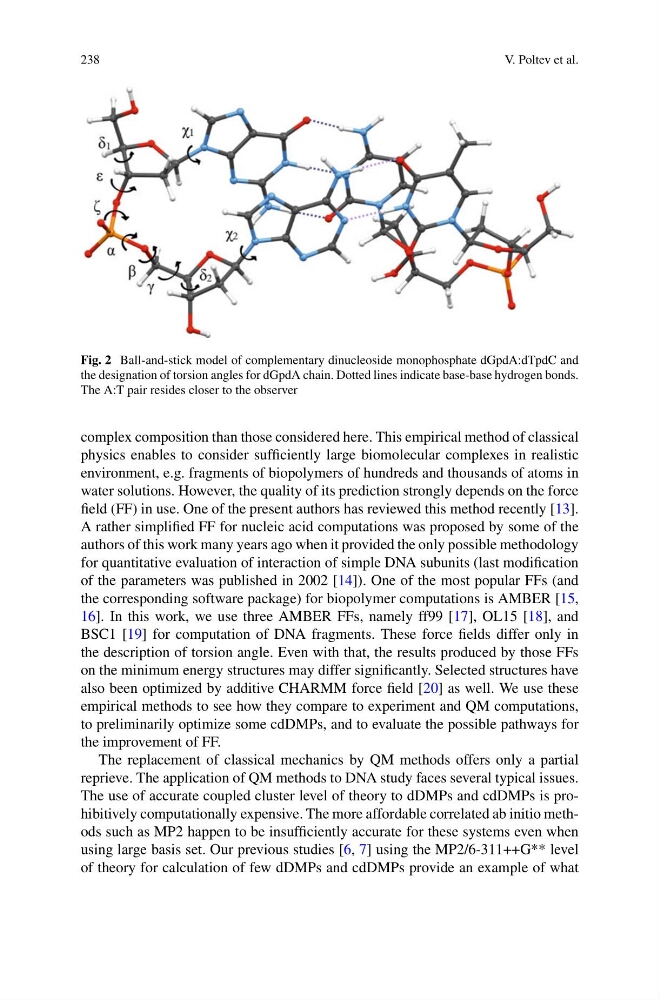
Fig. 2 Ball-and-stick model of complementary dinucleoside monophosphate dGpdA:dTpdC and
the designation of torsion angles for dGpdA chain. Dotted lines indicate base-base hydrogen bonds.
The A:T pair resides closer to the observer
complex composition than those considered here. This empirical method of classical
physics enables to consider sufficiently large biomolecular complexes in realistic
environment, e.g. fragments of biopolymers of hundreds and thousands of atoms in
water solutions. However, the quality of its prediction strongly depends on the force
field (FF) in use. One of the present authors has reviewed this method recently [13].
A rather simplified FF for nucleic acid computations was proposed by some of the
authors of this work many years ago when it provided the only possible methodology
for quantitative evaluation of interaction of simple DNA subunits (last modification
of the parameters was published in 2002 [14]). One of the most popular FFs (and
the corresponding software package) for biopolymer computations is AMBER [15,
16]. In this work, we use three AMBER FFs, namely ff99 [17], OL15 [18], and
BSC1 [19] for computation of DNA fragments. These force fields differ only in
the description of torsion angle. Even with that, the results produced by those FFs
on the minimum energy structures may differ significantly. Selected structures have
also been optimized by additive CHARMM force field [20] as well. We use these
empirical methods to see how they compare to experiment and QM computations,
to preliminarily optimize some cdDMPs, and to evaluate the possible pathways for
the improvement of FF.
The replacement of classical mechanics by QM methods offers only a partial
reprieve. The application of QM methods to DNA study faces several typical issues.
The use of accurate coupled cluster level of theory to dDMPs and cdDMPs is prohibitively computationally expensive. The more affordable correlated ab initio methods such as MP2 happen to be insufficiently accurate for these systems even when
using large basis set. Our previous studies [6, 7] using the MP2/6-311++G** level
of theory for calculation of few dDMPs and cdDMPs provide an example of what
V. Poltev et al.
Fig. 2 Ball-and-stick model of complementary dinucleoside monophosphate dGpdA:dTpdC and
the designation of torsion angles for dGpdA chain. Dotted lines indicate base-base hydrogen bonds.
The A:T pair resides closer to the observer
complex composition than those considered here. This empirical method of classical
physics enables to consider sufficiently large biomolecular complexes in realistic
environment, e.g. fragments of biopolymers of hundreds and thousands of atoms in
water solutions. However, the quality of its prediction strongly depends on the force
field (FF) in use. One of the present authors has reviewed this method recently [13].
A rather simplified FF for nucleic acid computations was proposed by some of the
authors of this work many years ago when it provided the only possible methodology
for quantitative evaluation of interaction of simple DNA subunits (last modification
of the parameters was published in 2002 [14]). One of the most popular FFs (and
the corresponding software package) for biopolymer computations is AMBER [15,
16]. In this work, we use three AMBER FFs, namely ff99 [17], OL15 [18], and
BSC1 [19] for computation of DNA fragments. These force fields differ only in
the description of torsion angle. Even with that, the results produced by those FFs
on the minimum energy structures may differ significantly. Selected structures have
also been optimized by additive CHARMM force field [20] as well. We use these
empirical methods to see how they compare to experiment and QM computations,
to preliminarily optimize some cdDMPs, and to evaluate the possible pathways for
the improvement of FF.
The replacement of classical mechanics by QM methods offers only a partial
reprieve. The application of QM methods to DNA study faces several typical issues.
The use of accurate coupled cluster level of theory to dDMPs and cdDMPs is prohibitively computationally expensive. The more affordable correlated ab initio methods such as MP2 happen to be insufficiently accurate for these systems even when
using large basis set. Our previous studies [6, 7] using the MP2/6-311++G** level
of theory for calculation of few dDMPs and cdDMPs provide an example of what