

Ab Initio and DFT Computational Study …
217
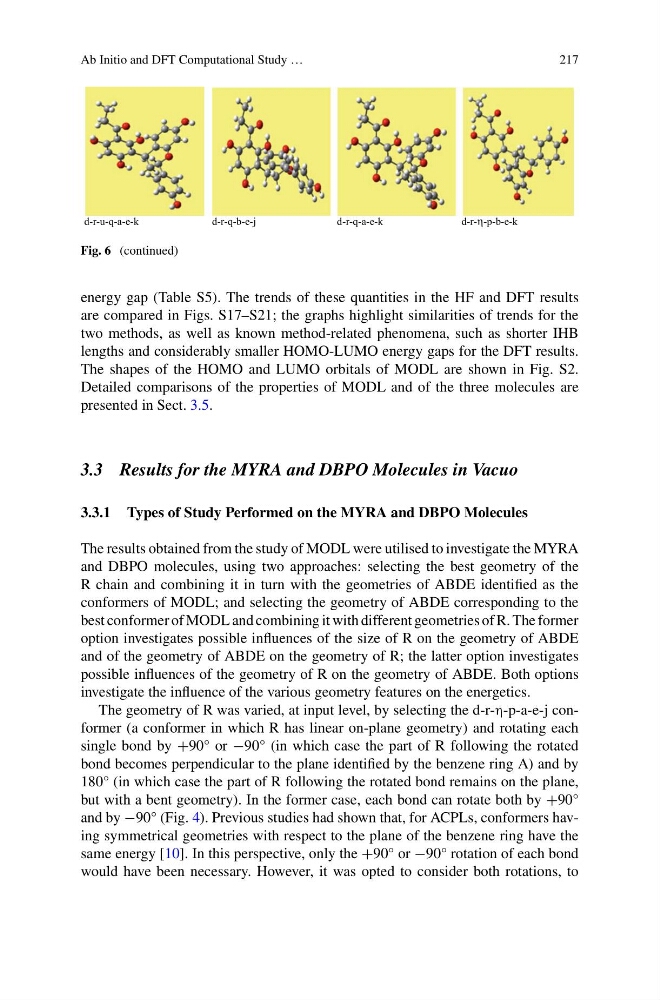
d-r-u-q-a-e-k
d-r-q-b-e-j
d-r-q-a-e-k
d-r-η-p-b-e-k
Fig. 6 (continued)
energy gap (Table S5). The trends of these quantities in the HF and DFT results
are compared in Figs. S17–S21; the graphs highlight similarities of trends for the
two methods, as well as known method-related phenomena, such as shorter IHB
lengths and considerably smaller HOMO-LUMO energy gaps for the DFT results.
The shapes of the HOMO and LUMO orbitals of MODL are shown in Fig. S2.
Detailed comparisons of the properties of MODL and of the three molecules are
presented in Sect. 3.5.
3.3 Results for the MYRA and DBPO Molecules in Vacuo
3.3.1 Types of Study Performed on the MYRA and DBPO Molecules
The results obtained from the study of MODL were utilised to investigate the MYRA
and DBPO molecules, using two approaches: selecting the best geometry of the
R chain and combining it in turn with the geometries of ABDE identified as the
conformers of MODL; and selecting the geometry of ABDE corresponding to the
best conformer of MODL and combining it with different geometries of R. The former
option investigates possible influences of the size of R on the geometry of ABDE
and of the geometry of ABDE on the geometry of R; the latter option investigates
possible influences of the geometry of R on the geometry of ABDE. Both options
investigate the influence of the various geometry features on the energetics.
The geometry of R was varied, at input level, by selecting the d-r-η-p-a-e-j conformer (a conformer in which R has linear on-plane geometry) and rotating each
single bond by +90° or −90° (in which case the part of R following the rotated
bond becomes perpendicular to the plane identified by the benzene ring A) and by
180° (in which case the part of R following the rotated bond remains on the plane,
but with a bent geometry). In the former case, each bond can rotate both by +90°
and by −90° (Fig. 4). Previous studies had shown that, for ACPLs, conformers having symmetrical geometries with respect to the plane of the benzene ring have the
same energy [10]. In this perspective, only the +90° or −90° rotation of each bond
would have been necessary. However, it was opted to consider both rotations, to
217
d-r-u-q-a-e-k
d-r-q-b-e-j
d-r-q-a-e-k
d-r-η-p-b-e-k
Fig. 6 (continued)
energy gap (Table S5). The trends of these quantities in the HF and DFT results
are compared in Figs. S17–S21; the graphs highlight similarities of trends for the
two methods, as well as known method-related phenomena, such as shorter IHB
lengths and considerably smaller HOMO-LUMO energy gaps for the DFT results.
The shapes of the HOMO and LUMO orbitals of MODL are shown in Fig. S2.
Detailed comparisons of the properties of MODL and of the three molecules are
presented in Sect. 3.5.
3.3 Results for the MYRA and DBPO Molecules in Vacuo
3.3.1 Types of Study Performed on the MYRA and DBPO Molecules
The results obtained from the study of MODL were utilised to investigate the MYRA
and DBPO molecules, using two approaches: selecting the best geometry of the
R chain and combining it in turn with the geometries of ABDE identified as the
conformers of MODL; and selecting the geometry of ABDE corresponding to the
best conformer of MODL and combining it with different geometries of R. The former
option investigates possible influences of the size of R on the geometry of ABDE
and of the geometry of ABDE on the geometry of R; the latter option investigates
possible influences of the geometry of R on the geometry of ABDE. Both options
investigate the influence of the various geometry features on the energetics.
The geometry of R was varied, at input level, by selecting the d-r-η-p-a-e-j conformer (a conformer in which R has linear on-plane geometry) and rotating each
single bond by +90° or −90° (in which case the part of R following the rotated
bond becomes perpendicular to the plane identified by the benzene ring A) and by
180° (in which case the part of R following the rotated bond remains on the plane,
but with a bent geometry). In the former case, each bond can rotate both by +90°
and by −90° (Fig. 4). Previous studies had shown that, for ACPLs, conformers having symmetrical geometries with respect to the plane of the benzene ring have the
same energy [10]. In this perspective, only the +90° or −90° rotation of each bond
would have been necessary. However, it was opted to consider both rotations, to