

198
M. K. Bilonda and L. Mammino
Table 10 Solvent effect (free energy of solvation, G solv ) of the calculated conformers of
shuangancistrotectorine A in the three solvents considered Results from HF/6-31G(d,p) single
point PCM calculations on the in-vacuo-optimized geometries
Conformers
G solv (kcal/mol)
Conformers
G solv (kcal/mol)
chlrf
actn
aq
chlrf
actn
aq
1-a-b-g-h-i-u-q-v-x 11.79 23.39
1.35 9-a-d-g-h-i-u-q-v-x
12.07 23.90
0.56
2-a-b-g-h-i-u-q-t-y 12.18 23.68
1.23 10-a-d-g-h-i-u-q-t-x 11.59 23.14 −0.43
3-a-b-g-h-i-u-p-v-y 13.29 25.58
2.73 11-b-c-g-h-i-u-q-t-x 11.69 22.90 −0.65
4-a-b-g-h-i-u-q-t-x 11.23 22.74 −0.07 12-b-c-g-h-i-u-q-t-y 12.13 24.01
1.34
5-b-c-g-h-i-u-p-v-y 12.16 24.07
1.03 13-c-d-g-h-i-u-p-v-y 14.59 26.64
3.53
6-a-d-g-h-i-u-q-t-y 12.16 24.07
1.03 14-c-d-g-h-i-u-q-t-x 11.80 23.42 −0.17
7-a-d-g-h-i-u-p-v-y 13.34 25.25
2.24 15-c-d-g-h-i-u-q-v-x 12.63 24.74
1.52
8-b-c-g-h-i-u-q-v-x 11.91 23.41
0.38 16-c-d-g-h-i-u-q-t-y 12.90 25.09
2.29
solution suggest that the four lower-energy conformers might all be considered as
potential responsibles for the antimalarial activity of SHA.
An approximate evaluation [39] of the octanol/water partition coefficient of SHA
yields 6.49452, which suggests preference for non-polar solvents. The size of the
molecule and the presence of multiple aromatic moieties also suggest poor solubility
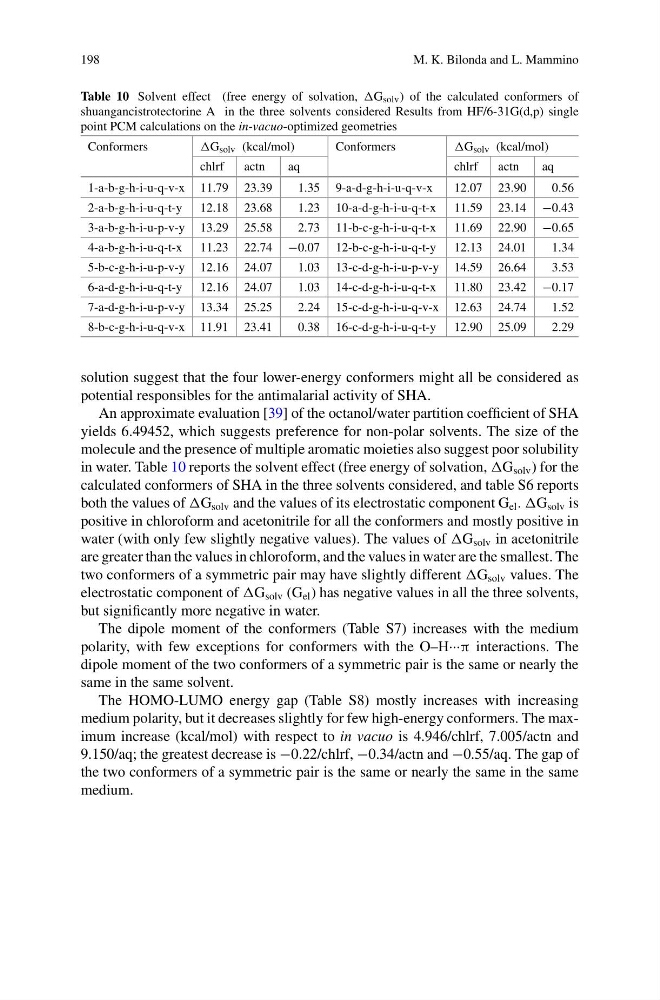
in water. Table 10 reports the solvent effect (free energy of solvation, G solv ) for the
calculated conformers of SHA in the three solvents considered, and table S6 reports
both the values of G solv and the values of its electrostatic component G el . G solv is
positive in chloroform and acetonitrile for all the conformers and mostly positive in
water (with only few slightly negative values). The values of G solv in acetonitrile
are greater than the values in chloroform, and the values in water are the smallest. The
two conformers of a symmetric pair may have slightly different G solv values. The
electrostatic component of G solv (G el ) has negative values in all the three solvents,
but significantly more negative in water.
The dipole moment of the conformers (Table S7) increases with the medium
polarity, with few exceptions for conformers with the O–H···π interactions. The
dipole moment of the two conformers of a symmetric pair is the same or nearly the
same in the same solvent.
The HOMO-LUMO energy gap (Table S8) mostly increases with increasing
medium polarity, but it decreases slightly for few high-energy conformers. The maximum increase (kcal/mol) with respect to in vacuo is 4.946/chlrf, 7.005/actn and
9.150/aq; the greatest decrease is −0.22/chlrf, −0.34/actn and −0.55/aq. The gap of
the two conformers of a symmetric pair is the same or nearly the same in the same
medium.
M. K. Bilonda and L. Mammino
Table 10 Solvent effect (free energy of solvation, G solv ) of the calculated conformers of
shuangancistrotectorine A in the three solvents considered Results from HF/6-31G(d,p) single
point PCM calculations on the in-vacuo-optimized geometries
Conformers
G solv (kcal/mol)
Conformers
G solv (kcal/mol)
chlrf
actn
aq
chlrf
actn
aq
1-a-b-g-h-i-u-q-v-x 11.79 23.39
1.35 9-a-d-g-h-i-u-q-v-x
12.07 23.90
0.56
2-a-b-g-h-i-u-q-t-y 12.18 23.68
1.23 10-a-d-g-h-i-u-q-t-x 11.59 23.14 −0.43
3-a-b-g-h-i-u-p-v-y 13.29 25.58
2.73 11-b-c-g-h-i-u-q-t-x 11.69 22.90 −0.65
4-a-b-g-h-i-u-q-t-x 11.23 22.74 −0.07 12-b-c-g-h-i-u-q-t-y 12.13 24.01
1.34
5-b-c-g-h-i-u-p-v-y 12.16 24.07
1.03 13-c-d-g-h-i-u-p-v-y 14.59 26.64
3.53
6-a-d-g-h-i-u-q-t-y 12.16 24.07
1.03 14-c-d-g-h-i-u-q-t-x 11.80 23.42 −0.17
7-a-d-g-h-i-u-p-v-y 13.34 25.25
2.24 15-c-d-g-h-i-u-q-v-x 12.63 24.74
1.52
8-b-c-g-h-i-u-q-v-x 11.91 23.41
0.38 16-c-d-g-h-i-u-q-t-y 12.90 25.09
2.29
solution suggest that the four lower-energy conformers might all be considered as
potential responsibles for the antimalarial activity of SHA.
An approximate evaluation [39] of the octanol/water partition coefficient of SHA
yields 6.49452, which suggests preference for non-polar solvents. The size of the
molecule and the presence of multiple aromatic moieties also suggest poor solubility
in water. Table 10 reports the solvent effect (free energy of solvation, G solv ) for the
calculated conformers of SHA in the three solvents considered, and table S6 reports
both the values of G solv and the values of its electrostatic component G el . G solv is
positive in chloroform and acetonitrile for all the conformers and mostly positive in
water (with only few slightly negative values). The values of G solv in acetonitrile
are greater than the values in chloroform, and the values in water are the smallest. The
two conformers of a symmetric pair may have slightly different G solv values. The
electrostatic component of G solv (G el ) has negative values in all the three solvents,
but significantly more negative in water.
The dipole moment of the conformers (Table S7) increases with the medium
polarity, with few exceptions for conformers with the O–H···π interactions. The
dipole moment of the two conformers of a symmetric pair is the same or nearly the
same in the same solvent.
The HOMO-LUMO energy gap (Table S8) mostly increases with increasing
medium polarity, but it decreases slightly for few high-energy conformers. The maximum increase (kcal/mol) with respect to in vacuo is 4.946/chlrf, 7.005/actn and
9.150/aq; the greatest decrease is −0.22/chlrf, −0.34/actn and −0.55/aq. The gap of
the two conformers of a symmetric pair is the same or nearly the same in the same
medium.