

Computational Study of Shuangancistrotectorine A …
193
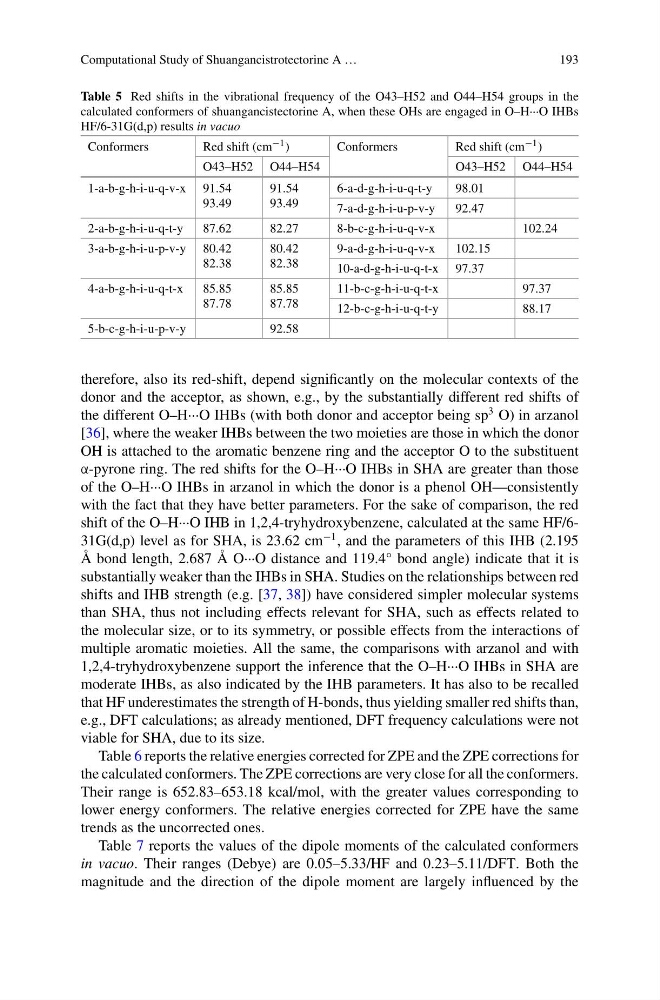
Table 5 Red shifts in the vibrational frequency of the O43–H52 and O44–H54 groups in the
calculated conformers of shuangancistectorine A, when these OHs are engaged in O–H···O IHBs
HF/6-31G(d,p) results in vacuo
Conformers
Red shift (cm −1 )
Conformers
Red shift (cm −1 )
O43 H52 O44 H54
O43 H52 O44 H54
1-a-b-g-h-i-u-q-v-x 91.54
93.49
91.54
93.49
6-a-d-g-h-i-u-q-t-y
98.01
7-a-d-g-h-i-u-p-v-y
92.47
2-a-b-g-h-i-u-q-t-y
87.62
82.27
8-b-c-g-h-i-u-q-v-x
102.24
3-a-b-g-h-i-u-p-v-y 80.42
82.38
80.42
82.38
9-a-d-g-h-i-u-q-v-x
102.15
10-a-d-g-h-i-u-q-t-x 97.37
4-a-b-g-h-i-u-q-t-x
85.85
87.78
85.85
87.78
11-b-c-g-h-i-u-q-t-x
97.37
12-b-c-g-h-i-u-q-t-y
88.17
5-b-c-g-h-i-u-p-v-y
92.58
therefore, also its red-shift, depend significantly on the molecular contexts of the
donor and the acceptor, as shown, e.g., by the substantially different red shifts of
the different O–H···O IHBs (with both donor and acceptor being sp
3 O) in arzanol
[36], where the weaker IHBs between the two moieties are those in which the donor
OH is attached to the aromatic benzene ring and the acceptor O to the substituent
α-pyrone ring. The red shifts for the O–H···O IHBs in SHA are greater than those
of the O–H···O IHBs in arzanol in which the donor is a phenol OH—consistently
with the fact that they have better parameters. For the sake of comparison, the red
shift of the O–H···O IHB in 1,2,4-tryhydroxybenzene, calculated at the same HF/631G(d,p) level as for SHA, is 23.62 cm
−1 , and the parameters of this IHB (2.195
Å bond length, 2.687 Å O···O distance and 119.4° bond angle) indicate that it is
substantially weaker than the IHBs in SHA. Studies on the relationships between red
shifts and IHB strength (e.g. [37, 38]) have considered simpler molecular systems
than SHA, thus not including effects relevant for SHA, such as effects related to
the molecular size, or to its symmetry, or possible effects from the interactions of
multiple aromatic moieties. All the same, the comparisons with arzanol and with
1,2,4-tryhydroxybenzene support the inference that the O–H···O IHBs in SHA are
moderate IHBs, as also indicated by the IHB parameters. It has also to be recalled
that HF underestimates the strength of H-bonds, thus yielding smaller red shifts than,
e.g., DFT calculations; as already mentioned, DFT frequency calculations were not
viable for SHA, due to its size.
Table 6 reports the relative energies corrected for ZPE and the ZPE corrections for
the calculated conformers. The ZPE corrections are very close for all the conformers.
Their range is 652.83–653.18 kcal/mol, with the greater values corresponding to
lower energy conformers. The relative energies corrected for ZPE have the same
trends as the uncorrected ones.
Table 7 reports the values of the dipole moments of the calculated conformers
in vacuo. Their ranges (Debye) are 0.05–5.33/HF and 0.23–5.11/DFT. Both the
magnitude and the direction of the dipole moment are largely influenced by the
193
Table 5 Red shifts in the vibrational frequency of the O43–H52 and O44–H54 groups in the
calculated conformers of shuangancistectorine A, when these OHs are engaged in O–H···O IHBs
HF/6-31G(d,p) results in vacuo
Conformers
Red shift (cm −1 )
Conformers
Red shift (cm −1 )
O43 H52 O44 H54
O43 H52 O44 H54
1-a-b-g-h-i-u-q-v-x 91.54
93.49
91.54
93.49
6-a-d-g-h-i-u-q-t-y
98.01
7-a-d-g-h-i-u-p-v-y
92.47
2-a-b-g-h-i-u-q-t-y
87.62
82.27
8-b-c-g-h-i-u-q-v-x
102.24
3-a-b-g-h-i-u-p-v-y 80.42
82.38
80.42
82.38
9-a-d-g-h-i-u-q-v-x
102.15
10-a-d-g-h-i-u-q-t-x 97.37
4-a-b-g-h-i-u-q-t-x
85.85
87.78
85.85
87.78
11-b-c-g-h-i-u-q-t-x
97.37
12-b-c-g-h-i-u-q-t-y
88.17
5-b-c-g-h-i-u-p-v-y
92.58
therefore, also its red-shift, depend significantly on the molecular contexts of the
donor and the acceptor, as shown, e.g., by the substantially different red shifts of
the different O–H···O IHBs (with both donor and acceptor being sp
3 O) in arzanol
[36], where the weaker IHBs between the two moieties are those in which the donor
OH is attached to the aromatic benzene ring and the acceptor O to the substituent
α-pyrone ring. The red shifts for the O–H···O IHBs in SHA are greater than those
of the O–H···O IHBs in arzanol in which the donor is a phenol OH—consistently
with the fact that they have better parameters. For the sake of comparison, the red
shift of the O–H···O IHB in 1,2,4-tryhydroxybenzene, calculated at the same HF/631G(d,p) level as for SHA, is 23.62 cm
−1 , and the parameters of this IHB (2.195
Å bond length, 2.687 Å O···O distance and 119.4° bond angle) indicate that it is
substantially weaker than the IHBs in SHA. Studies on the relationships between red
shifts and IHB strength (e.g. [37, 38]) have considered simpler molecular systems
than SHA, thus not including effects relevant for SHA, such as effects related to
the molecular size, or to its symmetry, or possible effects from the interactions of
multiple aromatic moieties. All the same, the comparisons with arzanol and with
1,2,4-tryhydroxybenzene support the inference that the O–H···O IHBs in SHA are
moderate IHBs, as also indicated by the IHB parameters. It has also to be recalled
that HF underestimates the strength of H-bonds, thus yielding smaller red shifts than,
e.g., DFT calculations; as already mentioned, DFT frequency calculations were not
viable for SHA, due to its size.
Table 6 reports the relative energies corrected for ZPE and the ZPE corrections for
the calculated conformers. The ZPE corrections are very close for all the conformers.
Their range is 652.83–653.18 kcal/mol, with the greater values corresponding to
lower energy conformers. The relative energies corrected for ZPE have the same
trends as the uncorrected ones.
Table 7 reports the values of the dipole moments of the calculated conformers
in vacuo. Their ranges (Debye) are 0.05–5.33/HF and 0.23–5.11/DFT. Both the
magnitude and the direction of the dipole moment are largely influenced by the