

170
L. Mammino
0.000
-319.033
6.6572
-313.420
9.425
-312.138
10.227
-309.473
d*-β-γ-a-Cu-O25-O30
d*-β-γ-e-Cu-O25-O30-O12 d*-β-δ-e-Cu-O25-O30-O12
d*-α-δ-e-Cu-O25-O30-O12
11.066
-309.012
12.508
-306.723
12.754
-302.903
22.706 -298.642
d*-β-γ-e-Cu-O25-O30
d*-α-δ-a-Cu-O8-O18
d*-β-γ-ε-a-Cu-O30
d-β^-γ-ε-a-Cu-O14
22.993
-294.225
27.311
-289.907
38.163
-282.505
45.439
-275.229
d*-β-γ-ε-e-Cu-O25-O12
d*-β-γ-ε^-e-Cu-O12
d-β-γ-c-Cu-O10-π1
d - β-γ-c-Cu-π1
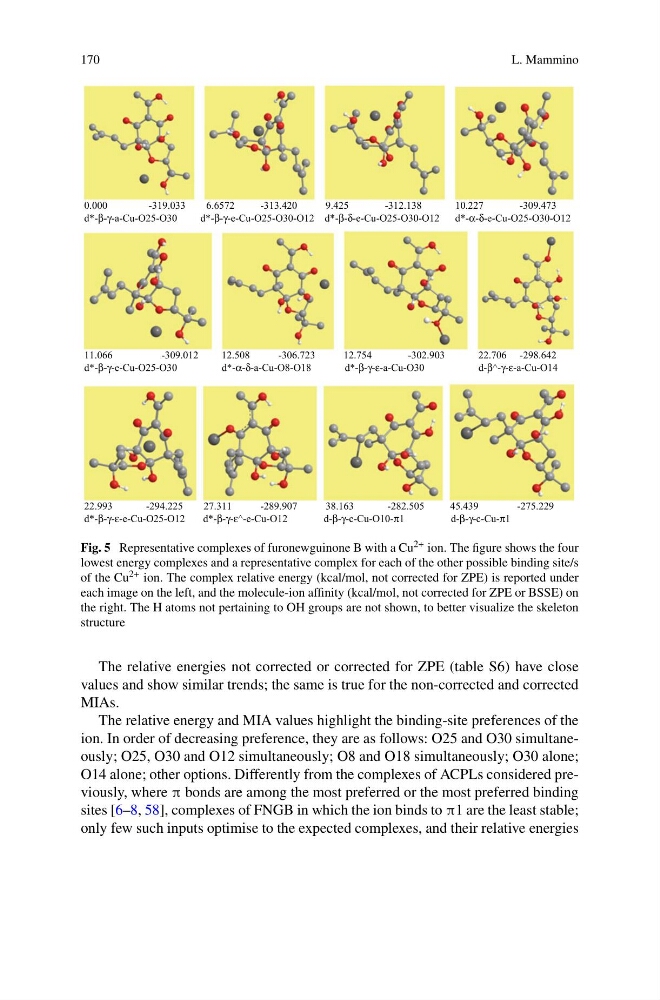
Fig. 5 Representative complexes of furonewguinone B with a Cu 2+ ion. The figure shows the four
lowest energy complexes and a representative complex for each of the other possible binding site/s
of the Cu 2+ ion. The complex relative energy (kcal/mol, not corrected for ZPE) is reported under
each image on the left, and the molecule-ion affinity (kcal/mol, not corrected for ZPE or BSSE) on
the right. The H atoms not pertaining to OH groups are not shown, to better visualize the skeleton
structure
The relative energies not corrected or corrected for ZPE (table S6) have close
values and show similar trends; the same is true for the non-corrected and corrected
MIAs.
The relative energy and MIA values highlight the binding-site preferences of the
ion. In order of decreasing preference, they are as follows: O25 and O30 simultaneously; O25, O30 and O12 simultaneously; O8 and O18 simultaneously; O30 alone;
O14 alone; other options. Differently from the complexes of ACPLs considered previously, where π bonds are among the most preferred or the most preferred binding
sites [6–8, 58], complexes of FNGB in which the ion binds to π1 are the least stable;
only few such inputs optimise to the expected complexes, and their relative energies
L. Mammino
0.000
-319.033
6.6572
-313.420
9.425
-312.138
10.227
-309.473
d*-β-γ-a-Cu-O25-O30
d*-β-γ-e-Cu-O25-O30-O12 d*-β-δ-e-Cu-O25-O30-O12
d*-α-δ-e-Cu-O25-O30-O12
11.066
-309.012
12.508
-306.723
12.754
-302.903
22.706 -298.642
d*-β-γ-e-Cu-O25-O30
d*-α-δ-a-Cu-O8-O18
d*-β-γ-ε-a-Cu-O30
d-β^-γ-ε-a-Cu-O14
22.993
-294.225
27.311
-289.907
38.163
-282.505
45.439
-275.229
d*-β-γ-ε-e-Cu-O25-O12
d*-β-γ-ε^-e-Cu-O12
d-β-γ-c-Cu-O10-π1
d - β-γ-c-Cu-π1
Fig. 5 Representative complexes of furonewguinone B with a Cu 2+ ion. The figure shows the four
lowest energy complexes and a representative complex for each of the other possible binding site/s
of the Cu 2+ ion. The complex relative energy (kcal/mol, not corrected for ZPE) is reported under
each image on the left, and the molecule-ion affinity (kcal/mol, not corrected for ZPE or BSSE) on
the right. The H atoms not pertaining to OH groups are not shown, to better visualize the skeleton
structure
The relative energies not corrected or corrected for ZPE (table S6) have close
values and show similar trends; the same is true for the non-corrected and corrected
MIAs.
The relative energy and MIA values highlight the binding-site preferences of the
ion. In order of decreasing preference, they are as follows: O25 and O30 simultaneously; O25, O30 and O12 simultaneously; O8 and O18 simultaneously; O30 alone;
O14 alone; other options. Differently from the complexes of ACPLs considered previously, where π bonds are among the most preferred or the most preferred binding
sites [6–8, 58], complexes of FNGB in which the ion binds to π1 are the least stable;
only few such inputs optimise to the expected complexes, and their relative energies