

Complexes of Furonewguinone B with a Cu 2+ Ion. A DFT Study
163
when comparisons are of interest, as in the current work (comparison of complexes
with the same binding site/s, of the binding abilities of different sites, of the ion
charge in different complexes, etc.).
Natural Bond Orbital [41–45] analysis was utilised to get detailed information
about the electronic structure and realistic values of the charge on the ion in the
complexes (the Mulliken charges are often too small to be realistic). A realistic
estimation of the charge on the ion is particularly important in studies like the current
one, because its value provides an indication of the molecule’s ability to reduce an
oxidant species.
The molecule-ion affinity (MIA) was taken as the energy difference between the
final situation (complex) and the initial situation (the molecule and the ion at infinite
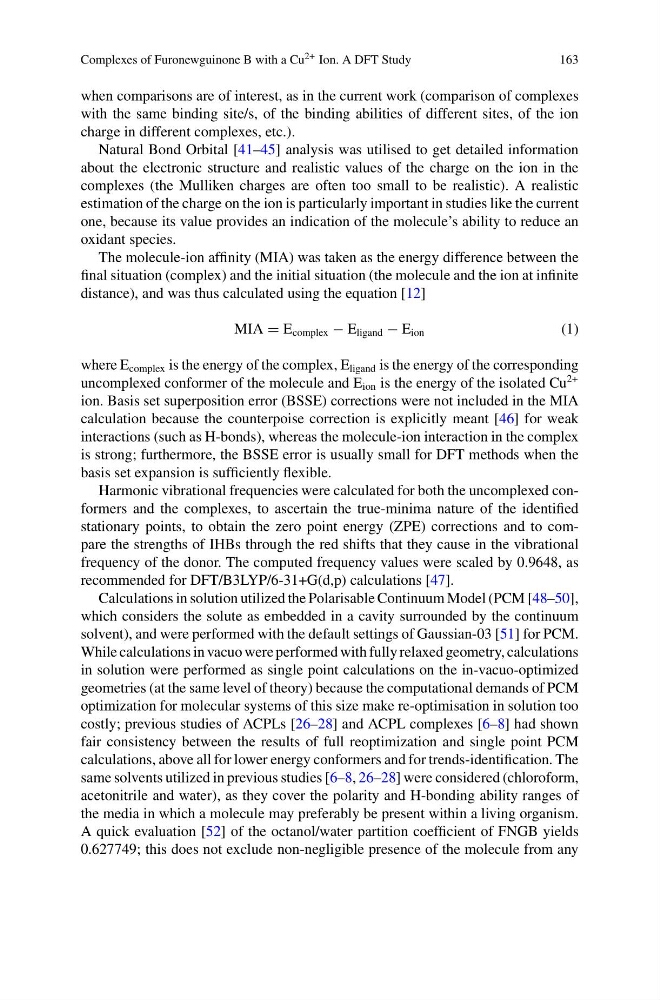
distance), and was thus calculated using the equation [12]
MIA = E complex − E ligand − E ion
(1)
where E complex is the energy of the complex, E ligand is the energy of the corresponding
uncomplexed conformer of the molecule and E ion is the energy of the isolated Cu
2+
ion. Basis set superposition error (BSSE) corrections were not included in the MIA
calculation because the counterpoise correction is explicitly meant [46] for weak
interactions (such as H-bonds), whereas the molecule-ion interaction in the complex
is strong; furthermore, the BSSE error is usually small for DFT methods when the
basis set expansion is sufficiently flexible.
Harmonic vibrational frequencies were calculated for both the uncomplexed conformers and the complexes, to ascertain the true-minima nature of the identified
stationary points, to obtain the zero point energy (ZPE) corrections and to compare the strengths of IHBs through the red shifts that they cause in the vibrational
frequency of the donor. The computed frequency values were scaled by 0.9648, as
recommended for DFT/B3LYP/6-31+G(d,p) calculations [47].
Calculations in solution utilized the Polarisable Continuum Model (PCM [48–50],
which considers the solute as embedded in a cavity surrounded by the continuum
solvent), and were performed with the default settings of Gaussian-03 [51] for PCM.
While calculations in vacuo were performed with fully relaxed geometry, calculations
in solution were performed as single point calculations on the in-vacuo-optimized
geometries (at the same level of theory) because the computational demands of PCM
optimization for molecular systems of this size make re-optimisation in solution too
costly; previous studies of ACPLs [26–28] and ACPL complexes [6–8] had shown
fair consistency between the results of full reoptimization and single point PCM
calculations, above all for lower energy conformers and for trends-identification. The
same solvents utilized in previous studies [6–8, 26–28] were considered (chloroform,
acetonitrile and water), as they cover the polarity and H-bonding ability ranges of
the media in which a molecule may preferably be present within a living organism.
A quick evaluation [52] of the octanol/water partition coefficient of FNGB yields
0.627749; this does not exclude non-negligible presence of the molecule from any
163
when comparisons are of interest, as in the current work (comparison of complexes
with the same binding site/s, of the binding abilities of different sites, of the ion
charge in different complexes, etc.).
Natural Bond Orbital [41–45] analysis was utilised to get detailed information
about the electronic structure and realistic values of the charge on the ion in the
complexes (the Mulliken charges are often too small to be realistic). A realistic
estimation of the charge on the ion is particularly important in studies like the current
one, because its value provides an indication of the molecule’s ability to reduce an
oxidant species.
The molecule-ion affinity (MIA) was taken as the energy difference between the
final situation (complex) and the initial situation (the molecule and the ion at infinite
distance), and was thus calculated using the equation [12]
MIA = E complex − E ligand − E ion
(1)
where E complex is the energy of the complex, E ligand is the energy of the corresponding
uncomplexed conformer of the molecule and E ion is the energy of the isolated Cu
2+
ion. Basis set superposition error (BSSE) corrections were not included in the MIA
calculation because the counterpoise correction is explicitly meant [46] for weak
interactions (such as H-bonds), whereas the molecule-ion interaction in the complex
is strong; furthermore, the BSSE error is usually small for DFT methods when the
basis set expansion is sufficiently flexible.
Harmonic vibrational frequencies were calculated for both the uncomplexed conformers and the complexes, to ascertain the true-minima nature of the identified
stationary points, to obtain the zero point energy (ZPE) corrections and to compare the strengths of IHBs through the red shifts that they cause in the vibrational
frequency of the donor. The computed frequency values were scaled by 0.9648, as
recommended for DFT/B3LYP/6-31+G(d,p) calculations [47].
Calculations in solution utilized the Polarisable Continuum Model (PCM [48–50],
which considers the solute as embedded in a cavity surrounded by the continuum
solvent), and were performed with the default settings of Gaussian-03 [51] for PCM.
While calculations in vacuo were performed with fully relaxed geometry, calculations
in solution were performed as single point calculations on the in-vacuo-optimized
geometries (at the same level of theory) because the computational demands of PCM
optimization for molecular systems of this size make re-optimisation in solution too
costly; previous studies of ACPLs [26–28] and ACPL complexes [6–8] had shown
fair consistency between the results of full reoptimization and single point PCM
calculations, above all for lower energy conformers and for trends-identification. The
same solvents utilized in previous studies [6–8, 26–28] were considered (chloroform,
acetonitrile and water), as they cover the polarity and H-bonding ability ranges of
the media in which a molecule may preferably be present within a living organism.
A quick evaluation [52] of the octanol/water partition coefficient of FNGB yields
0.627749; this does not exclude non-negligible presence of the molecule from any