

Density Functional Theory Studies of Ruthenium Dye …
153
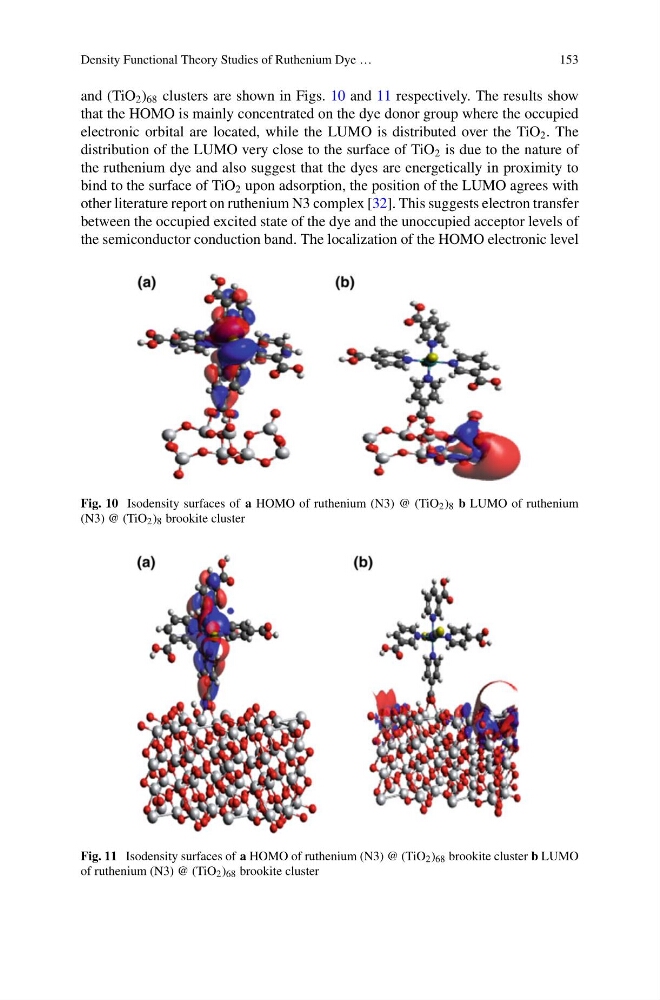
and (TiO 2 ) 68 clusters are shown in Figs. 10 and 11 respectively. The results show
that the HOMO is mainly concentrated on the dye donor group where the occupied
electronic orbital are located, while the LUMO is distributed over the TiO 2 . The
distribution of the LUMO very close to the surface of TiO 2 is due to the nature of
the ruthenium dye and also suggest that the dyes are energetically in proximity to
bind to the surface of TiO 2 upon adsorption, the position of the LUMO agrees with
other literature report on ruthenium N3 complex [32]. This suggests electron transfer
between the occupied excited state of the dye and the unoccupied acceptor levels of
the semiconductor conduction band. The localization of the HOMO electronic level
Fig. 10 Isodensity surfaces of a HOMO of ruthenium (N3) @ (TiO 2 ) 8 b LUMO of ruthenium
(N3) @ (TiO 2 ) 8 brookite cluster
Fig. 11 Isodensity surfaces of a HOMO of ruthenium (N3) @ (TiO 2 ) 68 brookite cluster b LUMO
of ruthenium (N3) @ (TiO 2 ) 68 brookite cluster
153
and (TiO 2 ) 68 clusters are shown in Figs. 10 and 11 respectively. The results show
that the HOMO is mainly concentrated on the dye donor group where the occupied
electronic orbital are located, while the LUMO is distributed over the TiO 2 . The
distribution of the LUMO very close to the surface of TiO 2 is due to the nature of
the ruthenium dye and also suggest that the dyes are energetically in proximity to
bind to the surface of TiO 2 upon adsorption, the position of the LUMO agrees with
other literature report on ruthenium N3 complex [32]. This suggests electron transfer
between the occupied excited state of the dye and the unoccupied acceptor levels of
the semiconductor conduction band. The localization of the HOMO electronic level
Fig. 10 Isodensity surfaces of a HOMO of ruthenium (N3) @ (TiO 2 ) 8 b LUMO of ruthenium
(N3) @ (TiO 2 ) 8 brookite cluster
Fig. 11 Isodensity surfaces of a HOMO of ruthenium (N3) @ (TiO 2 ) 68 brookite cluster b LUMO
of ruthenium (N3) @ (TiO 2 ) 68 brookite cluster