

Density Functional Theory Studies of Ruthenium Dye …
151
Table 4 Relaxation energies of ruthenium (N3) dye molecule absorbed on (TiO 2 ) 8 and (TiO 2 ) 68
brookite cluster
System
Relaxation energy
(eV)
Energy (TiO 2 ) n
cluster (slab) (eV)
Energy (slab +molecule)
Dyes@(TiO 2 ) n (eV)
Ruthenium (N3)
−432.919
(TiO 2 ) 8
−198.308
(TiO 2 ) 68
−1635.558
Ruthenium@(TiO 2 ) 8
−632.953
Ruthenium@(TiO 2 ) 68
−2072.267
3.4 Adsorption Energies of Ruthenium (N3) Dye Molecule
Absorbed on (TiO 2 ) n , n = 8, 68 Brookite Complex
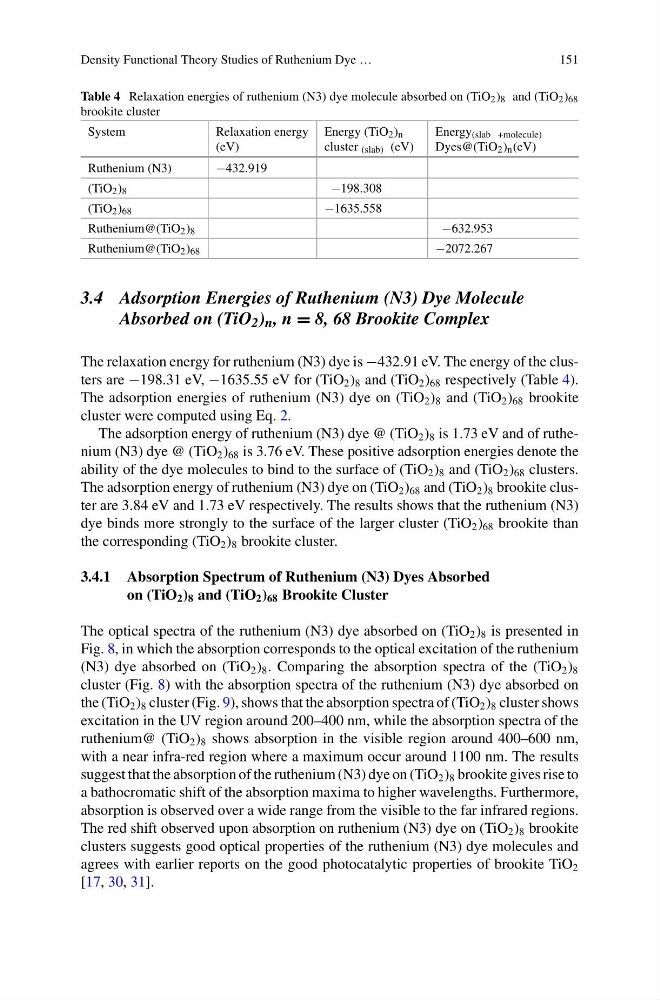
The relaxation energy for ruthenium (N3) dye is −432.91 eV. The energy of the clusters are −198.31 eV, −1635.55 eV for (TiO 2 ) 8 and (TiO 2 ) 68 respectively (Table 4).
The adsorption energies of ruthenium (N3) dye on (TiO 2 ) 8 and (TiO 2 ) 68 brookite
cluster were computed using Eq. 2.
The adsorption energy of ruthenium (N3) dye @ (TiO 2 ) 8 is 1.73 eV and of ruthenium (N3) dye @ (TiO 2 ) 68 is 3.76 eV. These positive adsorption energies denote the
ability of the dye molecules to bind to the surface of (TiO 2 ) 8 and (TiO 2 ) 68 clusters.
The adsorption energy of ruthenium (N3) dye on (TiO 2 ) 68 and (TiO 2 ) 8 brookite cluster are 3.84 eV and 1.73 eV respectively. The results shows that the ruthenium (N3)
dye binds more strongly to the surface of the larger cluster (TiO 2 ) 68 brookite than
the corresponding (TiO 2 ) 8 brookite cluster.
3.4.1 Absorption Spectrum of Ruthenium (N3) Dyes Absorbed
on (TiO 2 ) 8 and (TiO 2 ) 68 Brookite Cluster
The optical spectra of the ruthenium (N3) dye absorbed on (TiO 2 ) 8 is presented in
Fig. 8, in which the absorption corresponds to the optical excitation of the ruthenium
(N3) dye absorbed on (TiO 2 ) 8 . Comparing the absorption spectra of the (TiO 2 ) 8
cluster (Fig. 8) with the absorption spectra of the ruthenium (N3) dye absorbed on
the (TiO 2 ) 8 cluster (Fig. 9), shows that the absorption spectra of (TiO 2 ) 8 cluster shows
excitation in the UV region around 200–400 nm, while the absorption spectra of the
ruthenium@ (TiO 2 ) 8 shows absorption in the visible region around 400–600 nm,
with a near infra-red region where a maximum occur around 1100 nm. The results
suggest that the absorption of the ruthenium (N3) dye on (TiO 2 ) 8 brookite gives rise to
a bathocromatic shift of the absorption maxima to higher wavelengths. Furthermore,
absorption is observed over a wide range from the visible to the far infrared regions.
The red shift observed upon absorption on ruthenium (N3) dye on (TiO 2 ) 8 brookite
clusters suggests good optical properties of the ruthenium (N3) dye molecules and
agrees with earlier reports on the good photocatalytic properties of brookite TiO 2
[17, 30, 31].
151
Table 4 Relaxation energies of ruthenium (N3) dye molecule absorbed on (TiO 2 ) 8 and (TiO 2 ) 68
brookite cluster
System
Relaxation energy
(eV)
Energy (TiO 2 ) n
cluster (slab) (eV)
Energy (slab +molecule)
Dyes@(TiO 2 ) n (eV)
Ruthenium (N3)
−432.919
(TiO 2 ) 8
−198.308
(TiO 2 ) 68
−1635.558
Ruthenium@(TiO 2 ) 8
−632.953
Ruthenium@(TiO 2 ) 68
−2072.267
3.4 Adsorption Energies of Ruthenium (N3) Dye Molecule
Absorbed on (TiO 2 ) n , n = 8, 68 Brookite Complex
The relaxation energy for ruthenium (N3) dye is −432.91 eV. The energy of the clusters are −198.31 eV, −1635.55 eV for (TiO 2 ) 8 and (TiO 2 ) 68 respectively (Table 4).
The adsorption energies of ruthenium (N3) dye on (TiO 2 ) 8 and (TiO 2 ) 68 brookite
cluster were computed using Eq. 2.
The adsorption energy of ruthenium (N3) dye @ (TiO 2 ) 8 is 1.73 eV and of ruthenium (N3) dye @ (TiO 2 ) 68 is 3.76 eV. These positive adsorption energies denote the
ability of the dye molecules to bind to the surface of (TiO 2 ) 8 and (TiO 2 ) 68 clusters.
The adsorption energy of ruthenium (N3) dye on (TiO 2 ) 68 and (TiO 2 ) 8 brookite cluster are 3.84 eV and 1.73 eV respectively. The results shows that the ruthenium (N3)
dye binds more strongly to the surface of the larger cluster (TiO 2 ) 68 brookite than
the corresponding (TiO 2 ) 8 brookite cluster.
3.4.1 Absorption Spectrum of Ruthenium (N3) Dyes Absorbed
on (TiO 2 ) 8 and (TiO 2 ) 68 Brookite Cluster
The optical spectra of the ruthenium (N3) dye absorbed on (TiO 2 ) 8 is presented in
Fig. 8, in which the absorption corresponds to the optical excitation of the ruthenium
(N3) dye absorbed on (TiO 2 ) 8 . Comparing the absorption spectra of the (TiO 2 ) 8
cluster (Fig. 8) with the absorption spectra of the ruthenium (N3) dye absorbed on
the (TiO 2 ) 8 cluster (Fig. 9), shows that the absorption spectra of (TiO 2 ) 8 cluster shows
excitation in the UV region around 200–400 nm, while the absorption spectra of the
ruthenium@ (TiO 2 ) 8 shows absorption in the visible region around 400–600 nm,
with a near infra-red region where a maximum occur around 1100 nm. The results
suggest that the absorption of the ruthenium (N3) dye on (TiO 2 ) 8 brookite gives rise to
a bathocromatic shift of the absorption maxima to higher wavelengths. Furthermore,
absorption is observed over a wide range from the visible to the far infrared regions.
The red shift observed upon absorption on ruthenium (N3) dye on (TiO 2 ) 8 brookite
clusters suggests good optical properties of the ruthenium (N3) dye molecules and
agrees with earlier reports on the good photocatalytic properties of brookite TiO 2
[17, 30, 31].