

Density Functional Theory Studies of Ruthenium Dye …
149
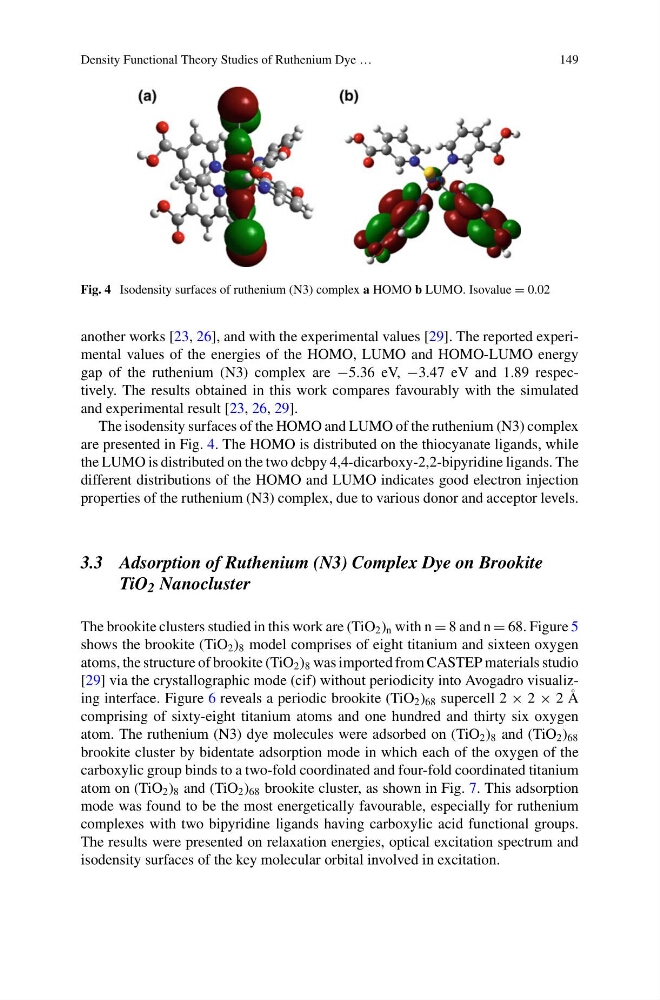
Fig. 4 Isodensity surfaces of ruthenium (N3) complex a HOMO b LUMO. Isovalue = 0.02
another works [23, 26], and with the experimental values [29]. The reported experimental values of the energies of the HOMO, LUMO and HOMO-LUMO energy
gap of the ruthenium (N3) complex are −5.36 eV, −3.47 eV and 1.89 respectively. The results obtained in this work compares favourably with the simulated
and experimental result [23, 26, 29].
The isodensity surfaces of the HOMO and LUMO of the ruthenium (N3) complex
are presented in Fig. 4. The HOMO is distributed on the thiocyanate ligands, while
the LUMO is distributed on the two dcbpy 4,4-dicarboxy-2,2-bipyridine ligands. The
different distributions of the HOMO and LUMO indicates good electron injection
properties of the ruthenium (N3) complex, due to various donor and acceptor levels.
3.3 Adsorption of Ruthenium (N3) Complex Dye on Brookite
TiO 2 Nanocluster
The brookite clusters studied in this work are (TiO 2 ) n with n = 8 and n = 68. Figure 5
shows the brookite (TiO 2 ) 8 model comprises of eight titanium and sixteen oxygen
atoms, the structure of brookite (TiO 2 ) 8 was imported from CASTEP materials studio
[29] via the crystallographic mode (cif) without periodicity into Avogadro visualizing interface. Figure 6 reveals a periodic brookite (TiO 2 ) 68 supercell 2 × 2 × 2 Å
comprising of sixty-eight titanium atoms and one hundred and thirty six oxygen
atom. The ruthenium (N3) dye molecules were adsorbed on (TiO 2 ) 8 and (TiO 2 ) 68
brookite cluster by bidentate adsorption mode in which each of the oxygen of the
carboxylic group binds to a two-fold coordinated and four-fold coordinated titanium
atom on (TiO 2 ) 8 and (TiO 2 ) 68 brookite cluster, as shown in Fig. 7. This adsorption
mode was found to be the most energetically favourable, especially for ruthenium
complexes with two bipyridine ligands having carboxylic acid functional groups.
The results were presented on relaxation energies, optical excitation spectrum and
isodensity surfaces of the key molecular orbital involved in excitation.
149
Fig. 4 Isodensity surfaces of ruthenium (N3) complex a HOMO b LUMO. Isovalue = 0.02
another works [23, 26], and with the experimental values [29]. The reported experimental values of the energies of the HOMO, LUMO and HOMO-LUMO energy
gap of the ruthenium (N3) complex are −5.36 eV, −3.47 eV and 1.89 respectively. The results obtained in this work compares favourably with the simulated
and experimental result [23, 26, 29].
The isodensity surfaces of the HOMO and LUMO of the ruthenium (N3) complex
are presented in Fig. 4. The HOMO is distributed on the thiocyanate ligands, while
the LUMO is distributed on the two dcbpy 4,4-dicarboxy-2,2-bipyridine ligands. The
different distributions of the HOMO and LUMO indicates good electron injection
properties of the ruthenium (N3) complex, due to various donor and acceptor levels.
3.3 Adsorption of Ruthenium (N3) Complex Dye on Brookite
TiO 2 Nanocluster
The brookite clusters studied in this work are (TiO 2 ) n with n = 8 and n = 68. Figure 5
shows the brookite (TiO 2 ) 8 model comprises of eight titanium and sixteen oxygen
atoms, the structure of brookite (TiO 2 ) 8 was imported from CASTEP materials studio
[29] via the crystallographic mode (cif) without periodicity into Avogadro visualizing interface. Figure 6 reveals a periodic brookite (TiO 2 ) 68 supercell 2 × 2 × 2 Å
comprising of sixty-eight titanium atoms and one hundred and thirty six oxygen
atom. The ruthenium (N3) dye molecules were adsorbed on (TiO 2 ) 8 and (TiO 2 ) 68
brookite cluster by bidentate adsorption mode in which each of the oxygen of the
carboxylic group binds to a two-fold coordinated and four-fold coordinated titanium
atom on (TiO 2 ) 8 and (TiO 2 ) 68 brookite cluster, as shown in Fig. 7. This adsorption
mode was found to be the most energetically favourable, especially for ruthenium
complexes with two bipyridine ligands having carboxylic acid functional groups.
The results were presented on relaxation energies, optical excitation spectrum and
isodensity surfaces of the key molecular orbital involved in excitation.