

A Theoretical Study of the Preferred Reaction Mechanism …
137
RC
TS1
IM1
TS2
IM2
TS3
PC
IP
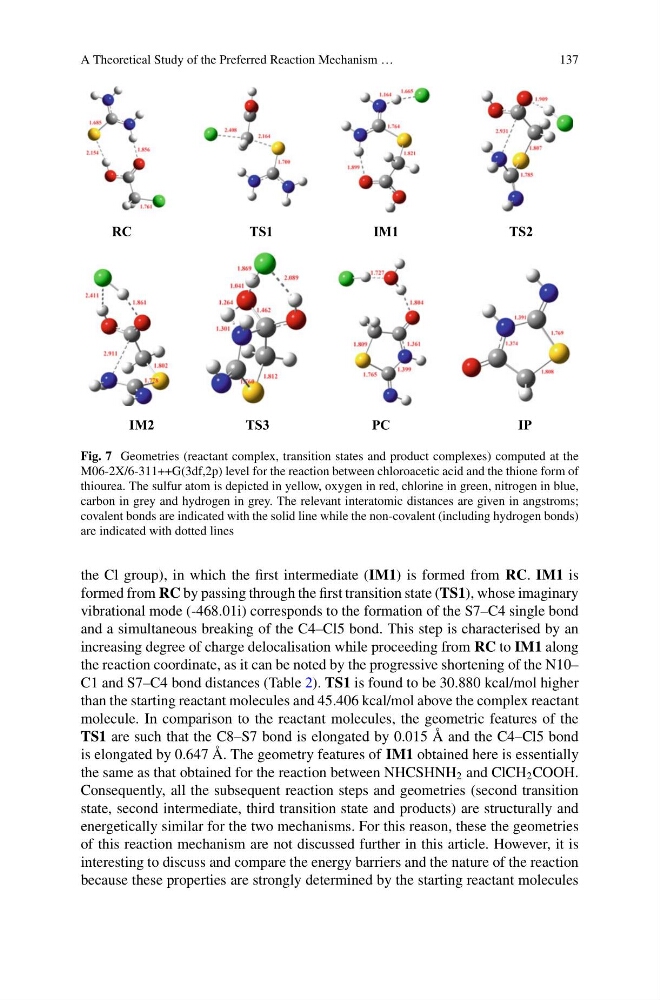
Fig. 7 Geometries (reactant complex, transition states and product complexes) computed at the
M06-2X/6-311++G(3df,2p) level for the reaction between chloroacetic acid and the thione form of
thiourea. The sulfur atom is depicted in yellow, oxygen in red, chlorine in green, nitrogen in blue,
carbon in grey and hydrogen in grey. The relevant interatomic distances are given in angstroms;
covalent bonds are indicated with the solid line while the non-covalent (including hydrogen bonds)
are indicated with dotted lines
the Cl group), in which the first intermediate (IM1) is formed from RC. IM1 is
formed from RC by passing through the first transition state (TS1), whose imaginary
vibrational mode (-468.01i) corresponds to the formation of the S7–C4 single bond
and a simultaneous breaking of the C4–Cl5 bond. This step is characterised by an
increasing degree of charge delocalisation while proceeding from RC to IM1 along
the reaction coordinate, as it can be noted by the progressive shortening of the N10–
C1 and S7–C4 bond distances (Table 2). TS1 is found to be 30.880 kcal/mol higher
than the starting reactant molecules and 45.406 kcal/mol above the complex reactant
molecule. In comparison to the reactant molecules, the geometric features of the
TS1 are such that the C8–S7 bond is elongated by 0.015 Å and the C4–Cl5 bond
is elongated by 0.647 Å. The geometry features of IM1 obtained here is essentially
the same as that obtained for the reaction between NHCSHNH 2 and ClCH 2 COOH.
Consequently, all the subsequent reaction steps and geometries (second transition
state, second intermediate, third transition state and products) are structurally and
energetically similar for the two mechanisms. For this reason, these the geometries
of this reaction mechanism are not discussed further in this article. However, it is
interesting to discuss and compare the energy barriers and the nature of the reaction
because these properties are strongly determined by the starting reactant molecules
137
RC
TS1
IM1
TS2
IM2
TS3
PC
IP
Fig. 7 Geometries (reactant complex, transition states and product complexes) computed at the
M06-2X/6-311++G(3df,2p) level for the reaction between chloroacetic acid and the thione form of
thiourea. The sulfur atom is depicted in yellow, oxygen in red, chlorine in green, nitrogen in blue,
carbon in grey and hydrogen in grey. The relevant interatomic distances are given in angstroms;
covalent bonds are indicated with the solid line while the non-covalent (including hydrogen bonds)
are indicated with dotted lines
the Cl group), in which the first intermediate (IM1) is formed from RC. IM1 is
formed from RC by passing through the first transition state (TS1), whose imaginary
vibrational mode (-468.01i) corresponds to the formation of the S7–C4 single bond
and a simultaneous breaking of the C4–Cl5 bond. This step is characterised by an
increasing degree of charge delocalisation while proceeding from RC to IM1 along
the reaction coordinate, as it can be noted by the progressive shortening of the N10–
C1 and S7–C4 bond distances (Table 2). TS1 is found to be 30.880 kcal/mol higher
than the starting reactant molecules and 45.406 kcal/mol above the complex reactant
molecule. In comparison to the reactant molecules, the geometric features of the
TS1 are such that the C8–S7 bond is elongated by 0.015 Å and the C4–Cl5 bond
is elongated by 0.647 Å. The geometry features of IM1 obtained here is essentially
the same as that obtained for the reaction between NHCSHNH 2 and ClCH 2 COOH.
Consequently, all the subsequent reaction steps and geometries (second transition
state, second intermediate, third transition state and products) are structurally and
energetically similar for the two mechanisms. For this reason, these the geometries
of this reaction mechanism are not discussed further in this article. However, it is
interesting to discuss and compare the energy barriers and the nature of the reaction
because these properties are strongly determined by the starting reactant molecules