

A Theoretical Study of the Preferred Reaction Mechanism …
135
3.2 NHCSHNH 2 + ClCH 2 COOH Reaction Mechanism
in Water Solution
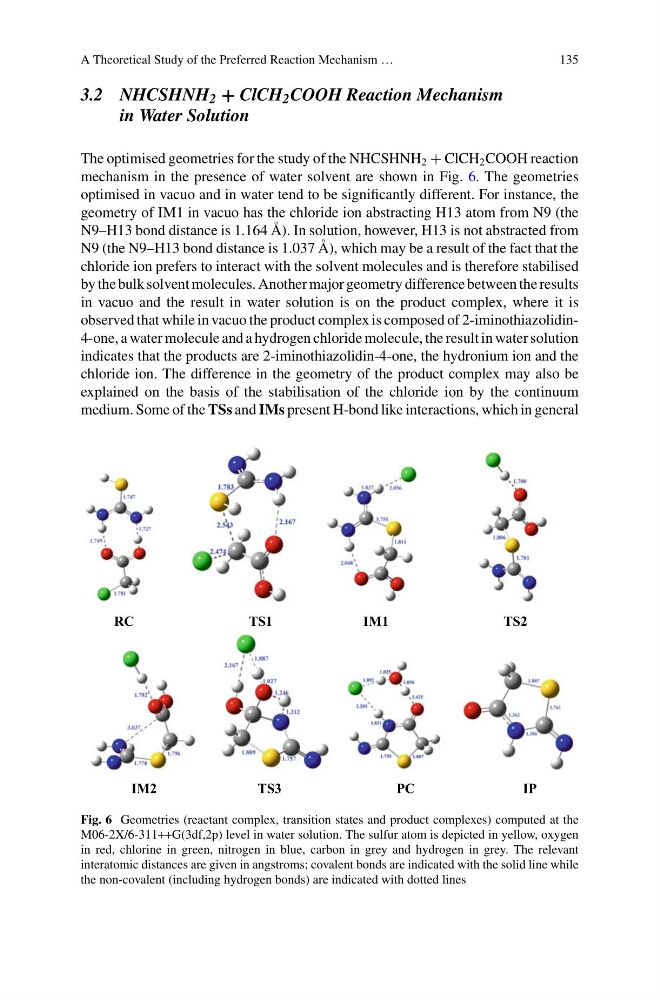
The optimised geometries for the study of the NHCSHNH 2 + ClCH 2 COOH reaction
mechanism in the presence of water solvent are shown in Fig. 6. The geometries
optimised in vacuo and in water tend to be significantly different. For instance, the
geometry of IM1 in vacuo has the chloride ion abstracting H13 atom from N9 (the
N9–H13 bond distance is 1.164 Å). In solution, however, H13 is not abstracted from
N9 (the N9–H13 bond distance is 1.037 Å), which may be a result of the fact that the
chloride ion prefers to interact with the solvent molecules and is therefore stabilised
by the bulk solvent molecules. Another major geometry difference between the results
in vacuo and the result in water solution is on the product complex, where it is
observed that while in vacuo the product complex is composed of 2-iminothiazolidin4-one, a water molecule and a hydrogen chloride molecule, the result in water solution
indicates that the products are 2-iminothiazolidin-4-one, the hydronium ion and the
chloride ion. The difference in the geometry of the product complex may also be
explained on the basis of the stabilisation of the chloride ion by the continuum
medium. Some of the TSs and IMs present H-bond like interactions, which in general
RC
TS1
IM1
TS2
IM2
TS3
PC
IP
Fig. 6 Geometries (reactant complex, transition states and product complexes) computed at the
M06-2X/6-311++G(3df,2p) level in water solution. The sulfur atom is depicted in yellow, oxygen
in red, chlorine in green, nitrogen in blue, carbon in grey and hydrogen in grey. The relevant
interatomic distances are given in angstroms; covalent bonds are indicated with the solid line while
the non-covalent (including hydrogen bonds) are indicated with dotted lines
135
3.2 NHCSHNH 2 + ClCH 2 COOH Reaction Mechanism
in Water Solution
The optimised geometries for the study of the NHCSHNH 2 + ClCH 2 COOH reaction
mechanism in the presence of water solvent are shown in Fig. 6. The geometries
optimised in vacuo and in water tend to be significantly different. For instance, the
geometry of IM1 in vacuo has the chloride ion abstracting H13 atom from N9 (the
N9–H13 bond distance is 1.164 Å). In solution, however, H13 is not abstracted from
N9 (the N9–H13 bond distance is 1.037 Å), which may be a result of the fact that the
chloride ion prefers to interact with the solvent molecules and is therefore stabilised
by the bulk solvent molecules. Another major geometry difference between the results
in vacuo and the result in water solution is on the product complex, where it is
observed that while in vacuo the product complex is composed of 2-iminothiazolidin4-one, a water molecule and a hydrogen chloride molecule, the result in water solution
indicates that the products are 2-iminothiazolidin-4-one, the hydronium ion and the
chloride ion. The difference in the geometry of the product complex may also be
explained on the basis of the stabilisation of the chloride ion by the continuum
medium. Some of the TSs and IMs present H-bond like interactions, which in general
RC
TS1
IM1
TS2
IM2
TS3
PC
IP
Fig. 6 Geometries (reactant complex, transition states and product complexes) computed at the
M06-2X/6-311++G(3df,2p) level in water solution. The sulfur atom is depicted in yellow, oxygen
in red, chlorine in green, nitrogen in blue, carbon in grey and hydrogen in grey. The relevant
interatomic distances are given in angstroms; covalent bonds are indicated with the solid line while
the non-covalent (including hydrogen bonds) are indicated with dotted lines