

A Theoretical Study of the Preferred Reaction Mechanism …
131
RC-t
TS1-t
IM1
TS2
IM2
TS3
PC
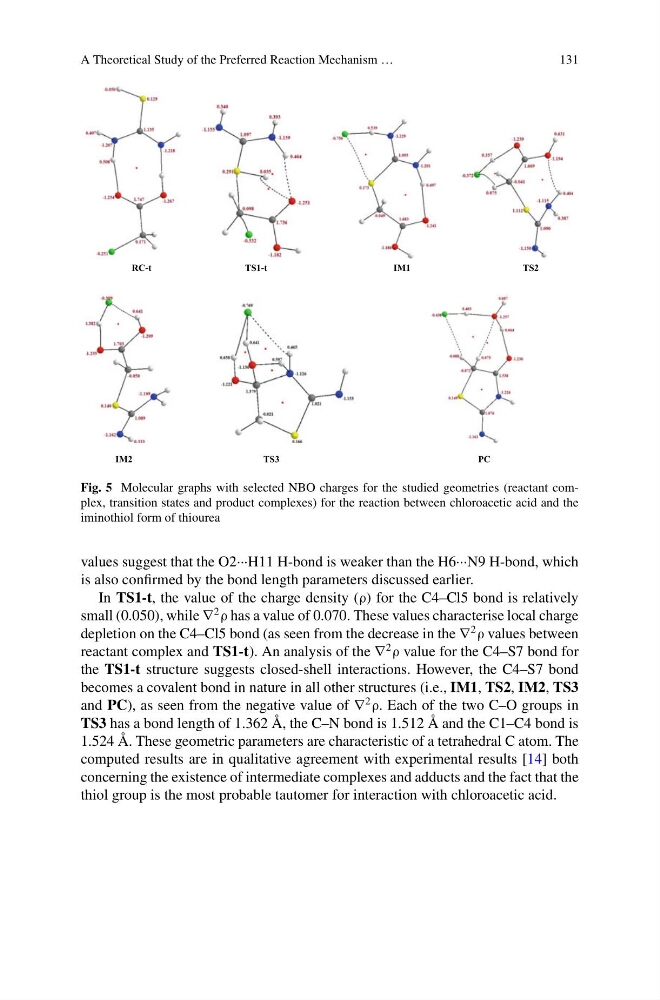
Fig. 5 Molecular graphs with selected NBO charges for the studied geometries (reactant complex, transition states and product complexes) for the reaction between chloroacetic acid and the
iminothiol form of thiourea
values suggest that the O2···H11 H-bond is weaker than the H6···N9 H-bond, which
is also confirmed by the bond length parameters discussed earlier.
In TS1-t, the value of the charge density (ρ) for the C4–Cl5 bond is relatively
small (0.050), while ∇
2
ρ has a value of 0.070. These values characterise local charge
depletion on the C4–Cl5 bond (as seen from the decrease in the ∇
2
ρ values between
reactant complex and TS1-t). An analysis of the ∇
2
ρ value for the C4–S7 bond for
the TS1-t structure suggests closed-shell interactions. However, the C4–S7 bond
becomes a covalent bond in nature in all other structures (i.e., IM1, TS2, IM2, TS3
and PC), as seen from the negative value of ∇
2
ρ. Each of the two C–O groups in
TS3 has a bond length of 1.362 Å, the C–N bond is 1.512 Å and the C1–C4 bond is
1.524 Å. These geometric parameters are characteristic of a tetrahedral C atom. The
computed results are in qualitative agreement with experimental results [14] both
concerning the existence of intermediate complexes and adducts and the fact that the
thiol group is the most probable tautomer for interaction with chloroacetic acid.
131
RC-t
TS1-t
IM1
TS2
IM2
TS3
PC
Fig. 5 Molecular graphs with selected NBO charges for the studied geometries (reactant complex, transition states and product complexes) for the reaction between chloroacetic acid and the
iminothiol form of thiourea
values suggest that the O2···H11 H-bond is weaker than the H6···N9 H-bond, which
is also confirmed by the bond length parameters discussed earlier.
In TS1-t, the value of the charge density (ρ) for the C4–Cl5 bond is relatively
small (0.050), while ∇
2
ρ has a value of 0.070. These values characterise local charge
depletion on the C4–Cl5 bond (as seen from the decrease in the ∇
2
ρ values between
reactant complex and TS1-t). An analysis of the ∇
2
ρ value for the C4–S7 bond for
the TS1-t structure suggests closed-shell interactions. However, the C4–S7 bond
becomes a covalent bond in nature in all other structures (i.e., IM1, TS2, IM2, TS3
and PC), as seen from the negative value of ∇
2
ρ. Each of the two C–O groups in
TS3 has a bond length of 1.362 Å, the C–N bond is 1.512 Å and the C1–C4 bond is
1.524 Å. These geometric parameters are characteristic of a tetrahedral C atom. The
computed results are in qualitative agreement with experimental results [14] both
concerning the existence of intermediate complexes and adducts and the fact that the
thiol group is the most probable tautomer for interaction with chloroacetic acid.