

A Theoretical Study of the Preferred Reaction Mechanism …
129
reaction coordinates
reaction coordinates
(a)
(b)
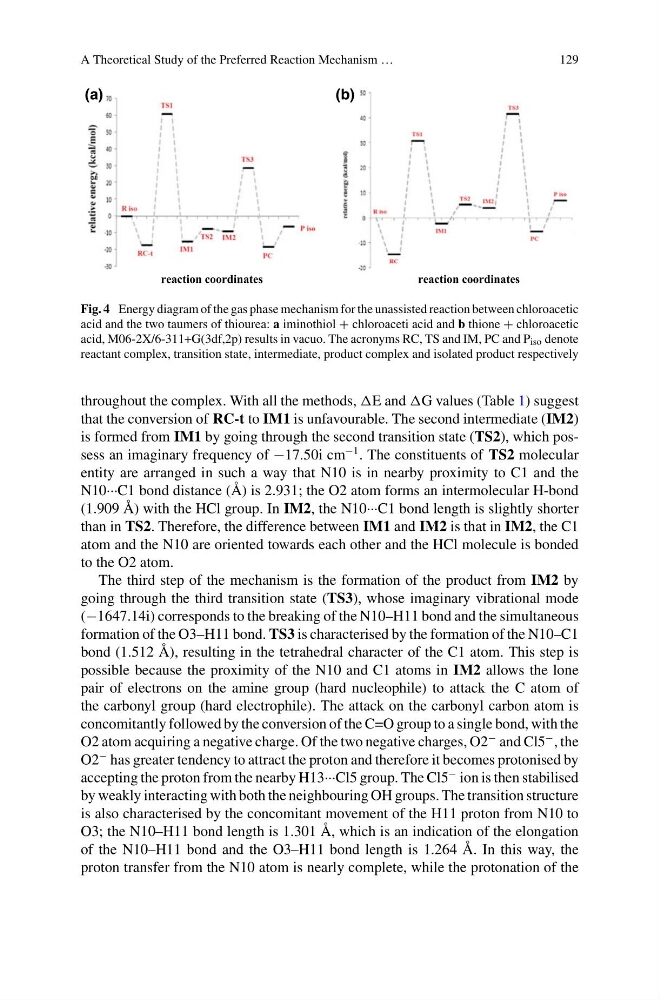
Fig. 4 Energy diagram of the gas phase mechanism for the unassisted reaction between chloroacetic
acid and the two taumers of thiourea: a iminothiol + chloroaceti acid and b thione + chloroacetic
acid, M06-2X/6-311+G(3df,2p) results in vacuo. The acronyms RC, TS and IM, PC and P iso denote
reactant complex, transition state, intermediate, product complex and isolated product respectively
throughout the complex. With all the methods, E and G values (Table 1) suggest
that the conversion of RC-t to IM1 is unfavourable. The second intermediate (IM2)
is formed from IM1 by going through the second transition state (TS2), which possess an imaginary frequency of −17.50i cm
−1 . The constituents of TS2 molecular
entity are arranged in such a way that N10 is in nearby proximity to C1 and the
N10···C1 bond distance (Å) is 2.931; the O2 atom forms an intermolecular H-bond
(1.909 Å) with the HCl group. In IM2, the N10···C1 bond length is slightly shorter
than in TS2. Therefore, the difference between IM1 and IM2 is that in IM2, the C1
atom and the N10 are oriented towards each other and the HCl molecule is bonded
to the O2 atom.
The third step of the mechanism is the formation of the product from IM2 by
going through the third transition state (TS3), whose imaginary vibrational mode
(−1647.14i) corresponds to the breaking of the N10–H11 bond and the simultaneous
formation of the O3–H11 bond. TS3 is characterised by the formation of the N10–C1
bond (1.512 Å), resulting in the tetrahedral character of the C1 atom. This step is
possible because the proximity of the N10 and C1 atoms in IM2 allows the lone
pair of electrons on the amine group (hard nucleophile) to attack the C atom of
the carbonyl group (hard electrophile). The attack on the carbonyl carbon atom is
concomitantly followed by the conversion of the C=O group to a single bond, with the
O2 atom acquiring a negative charge. Of the two negative charges, O2
− and Cl5
− , the
O2
− has greater tendency to attract the proton and therefore it becomes protonised by
accepting the proton from the nearby H13···Cl5 group. The Cl5
− ion is then stabilised
by weakly interacting with both the neighbouring OH groups. The transition structure
is also characterised by the concomitant movement of the H11 proton from N10 to
O3; the N10–H11 bond length is 1.301 Å, which is an indication of the elongation
of the N10–H11 bond and the O3–H11 bond length is 1.264 Å. In this way, the
proton transfer from the N10 atom is nearly complete, while the protonation of the
129
reaction coordinates
reaction coordinates
(a)
(b)
Fig. 4 Energy diagram of the gas phase mechanism for the unassisted reaction between chloroacetic
acid and the two taumers of thiourea: a iminothiol + chloroaceti acid and b thione + chloroacetic
acid, M06-2X/6-311+G(3df,2p) results in vacuo. The acronyms RC, TS and IM, PC and P iso denote
reactant complex, transition state, intermediate, product complex and isolated product respectively
throughout the complex. With all the methods, E and G values (Table 1) suggest
that the conversion of RC-t to IM1 is unfavourable. The second intermediate (IM2)
is formed from IM1 by going through the second transition state (TS2), which possess an imaginary frequency of −17.50i cm
−1 . The constituents of TS2 molecular
entity are arranged in such a way that N10 is in nearby proximity to C1 and the
N10···C1 bond distance (Å) is 2.931; the O2 atom forms an intermolecular H-bond
(1.909 Å) with the HCl group. In IM2, the N10···C1 bond length is slightly shorter
than in TS2. Therefore, the difference between IM1 and IM2 is that in IM2, the C1
atom and the N10 are oriented towards each other and the HCl molecule is bonded
to the O2 atom.
The third step of the mechanism is the formation of the product from IM2 by
going through the third transition state (TS3), whose imaginary vibrational mode
(−1647.14i) corresponds to the breaking of the N10–H11 bond and the simultaneous
formation of the O3–H11 bond. TS3 is characterised by the formation of the N10–C1
bond (1.512 Å), resulting in the tetrahedral character of the C1 atom. This step is
possible because the proximity of the N10 and C1 atoms in IM2 allows the lone
pair of electrons on the amine group (hard nucleophile) to attack the C atom of
the carbonyl group (hard electrophile). The attack on the carbonyl carbon atom is
concomitantly followed by the conversion of the C=O group to a single bond, with the
O2 atom acquiring a negative charge. Of the two negative charges, O2
− and Cl5
− , the
O2
− has greater tendency to attract the proton and therefore it becomes protonised by
accepting the proton from the nearby H13···Cl5 group. The Cl5
− ion is then stabilised
by weakly interacting with both the neighbouring OH groups. The transition structure
is also characterised by the concomitant movement of the H11 proton from N10 to
O3; the N10–H11 bond length is 1.301 Å, which is an indication of the elongation
of the N10–H11 bond and the O3–H11 bond length is 1.264 Å. In this way, the
proton transfer from the N10 atom is nearly complete, while the protonation of the