

A Theoretical Study of the Preferred Reaction Mechanism …
125
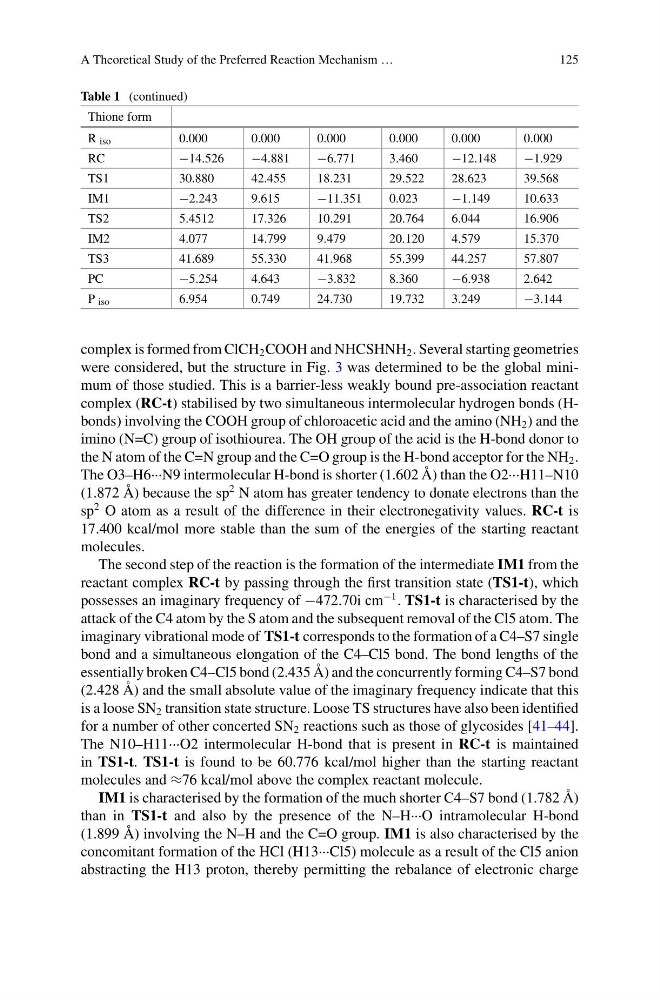
Table 1 (continued)
Thione form
R iso
0.000
0.000
0.000
0.000
0.000
0.000
RC
−14.526
−4.881
−6.771
3.460
−12.148
−1.929
TS1
30.880
42.455
18.231
29.522
28.623
39.568
IM1
−2.243
9.615
−11.351
0.023
−1.149
10.633
TS2
5.4512
17.326
10.291
20.764
6.044
16.906
IM2
4.077
14.799
9.479
20.120
4.579
15.370
TS3
41.689
55.330
41.968
55.399
44.257
57.807
PC
−5.254
4.643
−3.832
8.360
−6.938
2.642
P iso
6.954
0.749
24.730
19.732
3.249
−3.144
complex is formed from ClCH 2 COOH and NHCSHNH 2 . Several starting geometries
were considered, but the structure in Fig. 3 was determined to be the global minimum of those studied. This is a barrier-less weakly bound pre-association reactant
complex (RC-t) stabilised by two simultaneous intermolecular hydrogen bonds (Hbonds) involving the COOH group of chloroacetic acid and the amino (NH 2 ) and the
imino (N=C) group of isothiourea. The OH group of the acid is the H-bond donor to
the N atom of the C=N group and the C=O group is the H-bond acceptor for the NH 2 .
The O3–H6···N9 intermolecular H-bond is shorter (1.602 Å) than the O2···H11–N10
(1.872 Å) because the sp
2 N atom has greater tendency to donate electrons than the
sp
2 O atom as a result of the difference in their electronegativity values. RC-t is
17.400 kcal/mol more stable than the sum of the energies of the starting reactant
molecules.
The second step of the reaction is the formation of the intermediate IM1 from the
reactant complex RC-t by passing through the first transition state (TS1-t), which
possesses an imaginary frequency of −472.70i cm
−1 . TS1-t is characterised by the
attack of the C4 atom by the S atom and the subsequent removal of the Cl5 atom. The
imaginary vibrational mode of TS1-t corresponds to the formation of a C4–S7 single
bond and a simultaneous elongation of the C4–Cl5 bond. The bond lengths of the
essentially broken C4–Cl5 bond (2.435 Å) and the concurrently forming C4–S7 bond
(2.428 Å) and the small absolute value of the imaginary frequency indicate that this
is a loose SN 2 transition state structure. Loose TS structures have also been identified
for a number of other concerted SN 2 reactions such as those of glycosides [41–44].
The N10–H11···O2 intermolecular H-bond that is present in RC-t is maintained
in TS1-t. TS1-t is found to be 60.776 kcal/mol higher than the starting reactant
molecules and ≈76 kcal/mol above the complex reactant molecule.
IM1 is characterised by the formation of the much shorter C4–S7 bond (1.782 Å)
than in TS1-t and also by the presence of the N–H···O intramolecular H-bond
(1.899 Å) involving the N–H and the C=O group. IM1 is also characterised by the
concomitant formation of the HCl (H13···Cl5) molecule as a result of the Cl5 anion
abstracting the H13 proton, thereby permitting the rebalance of electronic charge
125
Table 1 (continued)
Thione form
R iso
0.000
0.000
0.000
0.000
0.000
0.000
RC
−14.526
−4.881
−6.771
3.460
−12.148
−1.929
TS1
30.880
42.455
18.231
29.522
28.623
39.568
IM1
−2.243
9.615
−11.351
0.023
−1.149
10.633
TS2
5.4512
17.326
10.291
20.764
6.044
16.906
IM2
4.077
14.799
9.479
20.120
4.579
15.370
TS3
41.689
55.330
41.968
55.399
44.257
57.807
PC
−5.254
4.643
−3.832
8.360
−6.938
2.642
P iso
6.954
0.749
24.730
19.732
3.249
−3.144
complex is formed from ClCH 2 COOH and NHCSHNH 2 . Several starting geometries
were considered, but the structure in Fig. 3 was determined to be the global minimum of those studied. This is a barrier-less weakly bound pre-association reactant
complex (RC-t) stabilised by two simultaneous intermolecular hydrogen bonds (Hbonds) involving the COOH group of chloroacetic acid and the amino (NH 2 ) and the
imino (N=C) group of isothiourea. The OH group of the acid is the H-bond donor to
the N atom of the C=N group and the C=O group is the H-bond acceptor for the NH 2 .
The O3–H6···N9 intermolecular H-bond is shorter (1.602 Å) than the O2···H11–N10
(1.872 Å) because the sp
2 N atom has greater tendency to donate electrons than the
sp
2 O atom as a result of the difference in their electronegativity values. RC-t is
17.400 kcal/mol more stable than the sum of the energies of the starting reactant
molecules.
The second step of the reaction is the formation of the intermediate IM1 from the
reactant complex RC-t by passing through the first transition state (TS1-t), which
possesses an imaginary frequency of −472.70i cm
−1 . TS1-t is characterised by the
attack of the C4 atom by the S atom and the subsequent removal of the Cl5 atom. The
imaginary vibrational mode of TS1-t corresponds to the formation of a C4–S7 single
bond and a simultaneous elongation of the C4–Cl5 bond. The bond lengths of the
essentially broken C4–Cl5 bond (2.435 Å) and the concurrently forming C4–S7 bond
(2.428 Å) and the small absolute value of the imaginary frequency indicate that this
is a loose SN 2 transition state structure. Loose TS structures have also been identified
for a number of other concerted SN 2 reactions such as those of glycosides [41–44].
The N10–H11···O2 intermolecular H-bond that is present in RC-t is maintained
in TS1-t. TS1-t is found to be 60.776 kcal/mol higher than the starting reactant
molecules and ≈76 kcal/mol above the complex reactant molecule.
IM1 is characterised by the formation of the much shorter C4–S7 bond (1.782 Å)
than in TS1-t and also by the presence of the N–H···O intramolecular H-bond
(1.899 Å) involving the N–H and the C=O group. IM1 is also characterised by the
concomitant formation of the HCl (H13···Cl5) molecule as a result of the Cl5 anion
abstracting the H13 proton, thereby permitting the rebalance of electronic charge