

A Theoretical Study of the Preferred Reaction Mechanism …
123
3 Results and Discussions
3.1 NHCSHNH 2 + ClCH 2 COOH Reaction Mechanism
in Vacuo
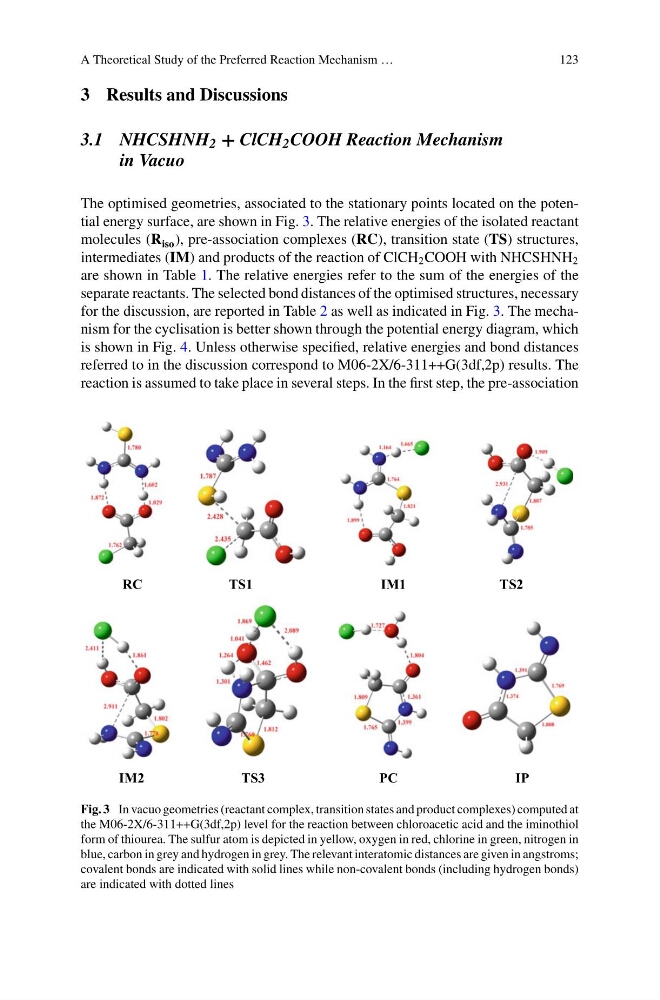
The optimised geometries, associated to the stationary points located on the potential energy surface, are shown in Fig. 3. The relative energies of the isolated reactant
molecules (R iso ), pre-association complexes (RC), transition state (TS) structures,
intermediates (IM) and products of the reaction of ClCH 2 COOH with NHCSHNH 2
are shown in Table 1. The relative energies refer to the sum of the energies of the
separate reactants. The selected bond distances of the optimised structures, necessary
for the discussion, are reported in Table 2 as well as indicated in Fig. 3. The mechanism for the cyclisation is better shown through the potential energy diagram, which
is shown in Fig. 4. Unless otherwise specified, relative energies and bond distances
referred to in the discussion correspond to M06-2X/6-311++G(3df,2p) results. The
reaction is assumed to take place in several steps. In the first step, the pre-association
RC
TS1
IM1
TS2
IM2
TS3
PC
IP
Fig. 3 In vacuo geometries (reactant complex, transition states and product complexes) computed at
the M06-2X/6-311++G(3df,2p) level for the reaction between chloroacetic acid and the iminothiol
form of thiourea. The sulfur atom is depicted in yellow, oxygen in red, chlorine in green, nitrogen in
blue, carbon in grey and hydrogen in grey. The relevant interatomic distances are given in angstroms;
covalent bonds are indicated with solid lines while non-covalent bonds (including hydrogen bonds)
are indicated with dotted lines
123
3 Results and Discussions
3.1 NHCSHNH 2 + ClCH 2 COOH Reaction Mechanism
in Vacuo
The optimised geometries, associated to the stationary points located on the potential energy surface, are shown in Fig. 3. The relative energies of the isolated reactant
molecules (R iso ), pre-association complexes (RC), transition state (TS) structures,
intermediates (IM) and products of the reaction of ClCH 2 COOH with NHCSHNH 2
are shown in Table 1. The relative energies refer to the sum of the energies of the
separate reactants. The selected bond distances of the optimised structures, necessary
for the discussion, are reported in Table 2 as well as indicated in Fig. 3. The mechanism for the cyclisation is better shown through the potential energy diagram, which
is shown in Fig. 4. Unless otherwise specified, relative energies and bond distances
referred to in the discussion correspond to M06-2X/6-311++G(3df,2p) results. The
reaction is assumed to take place in several steps. In the first step, the pre-association
RC
TS1
IM1
TS2
IM2
TS3
PC
IP
Fig. 3 In vacuo geometries (reactant complex, transition states and product complexes) computed at
the M06-2X/6-311++G(3df,2p) level for the reaction between chloroacetic acid and the iminothiol
form of thiourea. The sulfur atom is depicted in yellow, oxygen in red, chlorine in green, nitrogen in
blue, carbon in grey and hydrogen in grey. The relevant interatomic distances are given in angstroms;
covalent bonds are indicated with solid lines while non-covalent bonds (including hydrogen bonds)
are indicated with dotted lines