

112
P. R. P. Barreto et al.
Table 2 Equilibrium distance R eq and minimum energy D e of the F1 configuration for the three
systems, propylene oxide–He, –Ne and –Ar, calculated ab initio with and without counterpoise
correction of the basis set superposition error, and by SAPT calculation
Ab initio calculation with
CC
Ab initio calculation
without CC
SAPT
R eq (Å)
D e (cm −1 )
R eq (Å)
D e (cm −1 )
R eq (Å)
D e (cm −1 )
He
3.591
36.880
3.377
79.557
3.306
36.772
Ne
3.675
60.749
3.453
175.265
3.403
60.531
Ar
3.903
169.310
3.665
405.280
3.611
167.084
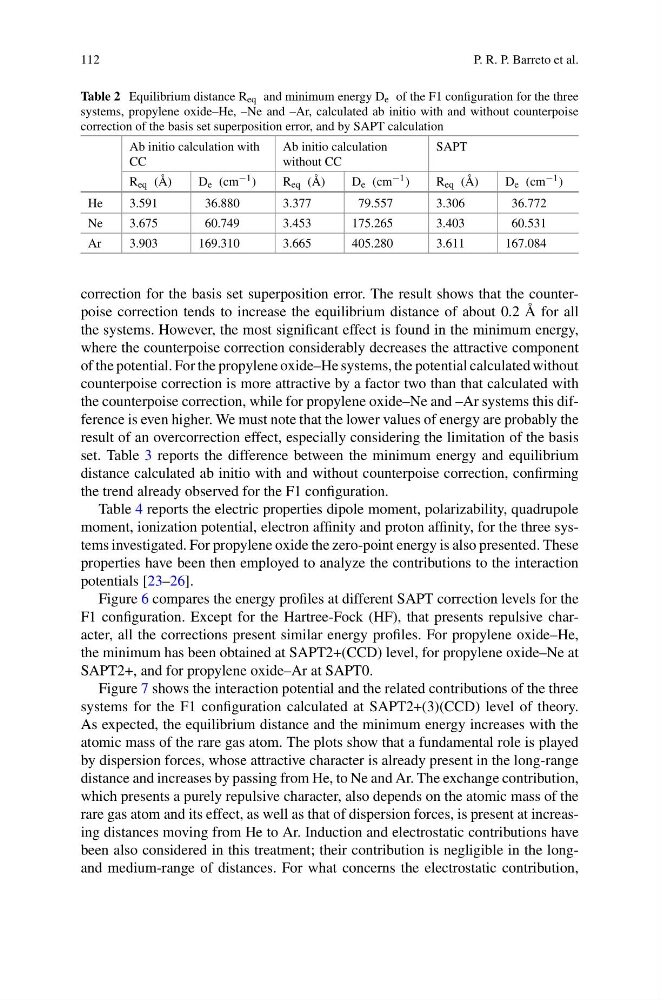
correction for the basis set superposition error. The result shows that the counterpoise correction tends to increase the equilibrium distance of about 0.2 Å for all
the systems. However, the most significant effect is found in the minimum energy,
where the counterpoise correction considerably decreases the attractive component
of the potential. For the propylene oxide–He systems, the potential calculated without
counterpoise correction is more attractive by a factor two than that calculated with
the counterpoise correction, while for propylene oxide–Ne and –Ar systems this difference is even higher. We must note that the lower values of energy are probably the
result of an overcorrection effect, especially considering the limitation of the basis
set. Table 3 reports the difference between the minimum energy and equilibrium
distance calculated ab initio with and without counterpoise correction, confirming
the trend already observed for the F1 configuration.
Table 4 reports the electric properties dipole moment, polarizability, quadrupole
moment, ionization potential, electron affinity and proton affinity, for the three systems investigated. For propylene oxide the zero-point energy is also presented. These
properties have been then employed to analyze the contributions to the interaction
potentials [23–26].
Figure 6 compares the energy profiles at different SAPT correction levels for the
F1 configuration. Except for the Hartree-Fock (HF), that presents repulsive character, all the corrections present similar energy profiles. For propylene oxide–He,
the minimum has been obtained at SAPT2+(CCD) level, for propylene oxide–Ne at
SAPT2+, and for propylene oxide–Ar at SAPT0.
Figure 7 shows the interaction potential and the related contributions of the three
systems for the F1 configuration calculated at SAPT2+(3)(CCD) level of theory.
As expected, the equilibrium distance and the minimum energy increases with the
atomic mass of the rare gas atom. The plots show that a fundamental role is played
by dispersion forces, whose attractive character is already present in the long-range
distance and increases by passing from He, to Ne and Ar. The exchange contribution,
which presents a purely repulsive character, also depends on the atomic mass of the
rare gas atom and its effect, as well as that of dispersion forces, is present at increasing distances moving from He to Ar. Induction and electrostatic contributions have
been also considered in this treatment; their contribution is negligible in the longand medium-range of distances. For what concerns the electrostatic contribution,
P. R. P. Barreto et al.
Table 2 Equilibrium distance R eq and minimum energy D e of the F1 configuration for the three
systems, propylene oxide–He, –Ne and –Ar, calculated ab initio with and without counterpoise
correction of the basis set superposition error, and by SAPT calculation
Ab initio calculation with
CC
Ab initio calculation
without CC
SAPT
R eq (Å)
D e (cm −1 )
R eq (Å)
D e (cm −1 )
R eq (Å)
D e (cm −1 )
He
3.591
36.880
3.377
79.557
3.306
36.772
Ne
3.675
60.749
3.453
175.265
3.403
60.531
Ar
3.903
169.310
3.665
405.280
3.611
167.084
correction for the basis set superposition error. The result shows that the counterpoise correction tends to increase the equilibrium distance of about 0.2 Å for all
the systems. However, the most significant effect is found in the minimum energy,
where the counterpoise correction considerably decreases the attractive component
of the potential. For the propylene oxide–He systems, the potential calculated without
counterpoise correction is more attractive by a factor two than that calculated with
the counterpoise correction, while for propylene oxide–Ne and –Ar systems this difference is even higher. We must note that the lower values of energy are probably the
result of an overcorrection effect, especially considering the limitation of the basis
set. Table 3 reports the difference between the minimum energy and equilibrium
distance calculated ab initio with and without counterpoise correction, confirming
the trend already observed for the F1 configuration.
Table 4 reports the electric properties dipole moment, polarizability, quadrupole
moment, ionization potential, electron affinity and proton affinity, for the three systems investigated. For propylene oxide the zero-point energy is also presented. These
properties have been then employed to analyze the contributions to the interaction
potentials [23–26].
Figure 6 compares the energy profiles at different SAPT correction levels for the
F1 configuration. Except for the Hartree-Fock (HF), that presents repulsive character, all the corrections present similar energy profiles. For propylene oxide–He,
the minimum has been obtained at SAPT2+(CCD) level, for propylene oxide–Ne at
SAPT2+, and for propylene oxide–Ar at SAPT0.
Figure 7 shows the interaction potential and the related contributions of the three
systems for the F1 configuration calculated at SAPT2+(3)(CCD) level of theory.
As expected, the equilibrium distance and the minimum energy increases with the
atomic mass of the rare gas atom. The plots show that a fundamental role is played
by dispersion forces, whose attractive character is already present in the long-range
distance and increases by passing from He, to Ne and Ar. The exchange contribution,
which presents a purely repulsive character, also depends on the atomic mass of the
rare gas atom and its effect, as well as that of dispersion forces, is present at increasing distances moving from He to Ar. Induction and electrostatic contributions have
been also considered in this treatment; their contribution is negligible in the longand medium-range of distances. For what concerns the electrostatic contribution,