

A Quantum Chemical Approach for the Characterization of …
109
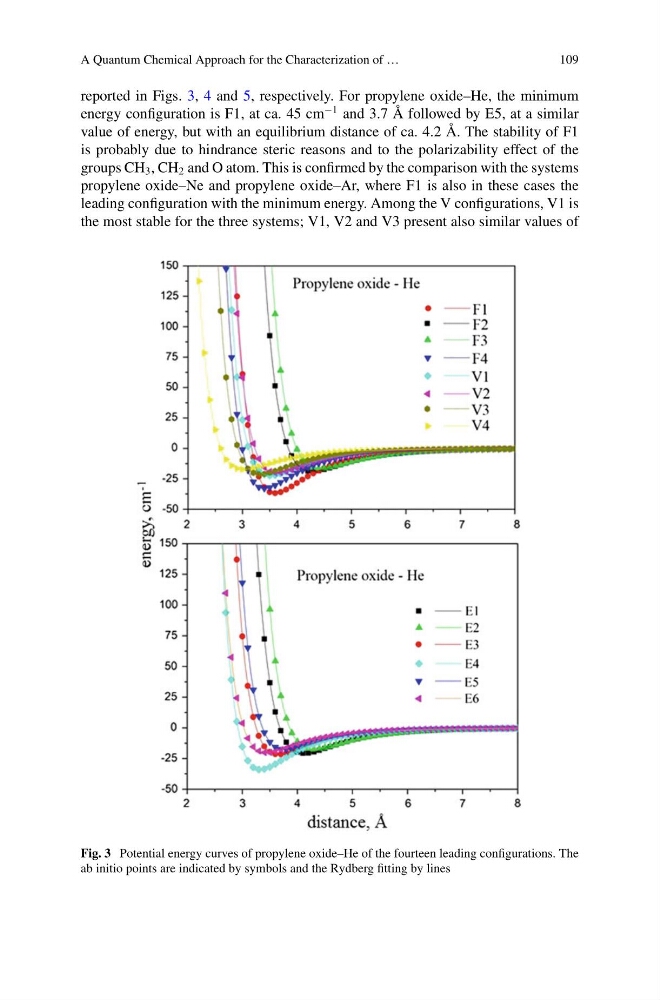
reported in Figs. 3, 4 and 5, respectively. For propylene oxide–He, the minimum
energy configuration is F1, at ca. 45 cm
−1 and 3.7 Å followed by E5, at a similar
value of energy, but with an equilibrium distance of ca. 4.2 Å. The stability of F1
is probably due to hindrance steric reasons and to the polarizability effect of the
groups CH 3 , CH 2 and O atom. This is confirmed by the comparison with the systems
propylene oxide–Ne and propylene oxide–Ar, where F1 is also in these cases the
leading configuration with the minimum energy. Among the V configurations, V1 is
the most stable for the three systems; V1, V2 and V3 present also similar values of
Fig. 3 Potential energy curves of propylene oxide–He of the fourteen leading configurations. The
ab initio points are indicated by symbols and the Rydberg fitting by lines
109
reported in Figs. 3, 4 and 5, respectively. For propylene oxide–He, the minimum
energy configuration is F1, at ca. 45 cm
−1 and 3.7 Å followed by E5, at a similar
value of energy, but with an equilibrium distance of ca. 4.2 Å. The stability of F1
is probably due to hindrance steric reasons and to the polarizability effect of the
groups CH 3 , CH 2 and O atom. This is confirmed by the comparison with the systems
propylene oxide–Ne and propylene oxide–Ar, where F1 is also in these cases the
leading configuration with the minimum energy. Among the V configurations, V1 is
the most stable for the three systems; V1, V2 and V3 present also similar values of
Fig. 3 Potential energy curves of propylene oxide–He of the fourteen leading configurations. The
ab initio points are indicated by symbols and the Rydberg fitting by lines