

A Quantum Chemical Approach for the Characterization of …
107
that connects the center-of-mass of the molecule and the center-of-mass of the edge
of the tetrahedron, defined by the center-of-mass of two vertices. In the determination
of the centers-of-mass of the edges involving C3 and C2, the whole masses of the
groups CH 3 and CH 2 have been considered. Thus, E1 represents the configuration
directed in correspondence of the center-of-mass of the edge C3-C2; E2 corresponds
to the center-of-mass C3-O, E3 goes through C3-H, E4 through C2-O, E5 through
C2-H, finally, and E6 is in correspondence of the center-of-mass of the edge O-H.
The F configurations are defined as the directions that connect the rare-gas-atom to
the centers-of-mass of the faces of the distorted tetrahedron and the center-of-mass of
the molecule: in F1, the rare-gas is directed toward the center-of-mass of C3-C2-O,
in F2 through C3-C2-H, in F3 through C3-O-H, and in F4 through the center of mass
of C2-O-H.
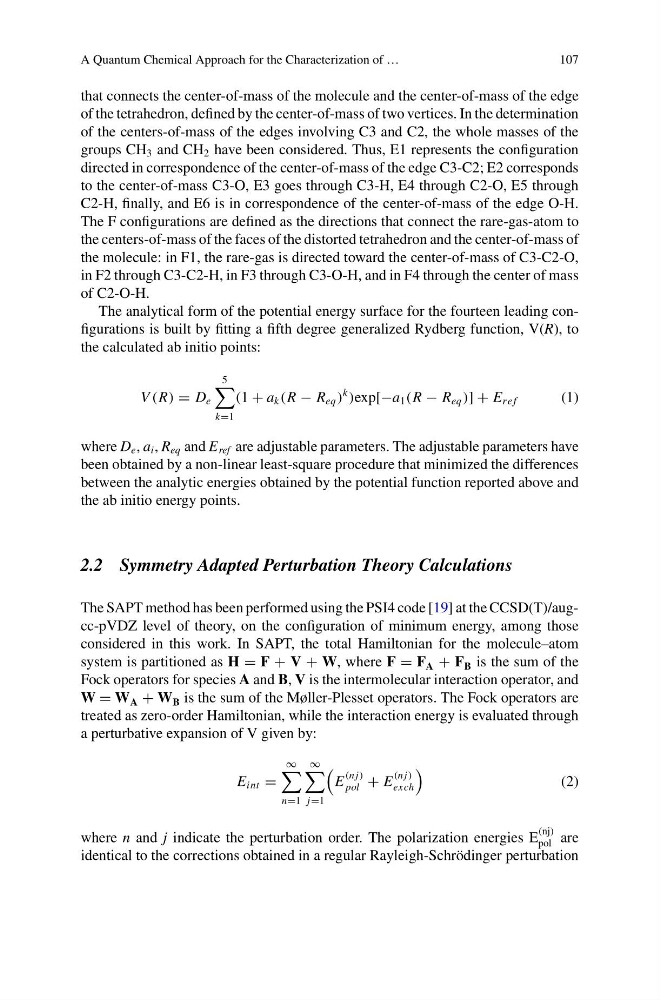
The analytical form of the potential energy surface for the fourteen leading configurations is built by fitting a fifth degree generalized Rydberg function, V(R), to
the calculated ab initio points:
V (R) = D e
5
k=1
(1 + a k (R − R eq )
k
)exp[−a 1 (R − R eq )] + E re f
(1)
where D e , a i , R eq and E ref are adjustable parameters. The adjustable parameters have
been obtained by a non-linear least-square procedure that minimized the differences
between the analytic energies obtained by the potential function reported above and
the ab initio energy points.
2.2 Symmetry Adapted Perturbation Theory Calculations
The SAPT method has been performed using the PSI4 code [19] at the CCSD(T)/augcc-pVDZ level of theory, on the configuration of minimum energy, among those
considered in this work. In SAPT, the total Hamiltonian for the molecule–atom
system is partitioned as H = F + V + W, where F = F A + F B is the sum of the
Fock operators for species A and B, V is the intermolecular interaction operator, and
W = W A + W B is the sum of the Møller-Plesset operators. The Fock operators are
treated as zero-order Hamiltonian, while the interaction energy is evaluated through
a perturbative expansion of V given by:
E int =
∞
n=1
∞
j=1
E
(nj)
pol + E
(nj)
exch
(2)
where n and j indicate the perturbation order. The polarization energies E
(nj)
pol are
identical to the corrections obtained in a regular Rayleigh-Schrödinger perturbation
107
that connects the center-of-mass of the molecule and the center-of-mass of the edge
of the tetrahedron, defined by the center-of-mass of two vertices. In the determination
of the centers-of-mass of the edges involving C3 and C2, the whole masses of the
groups CH 3 and CH 2 have been considered. Thus, E1 represents the configuration
directed in correspondence of the center-of-mass of the edge C3-C2; E2 corresponds
to the center-of-mass C3-O, E3 goes through C3-H, E4 through C2-O, E5 through
C2-H, finally, and E6 is in correspondence of the center-of-mass of the edge O-H.
The F configurations are defined as the directions that connect the rare-gas-atom to
the centers-of-mass of the faces of the distorted tetrahedron and the center-of-mass of
the molecule: in F1, the rare-gas is directed toward the center-of-mass of C3-C2-O,
in F2 through C3-C2-H, in F3 through C3-O-H, and in F4 through the center of mass
of C2-O-H.
The analytical form of the potential energy surface for the fourteen leading configurations is built by fitting a fifth degree generalized Rydberg function, V(R), to
the calculated ab initio points:
V (R) = D e
5
k=1
(1 + a k (R − R eq )
k
)exp[−a 1 (R − R eq )] + E re f
(1)
where D e , a i , R eq and E ref are adjustable parameters. The adjustable parameters have
been obtained by a non-linear least-square procedure that minimized the differences
between the analytic energies obtained by the potential function reported above and
the ab initio energy points.
2.2 Symmetry Adapted Perturbation Theory Calculations
The SAPT method has been performed using the PSI4 code [19] at the CCSD(T)/augcc-pVDZ level of theory, on the configuration of minimum energy, among those
considered in this work. In SAPT, the total Hamiltonian for the molecule–atom
system is partitioned as H = F + V + W, where F = F A + F B is the sum of the
Fock operators for species A and B, V is the intermolecular interaction operator, and
W = W A + W B is the sum of the Møller-Plesset operators. The Fock operators are
treated as zero-order Hamiltonian, while the interaction energy is evaluated through
a perturbative expansion of V given by:
E int =
∞
n=1
∞
j=1
E
(nj)
pol + E
(nj)
exch
(2)
where n and j indicate the perturbation order. The polarization energies E
(nj)
pol are
identical to the corrections obtained in a regular Rayleigh-Schrödinger perturbation