

39
amylase (Thoma and Stewart 1965). Three years later, Caesar summarized the use
of cycloamyloses as models for enzymes (Caesar 1968).
1.3.11 Toxicological Considerations
Pringsheim was the first to conduct several biological tests to determine whether the
dextrins were physiologically available either to plants or animals (Pringsheim and
Müller 1922; Hoesslin and Pringsheim 1923; Pringsheim 1928b, 1931a). Pringsheim
studied the absorption and metabolism of dextrins in rats, pigs, and humans.
Polyamylose, probably α-cyclodextrin, administered in a dose of 50 g to diabetic
persons, did not cause any change in the urinary glucose level, and no polyamylose
was found in the feces (Pringsheim and Müller 1922). Hoesslin and Pringsheim
(1923) fed polyamylose to starved rabbits and guinea pigs. No glycogen synthesis
was detected in the liver 3 h after administration. Pringsheim suggested that polyamylose was metabolized in the rat. His experiments also showed that the
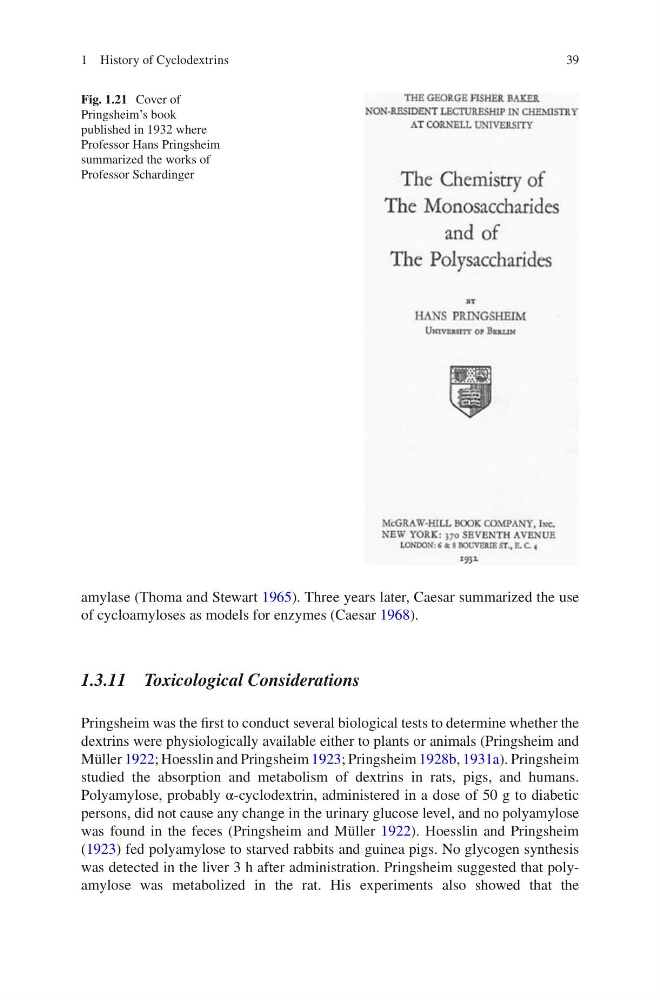
Fig. 1.21 Cover of
Pringsheim’s book
published in 1932 where
Professor Hans Pringsheim
summarized the works of
Professor Schardinger
1 History of Cyclodextrins
amylase (Thoma and Stewart 1965). Three years later, Caesar summarized the use
of cycloamyloses as models for enzymes (Caesar 1968).
1.3.11 Toxicological Considerations
Pringsheim was the first to conduct several biological tests to determine whether the
dextrins were physiologically available either to plants or animals (Pringsheim and
Müller 1922; Hoesslin and Pringsheim 1923; Pringsheim 1928b, 1931a). Pringsheim
studied the absorption and metabolism of dextrins in rats, pigs, and humans.
Polyamylose, probably α-cyclodextrin, administered in a dose of 50 g to diabetic
persons, did not cause any change in the urinary glucose level, and no polyamylose
was found in the feces (Pringsheim and Müller 1922). Hoesslin and Pringsheim
(1923) fed polyamylose to starved rabbits and guinea pigs. No glycogen synthesis
was detected in the liver 3 h after administration. Pringsheim suggested that polyamylose was metabolized in the rat. His experiments also showed that the
Fig. 1.21 Cover of
Pringsheim’s book
published in 1932 where
Professor Hans Pringsheim
summarized the works of
Professor Schardinger
1 History of Cyclodextrins