

371
molecule. The complexation reaction depended also on the polarity of the guest
molecule, stressing the major role played by the cyclodextrin in the mechanism
(Crini et al. 2002, 2003; Crini 2003). It was the most hydrophobic part of the host
molecule that was preferentially included in the cavity. The more hydrophobic the
guest molecule, the greater the stability of the complex, and the more efficient the
decontamination performance. Similar conclusions were previously reported by
Professor Szejtli.
Later, studying the formation of complexes with low molecular weight model
organic molecules such as phenol, benzene, and naphthol derivatives, up to more
complicated chemical structures with higher molecular weights (dyes, polycyclic
aromatic hydrocarbons), we have obtained four surprising results regarding the
adsorption of bulky molecules (Crini and Peindy 2006; Crini et al. 2007; Crini
2008; Charles et al. 2010). The first showed that, even if the guest dye was too large,
it could be complexed by the ECP polymers, irrespective of the size of the cyclodextrin ring. Even if the pollutant is too bulky, it could be immobilized in a complex,
thanks to the cooperative effect of the cyclodextrin molecules of the macromolecular network. Several different cyclodextrin cavities could encapsulate different parts
of a pollutant. This conclusion was in accordance with the notion of association
complexes introduced by Professor Cramer for soluble native cyclodextrins in solution or solid state and demonstrated by Professor Szejtli for insoluble cyclodextrin
polymers (Crini 2014). Two types of complexes are distinguished: complexes with
simple model molecules for which inclusion is total – these they called inclusion
complexes – and complexes with larger molecules for which inclusion would only
be partial, which they called association complexes, and which can be the preponderant form of interaction or simply occur alongside inclusion complexes. This is
why some bulky molecules are adsorbed by ECP polymers (Crini 2003, 2008; Crini
and Peindy 2006; Crini et al. 2007; Charles et al. 2010; Sancey et al. 2010, 2011a).
This was previously demonstrated using HRMAS experiments (Crini et al. 2000).
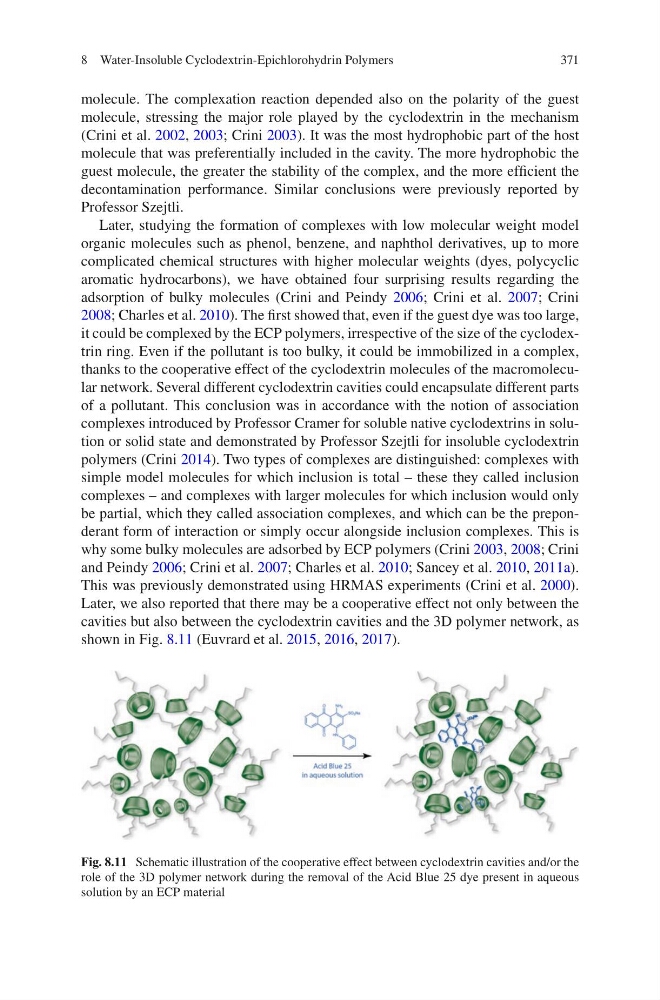
Later, we also reported that there may be a cooperative effect not only between the
cavities but also between the cyclodextrin cavities and the 3D polymer network, as
shown in Fig. 8.11 (Euvrard et al. 2015, 2016, 2017).
Fig. 8.11 Schematic illustration of the cooperative effect between cyclodextrin cavities and/or the
role of the 3D polymer network during the removal of the Acid Blue 25 dye present in aqueous
solution by an ECP material
8 Water-Insoluble Cyclodextrin-Epichlorohydrin Polymers
molecule. The complexation reaction depended also on the polarity of the guest
molecule, stressing the major role played by the cyclodextrin in the mechanism
(Crini et al. 2002, 2003; Crini 2003). It was the most hydrophobic part of the host
molecule that was preferentially included in the cavity. The more hydrophobic the
guest molecule, the greater the stability of the complex, and the more efficient the
decontamination performance. Similar conclusions were previously reported by
Professor Szejtli.
Later, studying the formation of complexes with low molecular weight model
organic molecules such as phenol, benzene, and naphthol derivatives, up to more
complicated chemical structures with higher molecular weights (dyes, polycyclic
aromatic hydrocarbons), we have obtained four surprising results regarding the
adsorption of bulky molecules (Crini and Peindy 2006; Crini et al. 2007; Crini
2008; Charles et al. 2010). The first showed that, even if the guest dye was too large,
it could be complexed by the ECP polymers, irrespective of the size of the cyclodextrin ring. Even if the pollutant is too bulky, it could be immobilized in a complex,
thanks to the cooperative effect of the cyclodextrin molecules of the macromolecular network. Several different cyclodextrin cavities could encapsulate different parts
of a pollutant. This conclusion was in accordance with the notion of association
complexes introduced by Professor Cramer for soluble native cyclodextrins in solution or solid state and demonstrated by Professor Szejtli for insoluble cyclodextrin
polymers (Crini 2014). Two types of complexes are distinguished: complexes with
simple model molecules for which inclusion is total – these they called inclusion
complexes – and complexes with larger molecules for which inclusion would only
be partial, which they called association complexes, and which can be the preponderant form of interaction or simply occur alongside inclusion complexes. This is
why some bulky molecules are adsorbed by ECP polymers (Crini 2003, 2008; Crini
and Peindy 2006; Crini et al. 2007; Charles et al. 2010; Sancey et al. 2010, 2011a).
This was previously demonstrated using HRMAS experiments (Crini et al. 2000).
Later, we also reported that there may be a cooperative effect not only between the
cavities but also between the cyclodextrin cavities and the 3D polymer network, as
shown in Fig. 8.11 (Euvrard et al. 2015, 2016, 2017).
Fig. 8.11 Schematic illustration of the cooperative effect between cyclodextrin cavities and/or the
role of the 3D polymer network during the removal of the Acid Blue 25 dye present in aqueous
solution by an ECP material
8 Water-Insoluble Cyclodextrin-Epichlorohydrin Polymers