

352
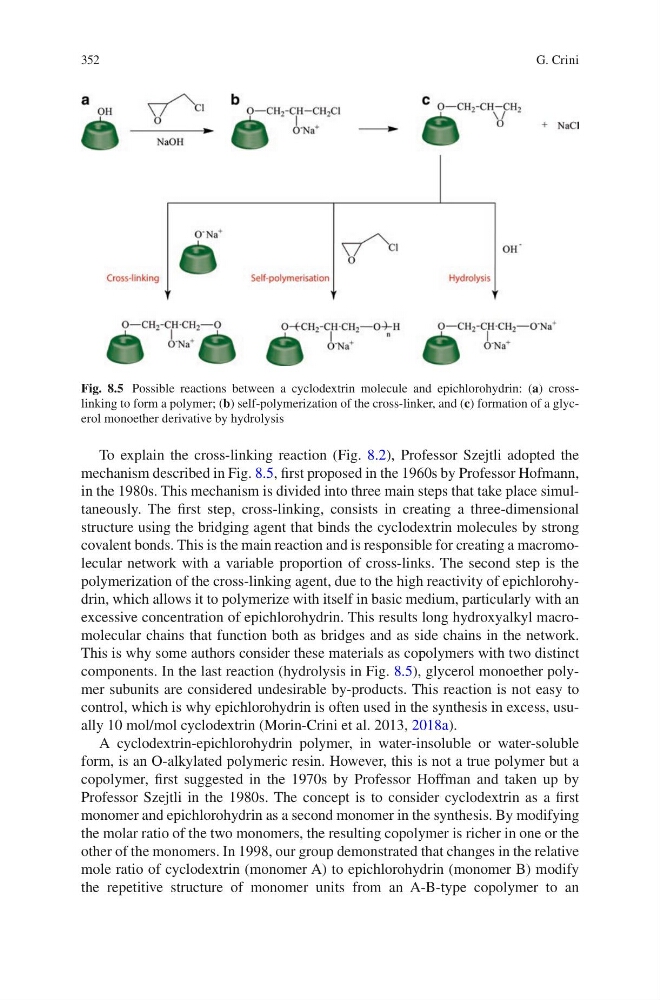
To explain the cross-linking reaction (Fig. 8.2), Professor Szejtli adopted the
mechanism described in Fig. 8.5, first proposed in the 1960s by Professor Hofmann,
in the 1980s. This mechanism is divided into three main steps that take place simultaneously. The first step, cross-linking, consists in creating a three-dimensional
structure using the bridging agent that binds the cyclodextrin molecules by strong
covalent bonds. This is the main reaction and is responsible for creating a macromolecular network with a variable proportion of cross-links. The second step is the
polymerization of the cross-linking agent, due to the high reactivity of epichlorohydrin, which allows it to polymerize with itself in basic medium, particularly with an
excessive concentration of epichlorohydrin. This results long hydroxyalkyl macromolecular chains that function both as bridges and as side chains in the network.
This is why some authors consider these materials as copolymers with two distinct
components. In the last reaction (hydrolysis in Fig. 8.5), glycerol monoether polymer subunits are considered undesirable by-products. This reaction is not easy to
control, which is why epichlorohydrin is often used in the synthesis in excess, usually 10 mol/mol cyclodextrin (Morin-Crini et al. 2013, 2018a).
A cyclodextrin-epichlorohydrin polymer, in water-insoluble or water-soluble
form, is an O-alkylated polymeric resin. However, this is not a true polymer but a
copolymer, first suggested in the 1970s by Professor Hoffman and taken up by
Professor Szejtli in the 1980s. The concept is to consider cyclodextrin as a first
monomer and epichlorohydrin as a second monomer in the synthesis. By modifying
the molar ratio of the two monomers, the resulting copolymer is richer in one or the
other of the monomers. In 1998, our group demonstrated that changes in the relative
mole ratio of cyclodextrin (monomer A) to epichlorohydrin (monomer B) modify
the repetitive structure of monomer units from an A-B-type copolymer to an
Fig. 8.5 Possible reactions between a cyclodextrin molecule and epichlorohydrin: (a) crosslinking to form a polymer; (b) self-polymerization of the cross-linker, and (c) formation of a glycerol monoether derivative by hydrolysis
G. Crini
To explain the cross-linking reaction (Fig. 8.2), Professor Szejtli adopted the
mechanism described in Fig. 8.5, first proposed in the 1960s by Professor Hofmann,
in the 1980s. This mechanism is divided into three main steps that take place simultaneously. The first step, cross-linking, consists in creating a three-dimensional
structure using the bridging agent that binds the cyclodextrin molecules by strong
covalent bonds. This is the main reaction and is responsible for creating a macromolecular network with a variable proportion of cross-links. The second step is the
polymerization of the cross-linking agent, due to the high reactivity of epichlorohydrin, which allows it to polymerize with itself in basic medium, particularly with an
excessive concentration of epichlorohydrin. This results long hydroxyalkyl macromolecular chains that function both as bridges and as side chains in the network.
This is why some authors consider these materials as copolymers with two distinct
components. In the last reaction (hydrolysis in Fig. 8.5), glycerol monoether polymer subunits are considered undesirable by-products. This reaction is not easy to
control, which is why epichlorohydrin is often used in the synthesis in excess, usually 10 mol/mol cyclodextrin (Morin-Crini et al. 2013, 2018a).
A cyclodextrin-epichlorohydrin polymer, in water-insoluble or water-soluble
form, is an O-alkylated polymeric resin. However, this is not a true polymer but a
copolymer, first suggested in the 1970s by Professor Hoffman and taken up by
Professor Szejtli in the 1980s. The concept is to consider cyclodextrin as a first
monomer and epichlorohydrin as a second monomer in the synthesis. By modifying
the molar ratio of the two monomers, the resulting copolymer is richer in one or the
other of the monomers. In 1998, our group demonstrated that changes in the relative
mole ratio of cyclodextrin (monomer A) to epichlorohydrin (monomer B) modify
the repetitive structure of monomer units from an A-B-type copolymer to an
Fig. 8.5 Possible reactions between a cyclodextrin molecule and epichlorohydrin: (a) crosslinking to form a polymer; (b) self-polymerization of the cross-linker, and (c) formation of a glycerol monoether derivative by hydrolysis
G. Crini