

350
The Dutch group of Niels Wiedenhof (Laboratory of General Chemistry,
Eindhoven) at the end of the 1960s (Wiedenhof 1969; Wiedenhof et al. 1969, 1971;
Wiedenhof and Trieling 1971), the American group of Jerald L. Hoffman (University
of Louisville, Kentucky) in the early 1970s (Hoffman 1970, 1972, 1973), and the
Hungarian group of József Szejtli (Chinoin Chemical and Pharmaceutical Works,
Budapest) in the late 1970s (Szejtli et al. 1978; Szejtli 1980, 1982, 1984, 1988;
Szemán et al. 1987) are also known for their many contributions to the cross-linking
of cyclodextrins with epichlorohydrin. In the late 1990s, our group also studied ECP
polymers and contributed to a better understanding of their synthesis. We used the
same the procedure as described by Solms and improved by Hoffman but with some
modifications, in particular in the molar ratios of the reagents.
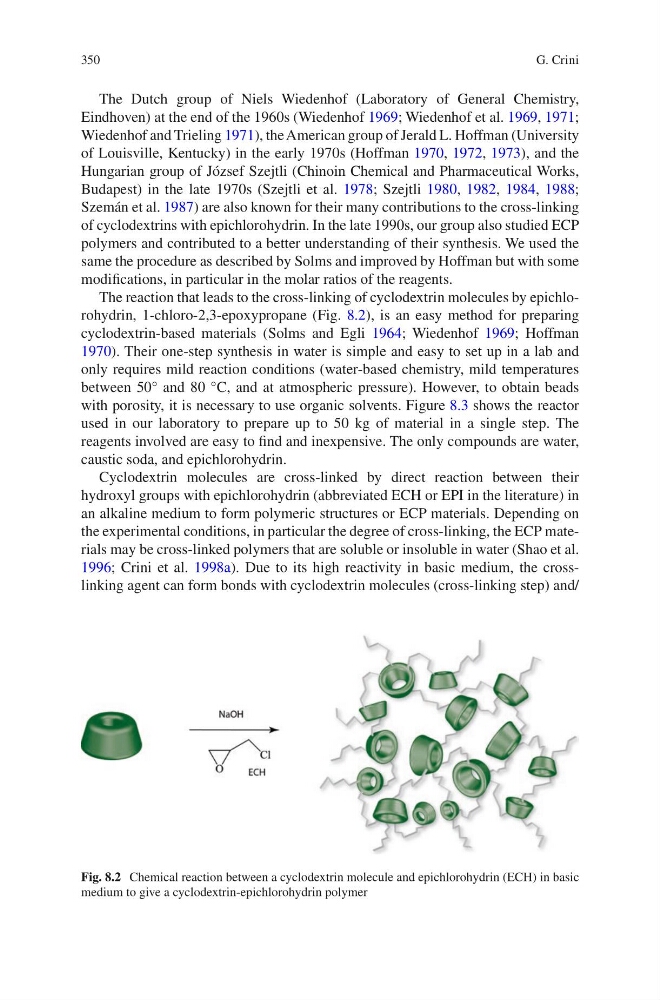
The reaction that leads to the cross-linking of cyclodextrin molecules by epichlorohydrin, 1-chloro-2,3-epoxypropane (Fig. 8.2), is an easy method for preparing
cyclodextrin-based materials (Solms and Egli 1964; Wiedenhof 1969; Hoffman
1970). Their one-step synthesis in water is simple and easy to set up in a lab and
only requires mild reaction conditions (water-based chemistry, mild temperatures
between 50° and 80 °C, and at atmospheric pressure). However, to obtain beads
with porosity, it is necessary to use organic solvents. Figure 8.3 shows the reactor
used in our laboratory to prepare up to 50 kg of material in a single step. The
reagents involved are easy to find and inexpensive. The only compounds are water,
caustic soda, and epichlorohydrin.
Cyclodextrin molecules are cross-linked by direct reaction between their
hydroxyl groups with epichlorohydrin (abbreviated ECH or EPI in the literature) in
an alkaline medium to form polymeric structures or ECP materials. Depending on
the experimental conditions, in particular the degree of cross-linking, the ECP materials may be cross-linked polymers that are soluble or insoluble in water (Shao et al.
1996; Crini et al. 1998a). Due to its high reactivity in basic medium, the crosslinking agent can form bonds with cyclodextrin molecules (cross-linking step) and/
Fig. 8.2 Chemical reaction between a cyclodextrin molecule and epichlorohydrin (ECH) in basic
medium to give a cyclodextrin-epichlorohydrin polymer
G. Crini
The Dutch group of Niels Wiedenhof (Laboratory of General Chemistry,
Eindhoven) at the end of the 1960s (Wiedenhof 1969; Wiedenhof et al. 1969, 1971;
Wiedenhof and Trieling 1971), the American group of Jerald L. Hoffman (University
of Louisville, Kentucky) in the early 1970s (Hoffman 1970, 1972, 1973), and the
Hungarian group of József Szejtli (Chinoin Chemical and Pharmaceutical Works,
Budapest) in the late 1970s (Szejtli et al. 1978; Szejtli 1980, 1982, 1984, 1988;
Szemán et al. 1987) are also known for their many contributions to the cross-linking
of cyclodextrins with epichlorohydrin. In the late 1990s, our group also studied ECP
polymers and contributed to a better understanding of their synthesis. We used the
same the procedure as described by Solms and improved by Hoffman but with some
modifications, in particular in the molar ratios of the reagents.
The reaction that leads to the cross-linking of cyclodextrin molecules by epichlorohydrin, 1-chloro-2,3-epoxypropane (Fig. 8.2), is an easy method for preparing
cyclodextrin-based materials (Solms and Egli 1964; Wiedenhof 1969; Hoffman
1970). Their one-step synthesis in water is simple and easy to set up in a lab and
only requires mild reaction conditions (water-based chemistry, mild temperatures
between 50° and 80 °C, and at atmospheric pressure). However, to obtain beads
with porosity, it is necessary to use organic solvents. Figure 8.3 shows the reactor
used in our laboratory to prepare up to 50 kg of material in a single step. The
reagents involved are easy to find and inexpensive. The only compounds are water,
caustic soda, and epichlorohydrin.
Cyclodextrin molecules are cross-linked by direct reaction between their
hydroxyl groups with epichlorohydrin (abbreviated ECH or EPI in the literature) in
an alkaline medium to form polymeric structures or ECP materials. Depending on
the experimental conditions, in particular the degree of cross-linking, the ECP materials may be cross-linked polymers that are soluble or insoluble in water (Shao et al.
1996; Crini et al. 1998a). Due to its high reactivity in basic medium, the crosslinking agent can form bonds with cyclodextrin molecules (cross-linking step) and/
Fig. 8.2 Chemical reaction between a cyclodextrin molecule and epichlorohydrin (ECH) in basic
medium to give a cyclodextrin-epichlorohydrin polymer
G. Crini